Ovulation Phase Workout: How to Use High-Energy Days Wisely
A practical, medically cautious guide to ovulation phase workouts, strength training, cardio, recovery, and tracking your personal energy pattern.
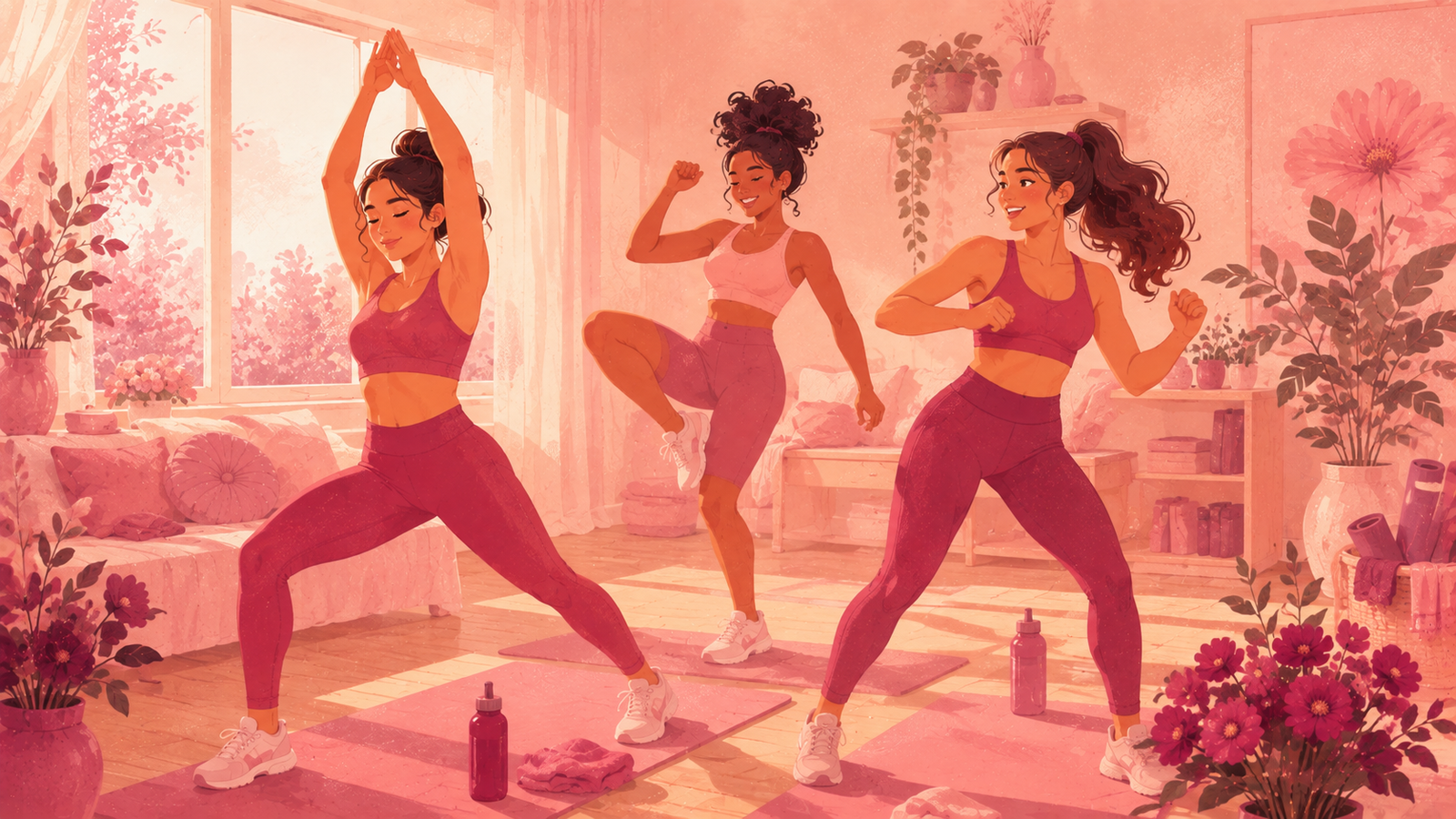
Ovulation is the short, specific event where one of your ovaries releases an egg. In a roughly typical cycle, this happens somewhere in the middle, though the exact day moves around for almost everyone. The hours and days leading up to it, plus the day itself, are sometimes called the high-energy phase. Estrogen tends to peak just before the egg releases, and that surge can show up as more motivation, sharper focus, better mood, and a sense that workouts feel easier than usual.
Why ovulation can feel like a power week
Some people notice it strongly. Some barely notice it at all. Both are normal. The phrase "ovulation phase workout" only makes sense if you treat it as a hypothesis to test against your own body, not a script you have to follow. If you want a calmer way to track your cycle and try phase-based movement, Flow & Glow is built for iPhone, and the principles in this guide will work with any tracker, or with none at all.
What the research actually says
Cycle-syncing content online often promises a clear performance peak around ovulation. Research is more cautious. Several reviews of menstrual cycle and exercise performance have concluded that the effect of any single phase on strength, endurance, or power is small at the group level, with high variability between individuals. That means some people genuinely lift more, run faster, or feel sharper around ovulation, and others see little measurable change.
Translation: your gym performance is shaped by sleep, food, stress, training history, illness, and life chaos at least as much as by your cycle phase. The ovulation window can be a useful nudge to schedule fun, ambitious sessions, but it is not a magic switch. This is why a careful approach to cycle syncing workouts leans on personal patterns first, broad phase ideas second.
The honest version of phase-based training is closer to this: hormones do shift across the cycle, and some of those shifts can influence how you feel. Your best lifts may sit near ovulation. Your toughest weeks may sit just before your period. But the size of those changes varies hugely, and life factors usually outweigh cycle factors when both are in play.
How ovulation shows up day to day
If you want to actually use a high energy ovulation approach, you first need to know where ovulation sits in your own cycle. Some common signals include:
- Cervical mucus becoming clearer, stretchier, and slipperier, often described as egg-white texture.
- A small, sometimes one-sided sensation in the lower abdomen.
- A modest rise in basal body temperature after the egg releases.
- Slight changes in libido, mood, or social energy.
- A subtle shift in skin and breast sensitivity.
Tracking these signs across several cycles is more reliable than picking a calendar day. For a more detailed walkthrough, the Flow & Glow guide to ovulation signs covers each signal and how it usually shows up.
A few realities to keep in mind. Stress, illness, travel, big training changes, sleep loss, and certain medications can delay or skip ovulation. Hormonal birth control suppresses ovulation by design. Conditions like PCOS, thyroid disorders, or endometriosis can change how ovulation looks and feels. None of that makes your body broken. It just means your ovulation phase workout plan needs to be based on your data, not a generic template.
Strength training during ovulation
If energy is up and you are not nursing an injury, ovulation week can be a great time to:
- Push for a personal best on a compound lift, like squats, deadlifts, hip thrusts, or bench press, after a full warm-up.
- Add a heavier top set, then drop to back-off sets at lower load.
- Increase volume on accessory work you usually breeze through.
- Try a slightly harder progression, like single-leg work, paused reps, or tempo lifts.
- Use rest periods that let you actually recover between sets, because heavier work needs longer rest, not shorter.
A few quiet rules:
- Warm up properly. Higher motivation does not protect you from injury if you skip prep work.
- Keep good form. Ego lifts feel great in the moment and stay sore for a week.
- Stop if anything feels wrong in a joint, in the lower belly, or in the pelvic floor, even if your numbers feel possible.
If you have a coach or a structured program, ovulation week is a fair time to hit the harder sessions on your plan. If you train on feel, this is the week to push a little past your comfort line, then notice what recovers well by the next morning. The goal is to come back stronger next week, not to write a check your body cannot cash.
Cardio and conditioning options
For cardio lovers, ovulation can be a satisfying week to:
- Do longer, steady runs, rides, or swims that feel almost meditative when energy is high.
- Add intervals, sprints, or hill repeats, where the work is short and intense and the rest is real.
- Try a HIIT class, kickboxing, spin, or rowing session.
- Run a longer outdoor trail, especially if you enjoy social movement.
- Join group classes or training partners, because the social side of ovulation can make community workouts feel easier and more fun.
Pay attention to a few things, since high motivation can mask early signs of overdoing it:
- Breathing should still feel hard but controlled, not panicked.
- Heart rate should recover between intervals, not stay pegged at the top.
- A racing pulse, lightheadedness, sudden weakness, or chest pressure are reasons to stop, sit down, and rehydrate, not to push through.
If you are planning training around your cycle, the phase explorer makes it easier to line up harder cardio with the days your body usually treats as high energy, while keeping softer days available when you need them.
Group classes, sports, and social movement
A lot of people notice that ovulation is not just a physical lift, but a social one. Confidence, willingness to be seen, and interest in being around people often climb. That makes ovulation a great week for:
- Group fitness classes you sometimes feel shy about, like dance, reformer Pilates, boxing, or a new format.
- Team sport games, racquet sport sessions, or pickup matches.
- Workout meet-ups with friends, even a brisk walk turned into catch-up time.
- Outdoor activities, hikes, climbing gym visits, or local fitness events.
This is the week your brain may be more open to trying something new without overthinking. If there is a class you have been quietly curious about for months, the high-energy days near ovulation might be a friendly window to try it. The class will still be there if you decide to come back during your luteal week, but the social pull is usually strongest now.
Mind-body movement still belongs here
Ovulation week is not only for intense work. Yoga, Pilates, mobility, and longer flexibility sessions still belong, especially if:
- You are easing back from an injury.
- Your week looks busy and you need calming movement.
- You feel high energy mentally but your body is heavy or sore.
- You want to balance heavy lifts with hip openers, hamstring work, or core stability.
Stronger flow yoga, vinyasa, power yoga, or longer Pilates sessions usually pair well with high-energy days. Restorative yoga, slower breathwork, and gentle stretching are always fine, no matter what phase you are in. A workout does not have to be hard to count.
Hydration, fueling, and sleep
If you push harder during ovulation week, your recovery needs go up, not down.
Hydration. Higher-intensity training and sweating in warmer weather both raise your fluid needs. Sip water through the day, and add a sodium-containing drink if you train hard, sweat heavily, or do longer sessions in heat. Headaches, irritability, sluggish performance, and unusually dark urine are basic hydration warnings.
Fueling. Harder workouts deserve more food, not less. Aim for a meal with carbs, protein, and a little fat a couple of hours before training, or a smaller snack if you train soon after waking. Refuel with carbs and protein within a few hours afterward, especially after long or intense sessions. Under-eating across hard training weeks affects energy, mood, sleep, and your cycle itself over time.
Sleep. Sleep is where strength and endurance gains actually happen. Try not to schedule your hardest sessions on nights when you have only slept four or five hours, even if motivation is high. Two great workouts in a well-slept week often beat four ambitious workouts in a sleep-deprived one.
Pain check. Cramping, sharp pelvic pain, unusual discomfort, dizziness, or feeling lightheaded should never be pushed through. Stop, hydrate, eat, and check in with a clinician if something feels off rather than ordinary post-workout fatigue.
When ovulation does not feel high energy
It is worth saying clearly: not everyone has a power week at ovulation. People with:
- Conditions like PCOS, endometriosis, or thyroid disorders.
- Hormonal birth control that suppresses ovulation.
- High life stress, poor sleep, or under-fueling.
- Recent illness, travel, or training overload.
may notice very different energy patterns. Some cycles barely register a peak. Some skip ovulation entirely. Some feel more tired around ovulation, especially if there is pain or unusual symptoms involved.
If your ovulation week feels low energy:
- Lower the intensity, not the motivation. A walk, an easy bike ride, or a yoga flow still counts.
- Notice patterns. If energy is consistently flat or rough around this window across several cycles, that is worth tracking and discussing with a clinician.
- Skip the pressure. The point of phase-based movement is to fit how you actually feel, not to impose a stranger's schedule on your body.
Tracking which days your body actually treats as the fertile window can also help you see whether your symptoms are really ovulation-related or shaped by something else in the week, like sleep, stress, or training load.
What to skip or scale back
Even when energy is high, a few things are worth approaching with care:
- New maximal lifts without a coach or a proper warm-up.
- Sudden jumps in volume or intensity that double what you did last week.
- Risky high-impact moves with unstable ankles or recent joint pain.
- Long endurance sessions in extreme heat without proper hydration and food.
- Workouts on top of a real pain pattern that has not been checked.
If you feel a sharp, sudden, one-sided abdominal or pelvic pain that does not fade, that is not "just ovulation cramps to push through." It is a reason to stop and consult a clinician, especially if it is severe, paired with fever, dizziness, or unusual bleeding.
The goal of an ovulation phase workout is not to chase intensity for its own sake. It is to lean into what your body offers, while still listening when it asks you to slow down.
How to build a personal high-energy plan
A simple version, built across one full cycle:
- Identify your likely ovulation window using cycle length, ovulation signs, and how you feel.
- Pencil in one or two harder sessions during that window: a strength session, a sprint session, a class, a long ride, or a sport.
- Keep one easy or recovery session that week so you are not training hard every single day.
- After each workout, note in two or three words how it felt. "Strong, fast, fun" is fine. "Heavy legs, low motivation" is also data.
- After three full cycles, look for patterns. Are your best lifts always within a few days? Are your fastest runs usually before or after that window? Are there cycles where the pattern flips?
- Adjust the next cycle based on what you actually see, not what an article told you.
This kind of personal tracking is more useful than any general schedule, because your ovulation phase workout plan is built from your data, not a stranger's averages.
How Flow & Glow supports phase-based movement
Phase-based movement is easier when you actually know where you are in your cycle. Flow & Glow helps with that by:
- Tracking your cycle gently, with simple logging that does not feel like data entry homework.
- Estimating your ovulation window so you can plan harder sessions with realistic timing.
- Letting you log workouts, mood, sleep, and symptoms next to each cycle day, so patterns become visible over time.
- Offering phase-based workout and yoga ideas that you can take or leave depending on how you feel.
- Keeping your data private, with a calmer, less clinical interface than many trackers.
The point is not to follow the app. The point is to use it as a quiet record of how your body actually behaves, so your training decisions can be based on real patterns rather than guesses.
A grounded note on cycle syncing
Cycle syncing as an idea has been useful for a lot of people. It has also been oversold in places. The honest version is simple. Hormones do shift across the cycle, and some of those shifts can influence how you feel. Some of your best workouts may sit near ovulation. Some of your toughest weeks may sit just before your period. But there is no fixed schedule that fits every body, every month, every year.
Take what works. Drop what does not. Treat ovulation week as a friendly invitation to do something harder if it fits, and as a normal week if it does not. Your body is not a calendar to be optimized. It is a system to be respected, and the better you listen, the more useful your high-energy days become.
Article information
- Written by Flow & Glow Editorial
- Medically reviewed by Dr. Jennifer Martinez, MD, FACOG
- Published on June 23, 2026
- Updated on October 7, 2026
Key takeaways
- Ovulation is the short window where an ovary releases an egg, and hormone shifts during this time can influence energy, mood, and strength for some people.
- Evidence on cycle phase and exercise performance is genuinely mixed, so use "high energy ovulation" as a possibility, not a guarantee.
- Strength training, sprints, longer runs, dance, lifting heavier, and HIIT all tend to fit well when energy and motivation are up.
- Recovery, hydration, fueling, and sleep matter more during harder weeks, not less.
- Pain, dizziness, heavy bleeding, or unusual symptoms always override a "push harder" plan.
- Tracking how you actually feel over three to six cycles is the only way to know your personal ovulation pattern.
- Phase-based movement should serve how you feel, not the other way around.
Frequently asked questions
Should I always do harder workouts during ovulation?
No. Ovulation can feel like a high-energy window for some people, but not everyone notices a meaningful change. If you feel strong and rested, harder sessions are reasonable. If you feel tired, sore, or are managing pain, gentler movement still counts. Use how you feel as the deciding factor, not the calendar.
Is it true that women are stronger during ovulation?
Some studies suggest small performance changes around ovulation for some people, but findings are mixed and individual differences are large. Sleep, food, stress, and training history shape performance at least as much as cycle phase. Track your own results across several cycles to see your personal pattern, then adjust your plan to match.
What is the best ovulation phase workout?
There is no single best workout. Strength training with heavier lifts, sprint or interval sessions, longer runs, dance, group classes, sport sessions, and stronger yoga or Pilates flows all fit well if you have the energy. The best workout is one you enjoy, can recover from, and can repeat consistently across cycles.
How do I know I am ovulating?
Common signs include changes in cervical mucus, mild one-sided lower abdominal sensations, shifts in libido, slight changes in basal body temperature, and a possible boost in energy or mood. Tracking apps, ovulation predictor kits, and consistent logging across several cycles all help. If you are unsure or have very irregular cycles, speak with a clinician.
Can ovulation cause low energy instead of high energy?
Yes. Some people feel tired, foggy, or uncomfortable around ovulation, especially if they manage pain conditions, ovulate around stressful weeks, are under-fueling, or are not sleeping well. Skipped or absent ovulation can also affect how the cycle feels. Persistent low energy or pain at ovulation deserves a conversation with a clinician.
How should I fuel an ovulation phase workout?
Eat enough across the day, with a balanced meal of carbs, protein, and some fat a couple of hours before training, or a smaller snack if you train soon after waking. After the session, eat a real meal with carbs and protein within a few hours. Under-eating across a hard training week affects performance, recovery, and your cycle itself over time.
How long does it take to see my own ovulation pattern?
Most people get a useful picture after three to six full cycles of consistent tracking. Note workouts, energy, sleep, food, stress, and symptoms next to each cycle day. After several cycles, patterns usually emerge: certain days that consistently feel strong, certain days that consistently feel heavy, and predictable windows where harder workouts work for you.
References
- American College of Obstetricians and Gynecologists. Exercise and physical activity guidance for women Source
- Office on Women's Health, U.S. Department of Health and Human Services. Trying to conceive: ovulation and fertility basics Source
- American College of Sports Medicine. Physical activity guidelines summary Source
- McNulty, K. L., Elliott-Sale, K. J., Dolan, E., Swinton, P. A., Ansdell, P., Goodall, S., Thomas, K., & Hicks, K. M. (2020). The effects of menstrual cycle phase on exercise performance in eumenorrheic women: a systematic review and meta-analysis. Sports Medicine, 50(10), 1813 to 1827 Source
- Carmichael, M. A., Thomson, R. L., Moran, L. J., & Wycherley, T. P. (2021). The impact of menstrual cycle phase on athletes' performance: a narrative review. International Journal of Environmental Research and Public Health, 18(4), 1667 Source
- National Health Service. Physical activity guidelines for adults aged 19 to 64 Source
Editorial and medical disclaimer
Flow & Glow health content is educational and is not a substitute for diagnosis, treatment, or personal medical advice from a qualified clinician.
Our editorial standards, reviewer process, sourcing approach, and correction process are explained in the Editorial Policy. You can also review our authors and medical reviewers, healthcare professional information, contact page, and privacy policy.