Ovulation Signs You Can Actually Notice Without Obsessing
Ovulation signs can include cervical mucus, timing, cramps, libido, and temperature shifts. Learn which clues matter and how to track them clearly.
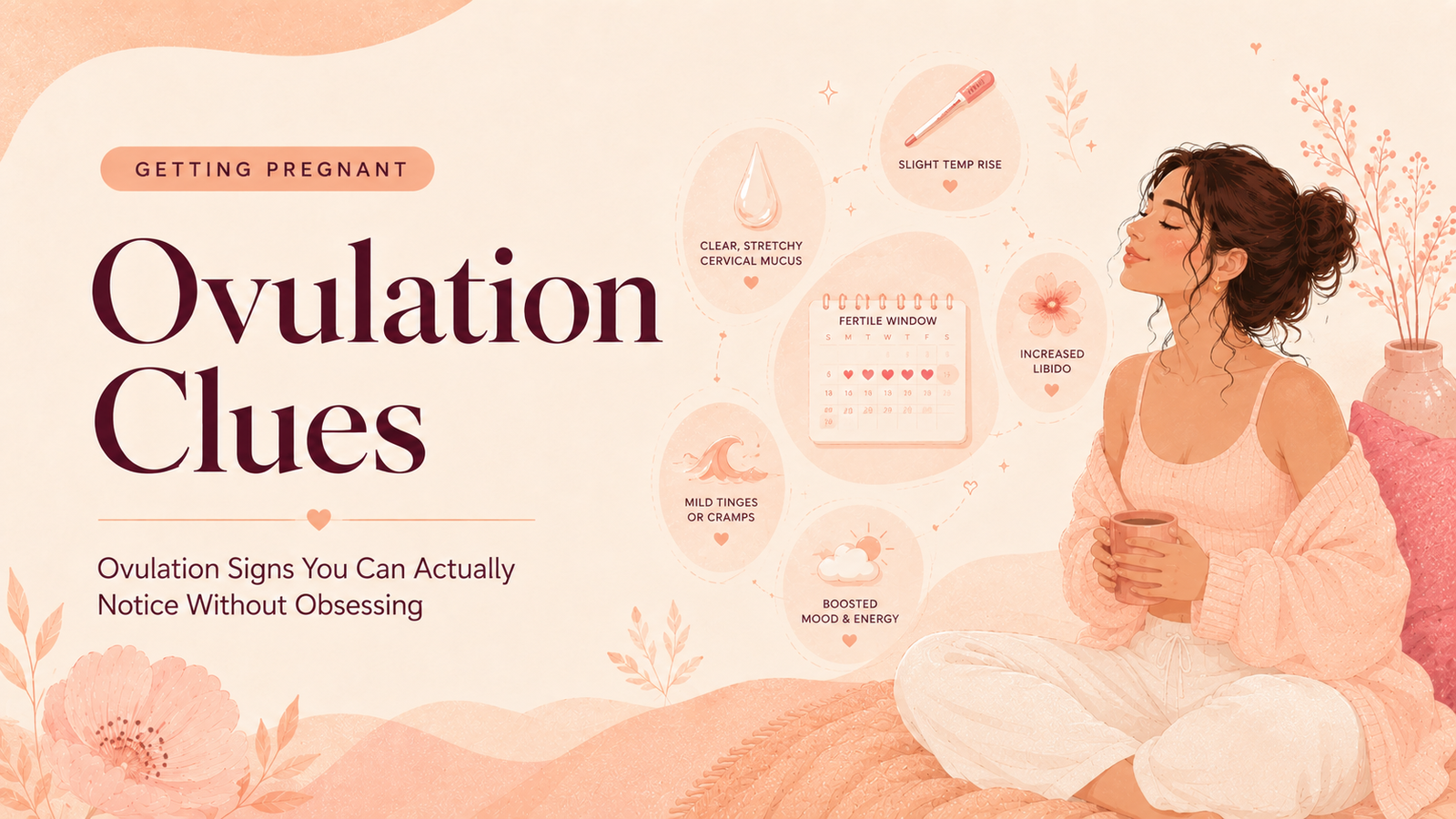
Ovulation is the moment an ovary releases a mature egg into the fallopian tube. It happens once in most cycles, usually about 12 to 16 days before your next period starts, not always on day 14. The egg itself lives for roughly 12 to 24 hours, but sperm can survive in supportive cervical mucus for up to about 5 days. That is why the fertile window is more than just one day. It typically covers the 5 days leading up to ovulation and the day of ovulation itself, with the highest pregnancy odds in the 2 to 3 days right before ovulation.
What Ovulation Actually Is
This matters because most people search for the perfect ovulation day, when the smarter target is the window. Your body is preparing for ovulation across several days, and your noticeable signs reflect that preparation, not a single instant. If you want a calmer experience, think in windows, not pinpoints.
How Your Hormones Set Up the Signs
A small rise in estrogen during the first half of your cycle thickens the uterine lining, softens and opens the cervix slightly, and changes the texture and amount of cervical mucus. As estrogen peaks, your brain releases a sharp surge of luteinizing hormone. That surge triggers ovulation about 24 to 36 hours later. After ovulation, the empty follicle becomes a small structure called the corpus luteum, which produces progesterone. Progesterone is what nudges your basal body temperature up and dries out cervical mucus.
You do not need to memorize the biology to use the signs. You just need to remember the order: estrogen leads, LH surges, ovulation happens, progesterone rises. That order is why some signs cluster before ovulation, like wet mucus, libido lift, and a positive LH test, while others appear after, like the temperature shift and drier mucus.
The Ovulation Signs You Can Actually Notice
Different bodies show different signs, and the same body can show different signs in different cycles. Here are the ones you are most likely to notice, ranked roughly by reliability.
1. Cervical Mucus Changes
This is the single sign most people can learn to read, and it shows up before ovulation, which is exactly when timing matters most. As estrogen rises, cervical mucus becomes more abundant, slippery, clearer, and stretchier. Right before ovulation, it often looks and feels like raw egg white discharge, and that texture is the friendliest environment for sperm.
After ovulation, mucus usually becomes thicker, stickier, drier, or even disappears for a few days. The shift from wet and stretchy to dry or creamy is a strong post ovulation signal in most cycles.
A few quick mucus reading tips:
- Check after using the bathroom, when you are not aroused and not just out of the shower.
- Notice color, stretch, and how it feels between two clean fingers.
- Track the wettest day of mucus rather than only the day with the most.
2. Basal Body Temperature Shift
Your basal body temperature is your resting temperature first thing in the morning before you sit up, talk, or drink anything. After ovulation, progesterone causes a small but real rise, usually about 0.3 to 1.0 degree Fahrenheit, that stays elevated for the rest of the cycle until your period.
A few things to know:
- BBT confirms ovulation after it happens. It is not a useful predictor of the next ovulation day in the current cycle.
- It is most accurate when you measure at roughly the same time each morning after at least 4 to 5 hours of sleep.
- Illness, alcohol, poor sleep, travel, and certain medications can blur the pattern, so look at the trend across at least a couple of weeks, not single days.
If you see a clear sustained shift for at least 3 days, your body almost certainly ovulated that cycle. If the temperature stays elevated for 18 days or more after the shift, that can be an early signal of pregnancy worth a test.
3. Positive LH Surge on an Ovulation Test
Ovulation predictor kits measure luteinizing hormone in urine. A positive LH test usually means ovulation will follow within about 24 to 36 hours. This is the closest thing to a real time predictor available without a doctor visit.
A few honest caveats:
- Some people show short, hard to catch surges, while others show long plateaus. Once or twice a day testing during your suspected fertile days is usually enough.
- Polycystic ovary syndrome and perimenopause can cause repeated LH bumps that are not real ovulation events.
- Drinking lots of water before testing can dilute results. Mid afternoon urine is often clearer than first morning.
LH tests work best when you pair them with cervical mucus and a cycle history. A solid positive plus fertile mucus is a much stronger pattern than either sign alone.
4. Mild One Sided Pelvic Twinge
A short, mild ache or pulling sensation on one side of the lower abdomen around ovulation is common enough to have its own name. Most people who feel it describe a brief twinge that lasts minutes to a few hours, rarely more than a day. It is usually not sharp and not disabling. For a deeper read, see this guide to ovulation pain.
This sign is helpful but tricky:
- Not everyone feels it, and not feeling it does not mean you are not ovulating.
- It can be felt on either side and may switch sides between cycles, which is normal.
- Severe, escalating, or one sided pain with fever, dizziness, heavy bleeding, or pain during intercourse is not normal ovulation pain and should be evaluated.
5. Cervix Position and Texture
If you are comfortable doing a self check, the cervix typically rises higher, softens, and opens slightly around ovulation. Many people compare the feel to the tip of the nose when low and firm, meaning less fertile, versus the softness of a lower lip when high and open, meaning more fertile.
This sign is useful but optional. It takes a few cycles to learn what your own normal feels like, and you need a consistent posture, like one foot up on the toilet, with clean hands. If checking your cervix raises anxiety rather than reducing it, skip it. The other signs are enough for most people.
6. Light Spotting
Some people notice very light spotting around ovulation. It is usually pale pink or light brown and lasts a day or less. The likely cause is a brief estrogen dip right before ovulation that can shed a tiny amount of uterine lining.
Useful clues:
- True ovulation spotting is light and short. Heavier or longer bleeding mid cycle deserves attention.
- It is not a reliable solo sign and tends to come and go across cycles.
7. Breast Tenderness
A subtle increase in breast tenderness, fullness, or sensitivity in the second half of the cycle can be a sign that ovulation happened and progesterone is rising. It is not unique to ovulation though, since many other things can cause similar feelings, including premenstrual changes, hormonal birth control transitions, and stress. Treat it as a soft supporting signal, not a primary one.
8. Libido and Mood Shifts
Many people notice a small bump in sexual desire, energy, or social confidence around the fertile days, which lines up with peak estrogen. After ovulation, as progesterone rises, mood can tip a little softer, more inward, or more tired. These shifts are usually subtle. If they feel dramatic, especially in the late luteal phase, that is worth discussing with a clinician.
9. Bloating and Digestive Changes
Some people feel slightly bloated, gassy, or notice mild constipation shifts around ovulation. These are very nonspecific signs and easy to misread. They can help round out a pattern, but never lead with them.
10. Skin and Hair Changes
A few people notice clearer skin or brighter hair days around ovulation, then breakouts or oilier skin in the days before a period. These are pattern hints, not standalone signs. If acne is persistent and severe, or hair growth is unusual, that can point to a hormonal issue worth evaluating, separately from cycle tracking.
How to Combine Signs Into a Reliable Pattern
One sign is a guess. Two signs is a hint. Three signs over several cycles is a pattern. The goal is not to nail down ovulation to the hour. The goal is to recognize your own fertile window early enough to act on it, then move on with your day.
A practical pattern to watch for is something like this:
- Cycle days 8 to 13: mucus becoming wetter and clearer
- Around day 12 to 14: positive LH test, more libido, mild twinge possible
- Day 14 or 15: peak fertile mucus, possible light spotting
- Day 15 or 16: drier mucus, BBT rises and stays up
- After: stable elevated BBT until the next period
The exact days are personal. Some cycles ovulate on day 11, some on day 21. The shape of the pattern matters more than the number on the calendar.
This is also where a calm tracker helps. Flow & Glow is a free cycle app that lets you log mucus, BBT, LH results, symptoms, and notes in one place, then quietly shows you your patterns over time. If you want to learn to track ovulation using a few signs at once instead of chasing one, that kind of view makes the work feel light. The point is not to obsess. The point is to stop trying to remember everything in your head.
Trying To Conceive Without Burning Out
If you are trying to conceive, the most useful research finding is that intercourse during the fertile window is what matters, not perfect timing on ovulation day. Couples with regular intercourse every 2 to 3 days during the cycle, especially in the days leading into the suspected fertile window, generally have the best chance over time. Daily intercourse is fine if it feels good. Skipping a day or two is also fine and does not noticeably hurt sperm quality for most people.
A few honest reminders for the TTC season:
- Most healthy couples take a few cycles to conceive. That is normal, not a problem.
- One cycle of seeing all the right signs and not getting pregnant is not a failure. Even at peak timing, a healthy cycle has only about a 1 in 4 to 1 in 3 chance of resulting in pregnancy.
- Stress about timing can itself reduce libido and make the process miserable. A calmer, slightly less precise approach is usually more sustainable.
- If you are 35 or older and have been trying for 6 months without success, or under 35 and trying for 12 months, that is a reasonable time to see a fertility specialist.
When Ovulation Signs Get Confusing
Several real life situations can make signs harder to read:
- Stress, big travel, illness, very intense training, and large weight changes can delay or skip ovulation.
- Polycystic ovary syndrome often produces multiple stretches of fertile looking mucus or LH bumps without ovulation.
- Perimenopause can shift cycle length, ovulation timing, and the strength of signs.
- Thyroid issues, high prolactin, and some medications can interfere with ovulation.
- Recently stopping hormonal birth control can produce a few unusual cycles before your natural pattern returns.
- Coming back to a regular cycle after pregnancy and breastfeeding can take many months, and signs can be muted at first.
If your cycles consistently look unusual to you, or signs disappear when they used to be present, that is a reason to talk with a clinician rather than try harder to interpret the patterns alone.
When To Seek Care
Some things deserve real attention, not patient watching. Reach out to a clinician if you notice:
- Severe pelvic pain, especially with fever, fainting, vomiting, or pain that prevents normal activity
- Heavy bleeding outside of your normal period, or unexplained mid cycle bleeding lasting more than a day or two
- Pain during intercourse
- Discharge that is gray, green, or strongly bad smelling, or that comes with itching, burning, or pelvic pain, since that points to an infection rather than normal ovulation discharge
- Cycles consistently shorter than 21 days or longer than 35 days
- Missed periods that are not explained by pregnancy
- Symptoms that suggest possible pregnancy if you had unprotected intercourse
- Trying to conceive without success for 12 months, or 6 months if you are 35 or older
None of this means anything is wrong by default. It just means a real person should look at the pattern with you.
A Simple Way To Start Without Obsessing
If you are new to all of this and want a quiet starting point, you do not need every tool at once. Try this for two or three cycles:
- Mark your period start and end days.
- Note your cervical mucus most days, especially when it clearly changes.
- Take your basal body temperature about 4 mornings a week if you can.
- Use LH tests only if you are trying to conceive or trying to confirm whether you ovulate.
- Write one line a day about how you felt, slept, and ate.
That is enough information for your body to start telling you its story. Most people see a recognizable pattern within two to three months. From there, you decide how much more detail is useful for your life and your goals.
The Honest Bottom Line
Ovulation signs are real, useful, and learnable. They are also imperfect, personal, and easy to misread when you only look at one cycle. The best gift you can give yourself, whether you are trying to conceive, avoiding pregnancy, or simply curious about your body, is to expect a pattern, not a single perfect sign. Patterns are kinder to live with than rules, and they hold up better when life gets messy.
If something feels off, trust that instinct and check in with a clinician. If everything feels reasonable, you do not need to track every detail to be doing this right.
Article information
- Written by Emma Hart, MS in Science Writing
- Medically reviewed by Dr. Alicia Williams, PhD, LMFT, CST
- Published on June 11, 2026
- Updated on October 7, 2026
Key takeaways
- Ovulation is a brief release of an egg, but your fertile window covers several days before and the day of ovulation itself.
- The three most reliable ovulation signs are cervical mucus changes, basal body temperature shift, and a positive LH test.
- Secondary signs like a small one sided pelvic ache, breast tenderness, mild bloating, light spotting, mood and libido shifts, and cervix position changes can help confirm the pattern.
- No single sign is definitive in any one cycle, so read signs together and across cycles.
- Stress, illness, sleep loss, travel, thyroid issues, polycystic ovary syndrome, perimenopause, and some medications can shift or hide ovulation signs.
- If you are trying to conceive, intercourse during the fertile window matters more than aiming for ovulation day itself.
- See a clinician if cycles are very irregular, pain is severe, bleeding is unusual, or you have been trying for 12 months (or 6 months if you are 35 or older).
Frequently asked questions
How do I know if I am ovulating without using a test?
The best clues come from your body, not a kit. Watch for several days of wetter, stretchier, clearer cervical mucus, often peaking on one or two days, then becoming drier or stickier after. A small sustained rise in basal body temperature after that mucus peak is strong evidence that ovulation happened. Mild one sided pelvic twinges, a small bump in libido, or light spotting can support the pattern. None of these alone proves ovulation, but seen together over a cycle or two they are usually reliable. If you never notice any signs across several cycles, that is worth discussing with a clinician.
Can you ovulate without noticing any signs?
Yes, and it is more common than people expect. Some bodies just have quieter ovulations, with subtle mucus changes, no pelvic twinge, and only small temperature shifts. Stress, irregular sleep, or being early in your cycle tracking journey can also blunt your awareness of the signs. If your periods are regular and arrive in a predictable range, you are most likely ovulating even when signs are quiet. If your cycles are very irregular or absent, that is a different situation and is worth bringing to a clinician.
What does ovulation discharge look like?
Right before ovulation, cervical mucus is usually clear, slippery, and stretchy, often described as similar to raw egg white. It tends to be more abundant and easier to notice than discharge in other parts of the cycle. After ovulation, it usually becomes thicker, stickier, white or creamy, or much drier. A wet, stretchy day or two surrounded by drier days is a very common ovulation pattern. Discharge that is gray, green, foamy, strongly bad smelling, or paired with itching or burning is not a normal ovulation sign and should be evaluated.
Is mild ovulation pain normal?
A short, mild, one sided ache or pulling sensation in the lower abdomen around the middle of your cycle is common and usually harmless. It can last anywhere from a few minutes to a few hours, occasionally a full day, and it may switch sides from cycle to cycle. It often appears around the same time as fertile cervical mucus or a positive LH test. What is not normal is pain that is severe, escalating, lasts for several days, prevents normal activity, or comes with fever, heavy bleeding, dizziness, or pain during intercourse. That kind of pain should be checked by a clinician.
How accurate is basal body temperature for ovulation?
Basal body temperature is a strong post ovulation confirmation, not a same day predictor. The progesterone made after ovulation raises your resting temperature by roughly 0.3 to 1.0 degree Fahrenheit, and that elevated level usually holds until your next period. A clear, sustained shift across at least three consecutive days, after a stretch of lower readings, is a reliable sign that you ovulated that cycle. The catch is that you must measure at a consistent time after several hours of sleep, and that illness, alcohol, late nights, and some medications can blur the signal. Trends matter more than single readings.
How long does ovulation actually last?
The egg itself is only viable for about 12 to 24 hours after release. That is the true ovulation event. Your fertile window is longer because healthy sperm can survive in supportive cervical mucus for up to about 5 days. In practical terms, the fertile window usually covers the 5 days leading up to ovulation and the day of ovulation, with the highest chances of conception in the 2 to 3 days right before ovulation. Trying to land on ovulation day itself is far less important than being inside the broader window.
When should I talk to a clinician about ovulation concerns?
Reach out if your cycles are consistently shorter than 21 days or longer than 35 days, if you regularly miss periods without a pregnancy explanation, if you never seem to ovulate over several months of consistent tracking, if you have severe pelvic pain, or if you are trying to conceive and have not become pregnant after 12 months under 35, or 6 months at 35 or older. Also reach out for unusual discharge with odor, itching, or pelvic pain, or for any sudden severe pain that worries you. None of these automatically mean something is wrong, but they all deserve a real conversation, not more guesswork.
References
- American College of Obstetricians and Gynecologists. (2024). Fertility awareness based methods of family planning Source
- American Society for Reproductive Medicine. (2022). Optimizing natural fertility: A committee opinion Source
- Cleveland Clinic. (2024). Ovulation Source
- National Health Service. (2023). How can I tell when I am ovulating? Source
- Office on Women's Health. (2024). Trying to conceive Source
- Wilcox, A. J., Weinberg, C. R., and Baird, D. D. (1995). Timing of sexual intercourse in relation to ovulation. New England Journal of Medicine, 333(23), 1517 to 1521 Source
Editorial and medical disclaimer
Flow & Glow health content is educational and is not a substitute for diagnosis, treatment, or personal medical advice from a qualified clinician.
Our editorial standards, reviewer process, sourcing approach, and correction process are explained in the Editorial Policy. You can also review our authors and medical reviewers, healthcare professional information, contact page, and privacy policy.