Ovulation Pain: Tiny Pinch, Big Clue, or Something Else?
That one-sided twinge mid-cycle has a name and a meaning. Here is what ovulation pain actually tells you, how to use it as a fertility clue, and when it deserves a closer look.
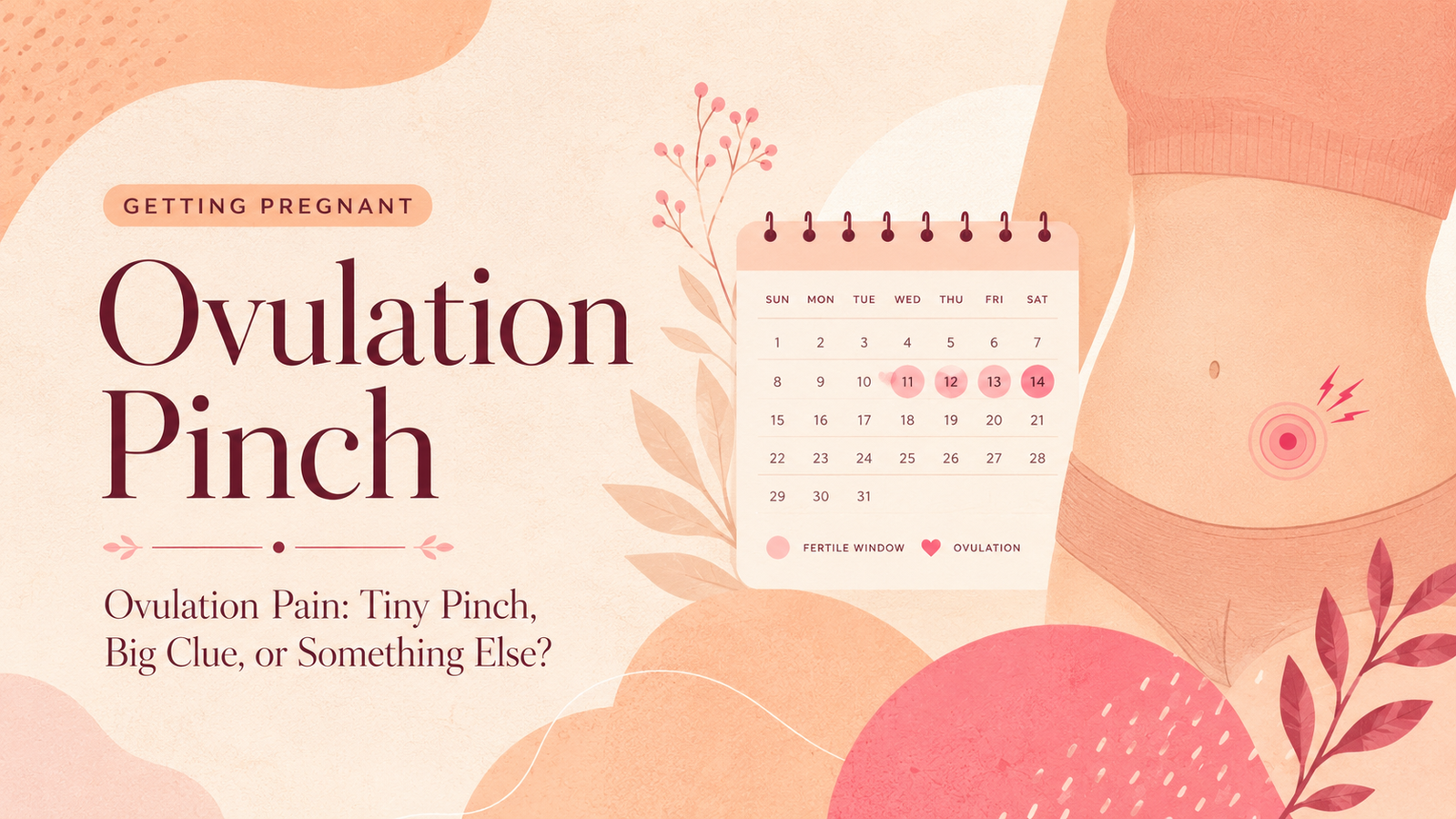
For some people, ovulation arrives like a quiet little tap on the side of the pelvis. For others, it is a dull ache that lingers across an afternoon, or a sharp twinge that disappears as quickly as it appeared. The medical word is mittelschmerz, which translates to middle pain, because it usually lands roughly in the middle of the cycle. Intensity varies a lot between people, and even between cycles in the same person. Some months bring nothing. Other months bring a sensation strong enough to make you pause whatever you are doing.
What That Pinch Actually Feels Like
It might show up as a pinch low and to one side of the lower belly. It might feel like a slow pulling sensation just above the hip bone. It might be a brief sharp catch when you stretch, twist, or sneeze, and then nothing for the rest of the day. Some people describe it as a warm, heavy feeling, almost like a small bruise on the inside. Others describe it as crampy, similar to period pain but milder and only on one side.
A few qualities tend to repeat across stories. The pain is usually lower than belly button level. It often favors one side. It rarely radiates very far. It tends to fade rather than build, which is the opposite of most worrying pain patterns. And it tends to come without the long list of accompanying symptoms that more serious causes bring with them.
If you have never felt anything like this in your cycles, that is also completely normal. Plenty of people ovulate quietly every month and never feel a single twinge. The absence of the pinch is not a sign that something is missing.
The Biology Behind the Pinch
To understand ovulation pain, it helps to know what is going on inside the pelvis around the time an egg is released. A small fluid-filled sac, called a follicle, grows on the surface of one ovary across the first half of the cycle. Around the time of ovulation, that follicle ruptures and releases an egg, along with a little bit of fluid and sometimes a tiny amount of blood. That fluid and blood can irritate the inner lining of the pelvis, which has plenty of nerve endings.
That irritation is one leading explanation for the sensation. Another is the stretching of the ovary itself as the follicle swells just before release. A third is the gentle contraction of the fallopian tube as it sweeps toward the ovary to pick up the egg. In real life, it is probably a mix of these, which is why the sensation is so different from person to person. Some bodies feel the stretch. Some bodies feel the irritation. Some bodies do not register any of it. None of these versions is more correct than another.
This biology also explains why the pain is usually one-sided. Ovaries take turns ovulating in many cycles, but not on a strict schedule, and either ovary can take a turn in any given month. That is why a person might feel a right-side pinch one month, a left-side ache two months later, and nothing in between.
Timing Clues: When It Tends to Show Up
The classic timing story is that ovulation happens about fourteen days before the next period starts. For someone with a textbook twenty-eight day cycle, that lands around day fourteen. Real cycles do not always match the textbook, so the actual day of ovulation can shift earlier or later. The pinch, when it happens, usually shows up close to this release. That can be hours before, right around it, or a little after. It is rarely a one-minute event lined up perfectly with the moment the follicle ruptures.
In practical terms, this means ovulation pain is a useful general window, not a stopwatch. If your cycles are fairly regular, the pain probably arrives somewhere in the middle stretch. If your cycles vary a lot, the pain can roam across a wider range of days. Either way, the sensation tells you, more or less, that your body is working on the ovulation step. It does not tell you the exact minute, and it does not tell you whether the egg has already been released or is about to be released.
This is also why ovulation pain alone is not a reliable way to time conception attempts. The most fertile days sit in a window that opens before ovulation, not just on the day of ovulation. Sperm can survive for several days in the right conditions, while the egg itself lives for a much shorter span. That is why getting a sense of the broader fertile window matters more than chasing a single sharp pinch.
Side-Switching and Other Patterns
A common worry is that one-sided pain must mean something is wrong on that side. In most cases, it does not. Ovaries do not strictly alternate. They take turns in a relaxed, sometimes uneven way. So a string of right-side ovulation pain followed by a left-side cycle is normal. So is several months on the same side. So is no obvious pattern at all.
You might also notice a different quality of pain on different sides. Some people feel the right side as sharper and the left side as duller, or the other way around. That is usually just anatomy, not a warning. The ovaries are tucked next to other organs, and the nerves around them share space with the gut and the lower back. A small ovulation event can light up nearby nerves in slightly different ways depending on the side.
What is worth watching is a sudden change in the pattern that does not match your normal experience. Pain that is much stronger than usual, lasts much longer, or comes with new symptoms is worth a closer look, even if you have had ovulation pain for years.
Fertility Limits: What Ovulation Pain Cannot Promise
It is tempting to read ovulation pain as a guarantee. Felt the pinch, must have ovulated, must be fertile this week. That reading is not quite right. Ovulation pain is a signal, not a certificate. Several things can produce a similar mid-cycle ache, including gut sensations, ligament strain, and other normal pelvic events. So feeling the pinch does not always mean a viable egg has been released, and not feeling the pinch does not mean ovulation skipped.
Another limit is precision. Even when the pain is genuinely tied to ovulation, the window of release can sit a little before or after the sensation. Conception attempts that depend on the pinch as a precise on switch can miss the actual best days. The body usually opens a fertile window across several days. That window is wider than the pinch and wider than any single symptom.
This is also where the difference between tracking and predicting matters. Tracking is what your body already did. Predicting is a best guess about what it will do next. Predictions are useful, but they sit on top of patterns from previous cycles, and they get less accurate when cycles are irregular. The honest version of any prediction tool, including a cycle app, is that it gives you a smart estimate, not a verdict, and you can read more about how those estimates work in our piece on cycle calculator accuracy.
Companion Signs That Often Travel With Ovulation Pain
Ovulation pain rarely shows up entirely alone. The body sends several quiet signals around the same window, and they are more useful together than any one of them is by itself.
Cervical Fluid That Stretches
In the days leading up to ovulation, cervical fluid often becomes clear, slippery, and stretchy. This is the texture many people describe as raw egg white discharge, and it is one of the more reliable signs that the body is moving through the fertile part of the cycle. When this texture overlaps with a mild one-sided pinch, the two together paint a clearer picture than either alone.
A Tiny Smear of Spotting
Some people notice a small amount of light pink or pale brown discharge around the same time. This is sometimes called ovulation spotting, and it is usually short, light, and nothing like a period. It does not happen for everyone, and its absence is not a problem. When it does happen alongside the pinch, it is another signal in the same general window.
Libido and Mood Shifts
Many people notice a small lift in libido in the days before ovulation. Others notice subtle mood changes, more energy, or a clearer feeling of confidence and sociability. These are not universal and not strong enough to be diagnostic on their own. They are gentle context for the rest of the picture.
Basal Body Temperature
After ovulation, the body usually shifts to a slightly higher resting temperature. This shift confirms that ovulation has already happened. It is more of a rear-view mirror than a heads-up, but across several cycles it can show a clear pattern. Charting that temperature alongside ovulation pain logs builds a richer record than either signal alone.
Breast Tenderness
Some people notice mild breast tenderness around mid-cycle, and stronger tenderness in the days before a period. The mid-cycle version can sit next to ovulation pain. It is usually mild and brief, and not a reason to worry on its own.
When Ovulation Pain Is Normal, and When It Is Not
Most ovulation pain is harmless and short. It is the kind of body event that quietly passes through and rarely needs anything more than a warm shower, a slower afternoon, or a basic over-the-counter pain reliever if it is truly bothersome. The pain is usually mild, located in the lower pelvis, on one side, lasting from a few minutes to a couple of days at most.
There are real situations where mid-cycle pelvic pain needs a careful look. Think of these as flags, not predictions. Any single one of them might still turn out to be nothing. Together, they signal that a clinician should be part of the conversation.
Worth taking seriously: - Pain that is severe, sharp, and keeps getting worse rather than easing - Pain that lasts more than a couple of days without easing - Pain that comes with fever, chills, or feeling unwell in your whole body - Heavy bleeding that looks more like a period than a small smear - Faintness, dizziness, or shoulder-tip pain that joins the lower belly pain - Pain during sex that is new, sharp, or keeps repeating - Burning, unusual discharge, or other signs that suggest infection - Any pelvic pain in someone who could be pregnant, especially if a period is late - Pain that breaks a long-standing pattern in a way that does not fit your normal cycle
None of this list means panic. It means call a clinician, get checked, and stop guessing. Severe pelvic pain has many possible causes that are not ovulation, and some of them are time-sensitive. Acting early is almost always easier than waiting.
Tracking Ovulation Pain in a Useful Way
A single ovulation pinch in a single cycle is mostly an anecdote. The same pinch logged across many cycles is data. It can show whether your body has a consistent ovulation window, how the sensation lines up with other signs, and whether anything is changing over time.
This is where a tracking app earns its keep. Logging the date, the side, the intensity, and any companion signs takes only seconds. Over several cycles, the pattern becomes visible. You might learn that the pinch lands two days after your stretchy fluid arrives. You might learn that it tends to come in the late afternoon, or that it is louder in cycles where you slept badly the week before. You might also learn that it has shifted in a way that is worth asking about at your next medical visit.
The app this article lives on, Flow and Glow, is built for exactly that kind of slow, honest tracking. It is not a fertility verdict and it is not a medical device. It is a calm place to write down what your body is doing, so that the next cycle is a little less of a guess.
A useful ovulation pain entry usually includes: - The day of your cycle when the pain showed up - The side of the pelvis where you felt it - How strong it was on your own scale, for example a one through ten - How long it lasted, in minutes or hours - Any companion signs that day, like cervical fluid changes or light spotting - Anything unusual in your context that week, such as a new exercise routine, illness, travel, or high stress
After three to six cycles, this kind of log is enough to start seeing a personal pattern. After a year, you have a much richer story than any single symptom can tell.
Soothing the Pinch at Home
For most people, ovulation pain is mild enough that it just needs a little patience. If it is bothersome, the same comfort tools that help with period cramps usually help here.
Things that often help: - A warm compress, hot water bottle, or warm shower on the lower belly - Resting in a position that takes pressure off the lower abdomen, such as lying on your side with a pillow between the knees - Gentle movement, like a slow walk or easy stretching, if standing still feels worse - Plenty of water through the day, since dehydration can make any cramping feel louder - A basic over-the-counter pain reliever taken as the label suggests, if there is no reason it would be a bad idea for you
Things that usually do not help much: - Pushing through a heavy workout while in active pain - Holding tense posture for hours at a desk - Skipping meals or running on too little sleep, which tends to amplify body sensations - Ignoring it for days while it gets worse
If your usual comfort routine is not denting the pain, that is itself a small flag. Pain that does not respond at all to gentle home care across a normal ovulation window is worth a closer medical look.
Birth Control, Hormones, and the Pinch
Hormonal birth control that suppresses ovulation usually also suppresses ovulation pain. If you are on a method that stops ovulation, like most combined hormonal pills used continuously, you might not feel any mid-cycle pinch at all. That is expected. If you do feel new mid-cycle pain on a method that is supposed to suppress ovulation, that is worth flagging at a check-in, not because it is necessarily bad, but because it is worth a conversation.
Other hormonal contexts can also change the sensation. Perimenopause, certain medications, post-pregnancy recovery, recent breastfeeding, and significant weight or stress changes can all shift cycle behavior. Ovulation pain can come and go through these phases. The presence or absence of the pinch in any given month is not a verdict on your fertility, your health, or your body.
Ovulation Pain and Trying to Conceive
For people actively trying to conceive, ovulation pain is often used as a green light. The honest answer is that it can be a useful nudge, but it is not the gold standard. The fertile window is wider than the pinch, and the broadly accepted advice has long been to focus on regular intercourse across that broader window rather than chasing a single day.
There is also the emotional layer. Trying to conceive can turn every body signal into either a hope or a worry. Ovulation pain can start to feel either like a promise or like a failure depending on what comes next. It is not either. It is one small data point in a much larger system. Putting it in a calm log, next to the other small data points, makes it easier to read without taking it personally.
If trying to conceive has been ongoing for a while without success, that is a separate conversation worth having with a clinician, regardless of whether you feel ovulation pain or not. The presence or absence of the pinch is not enough information to draw conclusions about fertility on its own.
What Ovulation Pain Is Not
A short list, because the internet sometimes mixes these up.
It is not a period. The bleeding around ovulation, if it happens at all, is light spotting, not flow.
It is not implantation pain. Implantation, if it happens, happens later in the cycle, not in the middle.
It is not appendicitis, even if it lands on the right side. Appendicitis pain tends to keep building, come with nausea or fever, and not stop after a day. If a right-sided pain is not behaving like your usual ovulation pain, treat it seriously.
It is not a pregnancy test. Feeling the pinch does not confirm conception. Missing the pinch does not rule it out.
It is not a permanent feature. Some people feel it for a stretch of years and then stop, and others start feeling it later in life. Changes are normal as long as they do not come with red flags.
When Ovulation Pain Means Time to Call a Clinician
A quick reminder, because this is the part people sometimes scroll past.
Call a clinician if pelvic pain is severe, sudden, or rising. Call a clinician if it comes with fever, vomiting, fainting, or heavy bleeding. Call a clinician if it lasts well beyond your usual ovulation window, if it changes in a way that does not match your history, if it interferes with daily life, or if you have any chance of being pregnant and feel new pelvic pain. Call a clinician if anything feels off in a way that words cannot quite capture. That gut sense matters.
The point of this article is to make ovulation pain less scary in the usual case, not to talk anyone out of getting help in an unusual one.
Putting It Together
Ovulation pain is one of those quiet signals the body sends when it is working through a normal monthly task. For most people who feel it, it is mild, brief, and meaningful only in a general way. Taken alongside other signs like cervical fluid changes, light spotting, libido shifts, and basal temperature data, it becomes a useful piece of a bigger picture. Taken alone, it is a clue, not a conclusion.
The most helpful posture is calm and curious. Notice the pinch when it shows up. Write down where it was, how strong it felt, and how long it lasted. Watch how it lines up with the rest of your cycle. Adjust your comfort routine for the day if you need to. Loop in a clinician if anything looks off. And let the long view, across many cycles, tell you more than any single sensation ever could.
Article information
- Written by Emma Hart, MS in Science Writing
- Medically reviewed by Dr. Jennifer Martinez, MD, FACOG
- Published on June 9, 2026
- Updated on October 7, 2026
Key takeaways
- Ovulation pain, sometimes called mittelschmerz, is mid-cycle pelvic discomfort linked to ovulation.
- It can feel like a pinch, a dull ache, a twinge, or a mild cramp, and it usually lasts minutes to a day or two.
- The pain often sits on one side, and the side can switch between cycles.
- It is a useful signal, but not a precise ovulation alarm, and it does not guarantee a viable egg has been released.
- Other ovulation signs are stronger together than apart, such as cervical fluid changes, mild spotting, libido shifts, and basal temperature patterns.
- Severe pain, fever, heavy bleeding, fainting, or pain that breaks your usual pattern needs medical attention.
- Logging the sensation cycle by cycle is far more useful than treating any single episode as proof.
Frequently asked questions
Is ovulation pain a reliable sign that I just ovulated?
It is a soft sign, not a hard one. The pinch usually lines up with the general ovulation window, but it can sit a little before or after the actual release. Other signs around the same time, like stretchy cervical fluid and a basal temperature shift across the following days, make the picture more reliable than the pinch on its own.
How long does ovulation pain normally last?
For most people, it lasts from a few minutes to a couple of days. A few hours is very common. Pain that lasts much longer, gets stronger, or comes with other symptoms is not the typical pattern, and it is worth a medical check.
Why does ovulation pain switch sides between cycles?
Ovaries do not strictly alternate. They take turns in a relaxed way, and either ovary can be the active one in any given month. So feeling the pain on the right one cycle and the left the next, or the same side several months in a row, is all within normal range.
Can I feel ovulation pain even if I am not actually fertile that cycle?
Yes. Mid-cycle pelvic sensations can happen without a viable egg being released, and other normal pelvic events can produce a similar pinch. That is one reason ovulation pain on its own is not a reliable fertility test.
Does birth control stop ovulation pain?
Hormonal methods that suppress ovulation usually also stop the pinch. If you are on a method that prevents ovulation and you still feel mid-cycle pain, that is worth mentioning to your clinician, not as an emergency, but as a small detail at your next check-in.
Is ovulation pain different from period cramps?
Usually yes. Period cramps tend to be central, dull, and tied to the start of bleeding. Ovulation pain tends to be one-sided, mid-cycle, and shorter. The intensity is usually milder. Some people experience them very differently and notice each clearly. Others find them harder to tell apart, which is a normal variation.
When should I see a doctor about ovulation pain?
Reach out if the pain is severe, lasting, or new in a way that does not match your normal pattern. Also reach out if it comes with fever, heavy bleeding, fainting, vomiting, possible pregnancy, signs of infection, or pain during sex that is sharp or new. Routine, mild ovulation pain rarely needs a visit. Anything outside that picture does.
References
- Mayo Clinic. Mittelschmerz Source
- Cleveland Clinic. Ovulation pain Source
- American College of Obstetricians and Gynecologists. The menstrual cycle Source
- NHS. Ovulation pain Source
- National Institute of Child Health and Human Development. Menstruation and the menstrual cycle Source
- Wilcox, A. J., et al. Timing of sexual intercourse in relation to ovulation Source
Editorial and medical disclaimer
Flow & Glow health content is educational and is not a substitute for diagnosis, treatment, or personal medical advice from a qualified clinician.
Our editorial standards, reviewer process, sourcing approach, and correction process are explained in the Editorial Policy. You can also review our authors and medical reviewers, healthcare professional information, contact page, and privacy policy.