Your Fertile Window Is Sneakier Than You Think
Your fertile window is not just ovulation day. Learn how cervical mucus, LH tests, sperm survival, and cycle shifts change your fertile days.
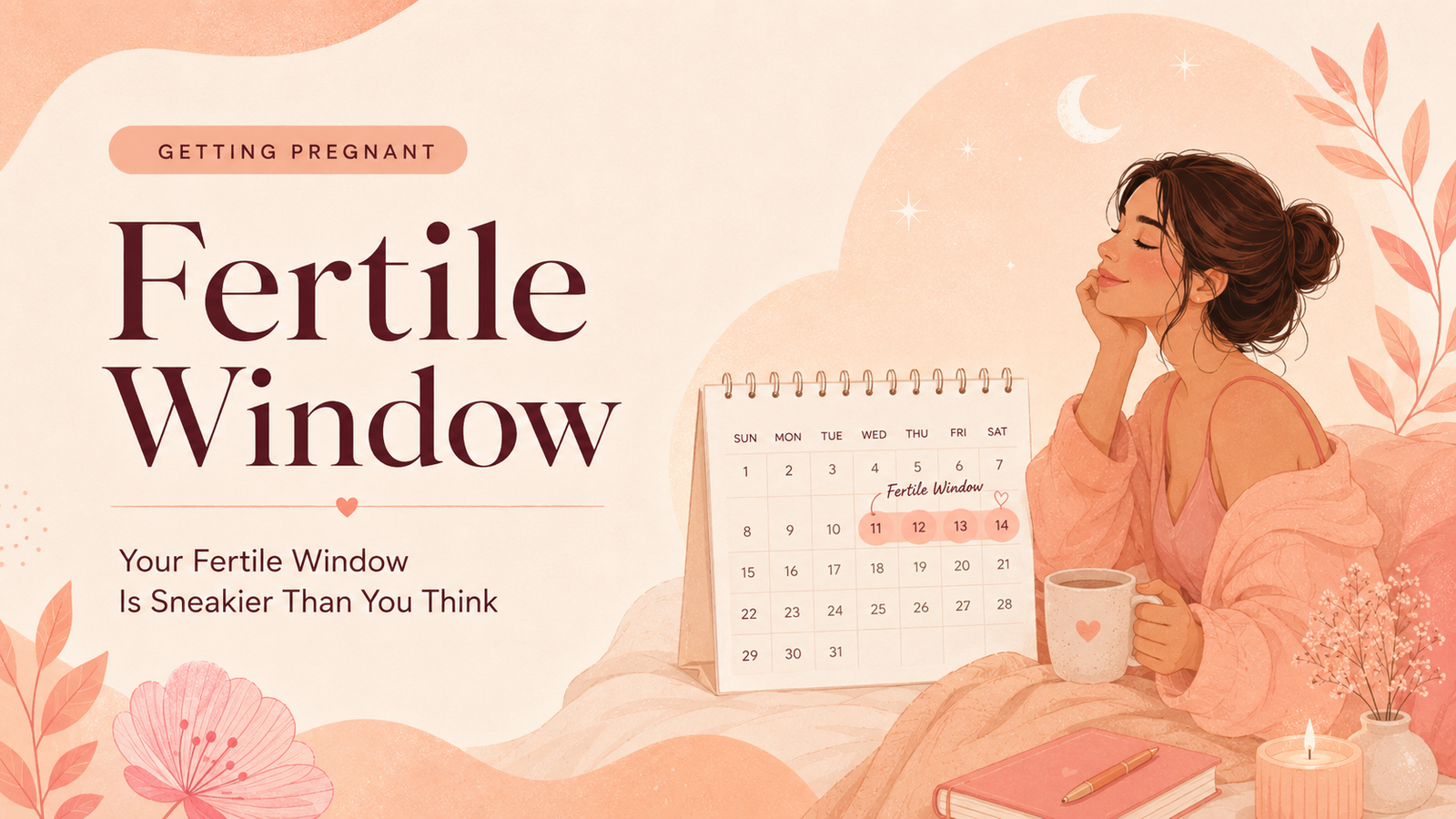
The fertile window is the small set of days in your cycle when pregnancy is possible. It is not the whole second half of your cycle. It is not your period. It is a moving target that lines up with ovulation, the moment your ovary releases a mature egg.
What the fertile window really means
Here is the simple version. Sperm can hang out in fertile cervical fluid for a few days waiting for an egg. The egg shows up once per cycle and only lives for less than a day. The window opens a few days before ovulation when sperm have a runway, and it closes within a day of the egg appearing.
If you map that out, you get roughly six fertile days per cycle. The two or three days right before ovulation are the highest chance days. The day after ovulation is usually the last day. After that, the window has closed for the cycle.
This is why people who are casually trying often feel confused. The math is not generous. Miss the window by a couple of days and the cycle does not count, even if you had sex many other times that month. Your fertile days are not a vibe across the month. They are a small concentrated stretch tucked inside it.
Why day fourteen is misleading
Almost every period app has shown you day fourteen at some point. It is the textbook average for a twenty eight day cycle. The problem is most people do not run on textbook cycles, and even people with regular cycles often ovulate on a different day each month.
Cycles can range from about twenty one to thirty five days and still be considered normal. The first half of the cycle, before ovulation, is the part that varies most. Once ovulation happens, the second half is usually pretty steady at around twelve to fourteen days.
So if you have a thirty two day cycle, your ovulation is more likely to land somewhere around day eighteen, not day fourteen. If you have a twenty five day cycle, ovulation might land around day eleven. Stress, travel, illness, a new workout routine, a big work week, or a season of poor sleep can all shift ovulation a few days in either direction.
The honest answer to when is fertile window is that it depends on this specific cycle, not on a calendar average. That is why we lean on signs and signals rather than a fixed date.
This is also where the fertility window becomes a more useful idea than ovulation day. The window thinks in days, not in a single moment. It gives your body room to be a few days off and still lets you plan with confidence.
The six day window, broken down
Picture the window as a runway with one landing strip.
Day one of the window, roughly five days before ovulation. Cervical fluid may start shifting from sticky or creamy toward something more slippery. Some sperm released today can survive until the egg arrives if conditions are right. Conception is possible but not common on this day.
Day two, about four days before ovulation. Fluid is usually wetter. Sperm survival improves. Chances are higher than yesterday but still modest.
Day three, three days before ovulation. The fluid is often clear and stretchy. Conception chances rise.
Day four, two days before ovulation. Many studies place this and the next day at the highest chance for conception. The body is preparing to release the egg, and the cervix is friendlier to sperm.
Day five, the day before ovulation. Often the single highest probability day. LH levels rise, mood and energy may shift, and the body is on the edge of release.
Day six, the day of ovulation. The egg is released. There is still a real chance today. Once the egg is out, you have less than a day before it is no longer viable.
The day after ovulation is usually outside the window. Sex that day rarely leads to pregnancy in the same cycle.
This is why the best days to get pregnant tend to sit before ovulation, not after. People who wait for proof that ovulation happened often miss it. The window is a forecast, not a confirmation, and forecasts mean you commit a little early.
Sperm survival, in plain language
The reason the window opens days before ovulation is sperm survival. In dry conditions outside fertile fluid, sperm die within hours. In the right cervical fluid, they can live up to about five days, with three days being more common.
Fertile cervical fluid is the slippery, clear, stretchy fluid that shows up as ovulation approaches. It is alkaline rather than acidic. It creates tiny channels that help sperm swim upward and rest in small pockets while waiting for the egg.
This is why couples are often told to have sex before they think ovulation will happen, not after. If sperm are already in place, the egg meets them quickly. If you wait for ovulation to feel obvious and only then have sex, you have a shorter runway and a tighter window.
It also helps explain why some couples conceive in months when the timing felt wrong, and miss in months when the timing felt perfect. Sperm survival adds slack on the front end and almost none on the back end. The right move is to lean early.
Why the egg is so brief
The egg has a short life. Once released, it travels into the fallopian tube and is viable for roughly twelve to twenty four hours. Some sources lean closer to twelve. After that, even if sperm arrive, fertilization is unlikely.
This is why most people cannot extend the window by trying harder after ovulation. The egg is gone. Energy spent stressing about the days after ovulation usually does not change the outcome of that cycle. The next cycle is the next chance.
It also means that two cycles in a row can give very different results, even with the same effort. Timing is not just about being intimate often. It is about being intimate during the right small ovulation window.
Body signs that hint at the window
Your body gives clues, but they are clues, not contracts. Watching for two or three of them at once tends to be more reliable than relying on a single one.
Cervical fluid changes
Fluid often moves from dry, to sticky, to creamy, to wet, to clear and stretchy as ovulation approaches. The slippery, clear, stretchy phase is the most fertile. This is what people call egg white discharge, and it usually shows up in the day or two before ovulation. After ovulation, fluid often becomes thicker or drier.
Basal body temperature
Basal body temperature is your temperature first thing in the morning before getting out of bed. After ovulation, progesterone rises and your temperature usually shifts up by about a few tenths of a degree. The catch is that the rise confirms ovulation has already happened. It is a great long term pattern detector, not a real time alarm.
Cervical position
The cervix can shift higher, softer, and slightly more open near ovulation, and lower, firmer, and more closed at other times. Some people find this useful, others find it inconsistent. It takes a few cycles to learn your normal.
LH surge
Luteinizing hormone surges about twenty four to thirty six hours before ovulation. Ovulation predictor kits detect this surge. A positive test is a real time signal that ovulation is likely close. It is not a guarantee that ovulation actually happens that cycle, but most cycles do follow a positive test with ovulation.
Mid cycle aches and mood
Some people feel a one sided pelvic twinge, a dip or surge in energy, breast tenderness, a stronger sex drive, or mild mood shifts near ovulation. None of these are reliable on their own, and they are easy to mix up with other things. Combined with fluid changes, they help confirm the bigger pattern.
You can read more on ovulation signs and build a small mental checklist for what your body usually does. Over a few months, your version of the window becomes clearer than any calendar prediction.
Why calculators get it wrong
Most fertile day calculators take your average cycle length, subtract fourteen days from the next expected period, and call that ovulation. Then they highlight five or six days around it.
That math has three big holes.
First, it assumes you ovulate fourteen days before your next period. Many people ovulate earlier or later than that, and that gap can vary cycle to cycle.
Second, it assumes your past cycles predict your next cycle. Stress, sleep, illness, weight changes, hormonal shifts, and many other factors can move ovulation in a given cycle.
Third, it assumes your luteal phase, the part after ovulation, is stable. It usually is, but not always. People with shorter or longer luteal phases get misled by simple subtraction.
This is the reason cycle calculator accuracy is so often the missing piece of the conversation. Calculators are a starting frame, not a stopping point. Pair them with body signs and, if you want more confidence, with LH tests. Treat the highlighted days as a guess that needs your body's input to sharpen.
Sex timing without burnout
The classic advice is every one to two days through the fertile window. The reasoning is simple. If you keep sperm fresh and present, you do not need to nail the exact day of ovulation.
There are a few flavors of this.
Daily through the window. Works for some couples, exhausting for others, and may stretch sperm count if there are existing fertility concerns.
Every other day from the start of fertile fluid until a day after ovulation. This is the most balanced for most couples. It keeps sperm available without pressure.
LH triggered. When the test turns positive, aim for the next two days. This works if you test consistently and accept that you will miss some sperm runway by waiting for the surge.
Casual rhythm. Sex two or three times a week, without a calendar. Many couples conceive this way. It is lower pressure, but takes longer to overlap the window in cycles where timing is fussy.
The right rhythm is the one you can keep. Burnout is real. People often describe TTC pressure as turning closeness into a chore. If a strategy adds stress without adding chances, drop it for a softer one. Sex on schedule that you both dread is not better than relaxed sex that overlaps the window most months.
When tracking helps and when it hurts
Tracking gives you data. Data lowers panic for some people and raises it for others. Here is a quick read on which side you may land on.
Tracking helps when you like patterns, when you want to see what your body actually does, when you want to talk with a clinician using real numbers, or when you want to identify cycles where ovulation may have shifted.
Tracking can hurt when every chart becomes a referendum on your worth, when you feel like a failure on days the data is unclear, when you start avoiding sex unless conditions are perfect, or when small fluctuations send you into stress spirals.
If you notice tracking moving from helpful to stressful, scale back. Try logging only period start, period end, and rough fluid notes. Drop temperature for a month. Stop testing LH every cycle. The window does not need elaborate proof every month to keep working.
This is one place where a calm, light app can carry more of the mental load for you. The Flow & Glow approach is meant to be a quiet companion, not a homework assignment. You can use it as much or as little as you want, and the goal is to make your window easier to see, not to give you another thing to obsess over.
Age, lifestyle, and the bigger picture
The fertile window is a monthly question. Fertility overall is a longer arc.
Age changes the picture gradually. Egg count and egg quality usually decline through the thirties and more steeply in the late thirties and forties. This does not mean the window itself changes shape. It means a given window may have lower odds at older ages, especially over thirty five.
Lifestyle matters in small steady ways. Sleep, food patterns, stress load, smoking, heavy drinking, and major weight swings can affect ovulation timing and consistency. Big improvements usually take a few cycles to show up.
Health conditions can change the window. PCOS, thyroid disorders, endometriosis, fibroids, untreated infections, and certain medications can shift or block ovulation. If your cycles are very long, very short, very heavy, very painful, or simply not arriving, that is worth a conversation with a clinician.
You do not need to optimize everything. You do need to know that the window is one piece of a bigger story. Optimizing the window only goes so far if a bigger factor is in the background.
How long should this take
This is the hardest question to sit with.
For people under thirty five with no known issues, doctors usually say it is reasonable to try for up to twelve months before seeking a fertility evaluation. For people thirty five and older, that timeframe is usually shortened to six months. For people forty and older, many clinicians suggest a fertility check sooner rather than later.
These are averages, not commands. If something feels off, if cycles are very irregular, or if you have a known condition, going in earlier is reasonable. Reading the room of your own body is part of the work.
In the meantime, knowing your window matters. So does knowing when to set it down. Most cycles do not result in pregnancy, even with perfect timing. That is normal biology, not a personal failure.
A gentler way to think about timing
Here is a quieter version of the advice.
Watch your fluid most months. Note when it turns slippery and clear. Treat the few days before and the day of as your window. Have sex during that window as your energy allows. If you want a sharper signal, add a few LH tests in the days you suspect are close.
Skip the rest of the noise unless you enjoy it. Apps, charts, books, and supplements can all add value, but they can also add noise. Pick the smallest set of tools that helps you feel informed without feeling pressured.
When a cycle does not work, give yourself a beat. Not every cycle ovulates. Not every ovulation lines up with sex. Not every well timed sex day results in fertilization. The window can be perfect and the answer can still be not this month.
When several cycles in a row do not work, you have not done something wrong. It is reasonable to step back, look at the bigger picture, and ask whether you want to bring in a clinician for a closer look.
When to talk to a clinician sooner
Please reach out to a qualified clinician sooner if you have any of these patterns.
Cycles that are consistently shorter than twenty one days or longer than thirty five days, periods that disappear for months at a time, severe pelvic pain, very heavy bleeding, fever during a cycle, foul smelling discharge, dizziness with periods, signs of infection, possible exposure to a sexually transmitted infection, or persistent disruption to daily life.
If you may already be pregnant and have severe pain, heavy bleeding, fainting, or extreme symptoms, treat that as urgent care.
This article is education, not medical advice. Your clinician has your full picture and can give you guidance that fits your body.
What to take away
The fertile window is short, sneaky, and shaped by signs your body is already giving you. It is not day fourteen. It is the few days running up to ovulation, where sperm can wait and the egg will eventually arrive.
You do not need a perfect chart to find it. You need a rough idea of your cycle length, a habit of noticing fluid changes, and a willingness to be wrong sometimes. The body is honest. It just speaks softly.
If you take one thing from this guide, take this. Aim for the days before, not after. Treat the calendar as a draft. Let your body have the final word.
Article information
- Written by Emma Hart, MS in Science Writing
- Medically reviewed by Dr. Jennifer Martinez, MD, FACOG
- Last medically reviewed on June 1, 2026
- Published on June 1, 2026
- Updated on October 7, 2026
Key takeaways
- The fertile window is about six days long, ending on the day of ovulation.
- Sperm can survive in fertile cervical fluid for up to about five days.
- The egg only lives for about twelve to twenty four hours after release.
- The most likely days for conception are the two to three days before ovulation.
- Day fourteen is an average, not a rule. Most cycles do not ovulate exactly on day fourteen.
- Calculators are estimates. Body signs and tests fine tune the picture.
- Stress about timing can backfire. Gentle, consistent tracking beats panic timing.
Frequently asked questions
How long is the fertile window?
About six days in most cycles. It opens up to five days before ovulation, when sperm can survive in fertile fluid, and closes within a day after the egg is released. The two days right before ovulation are usually the highest chance days.
When is the fertile window if I do not have a regular cycle?
Without a regular cycle, calendar math is less helpful. Watch for fertile cervical fluid that turns clear and stretchy, consider LH tests across several days, and look for a pattern of body signs together. A clinician can also help if cycles are very long, very short, or unpredictable.
Can I get pregnant outside my fertile window?
The chance is very low. Sperm need fertile fluid to survive long enough to meet an egg, and the egg only lives for about a day after release. Most pregnancies trace back to sex during the six day window, with the highest odds in the few days before ovulation.
Are ovulation predictor kits accurate?
They detect the LH surge that usually comes before ovulation. A positive test is a strong signal that ovulation is likely within a day or two. They are not perfect. Some cycles have surges without ovulation, and some people have surges that the test misses. Use them as one input, not the only input.
What if I miss my fertile window this month?
Then the cycle is closed for pregnancy and the next cycle is the next chance. This happens often, even when people are tracking carefully. Missing one cycle is not a sign that something is wrong.
Does stress shift my fertile window?
It can. Big stress, illness, travel, poor sleep, or major changes in routine can delay ovulation by a few days or, less often, by longer. Mild day to day stress usually does not move it. If your cycle suddenly feels off, give your body time and watch the signs.
Should I have sex every day in the fertile window?
You can, but it is not required. Every other day across the window keeps sperm fresh and protects you from burnout. If daily feels good, that is fine too. If daily feels like pressure, scale back. Connection matters as much as timing.
References
- ASRM. Optimizing natural fertility Source
- ACOG. Fertility awareness-based methods Source
- Wilcox, A. J., et al. (1995). Timing of sexual intercourse in relation to ovulation Source
- NHS. Trying to get pregnant Source
- NIH NICHD. Menstruation and the menstrual cycle Source
- Dunson, D. B., et al. (2002). Changes with age in fertility Source
Editorial and medical disclaimer
Flow & Glow health content is educational and is not a substitute for diagnosis, treatment, or personal medical advice from a qualified clinician.
Our editorial standards, reviewer process, sourcing approach, and correction process are explained in the Editorial Policy. You can also review our authors and medical reviewers, healthcare professional information, contact page, and privacy policy.