What Happens During Each Phase of Your Cycle: Understanding Your Body's Natural Rhythm
Menstrual cycle phases describe the hormonal shifts from menstruation through ovulation and the luteal phase.
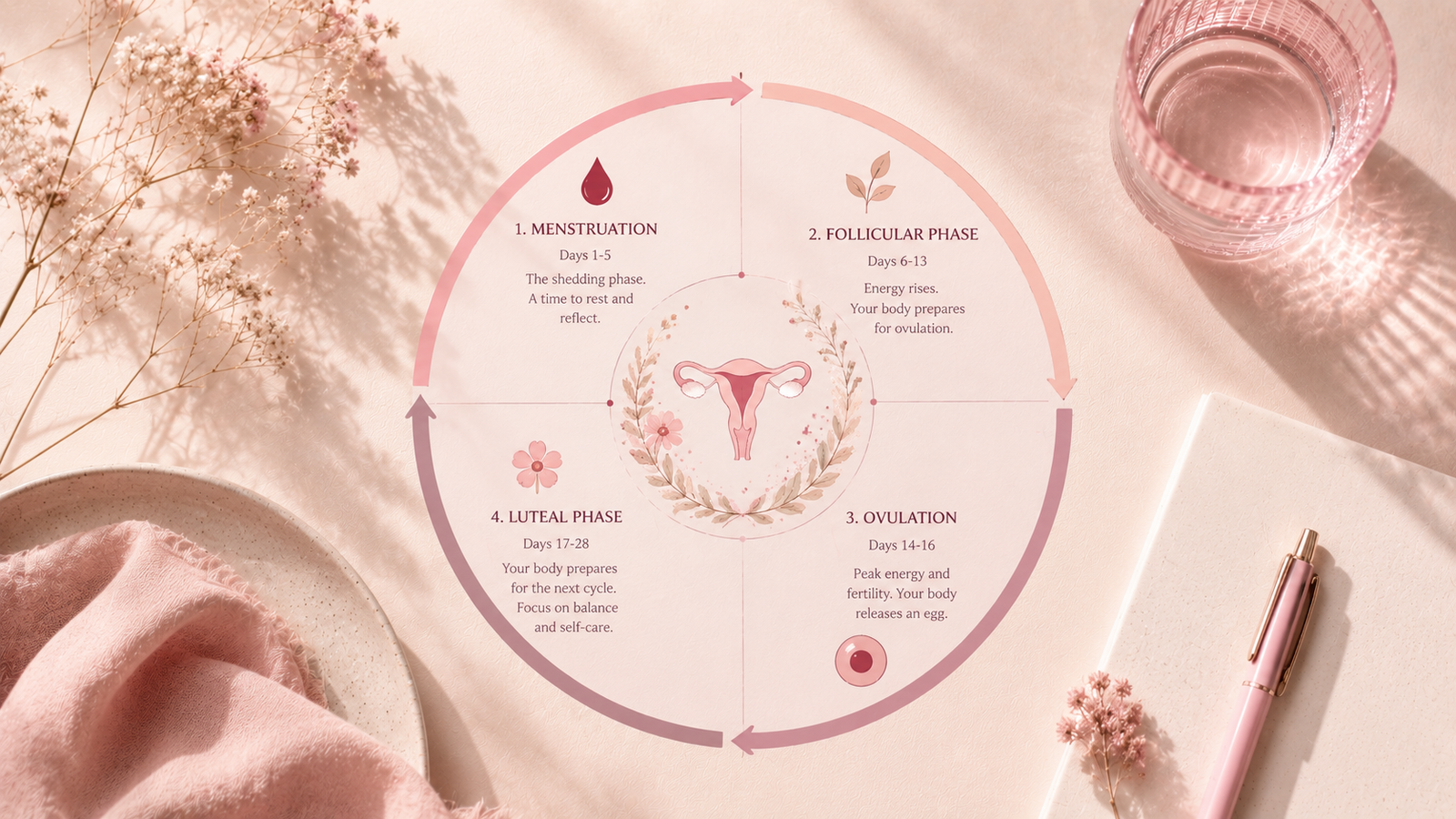
Most of us learn about periods as one thing that happens for a few days each month, and then we are supposed to forget about it until next time. That framing misses almost everything interesting about your body. The menstrual cycle is a coordinated loop that runs in the background of your life every single day. The bleeding is only the most visible part.
Your Cycle Is a Loop, Not a Calendar Square
Inside that loop, your brain releases hormones that tell your ovaries what to do. Your ovaries respond by maturing eggs and producing their own hormones. Those ovarian hormones shape your uterine lining, your cervical fluid, your basal temperature, your skin, your sleep architecture, your appetite, and your mood. When the cycle finishes, the system resets and starts again.
Understanding the four phases is not about labelling yourself or forcing your life into rigid boxes. It is about recognising patterns so that when something feels off, you actually have language for it. If you are using a tracker like Flow & Glow on your phone, those patterns become much easier to spot over a few months of consistent logging.
A quick note before we get into the phases. Cycle length varies. Real cycles in the published literature range widely across people and across months in the same person. If you want a deeper look at what is typical and what is worth investigating, our guide to normal cycle length walks through it.
The Four Phases at a Glance
Before we go deep into each one, here is the basic shape of a cycle. Day 1 is the first day of real bleeding, not spotting.
- Menstrual phase: roughly days 1 to 5, though anywhere from 3 to 7 days of bleeding is common.
- Follicular phase: starts on day 1 and overlaps with the menstrual phase, then continues until ovulation. This phase varies the most in length.
- Ovulation phase: a short window around the release of an egg, usually somewhere in the middle of the cycle.
- Luteal phase: the stretch between ovulation and the next bleed. For most people this is around 11 to 14 days and is the most consistent part of the cycle.
Hormones do not flip on and off like switches. They climb, peak, and fall in curves. So the boundaries between phases are soft. A day that feels like the end of your period might also be the start of your follicular energy lift.
Phase 1: The Menstrual Phase
This is the phase you already know. Bleeding begins, and the lining your uterus built up during the previous cycle is shed.
What Is Happening Inside
Estrogen and progesterone, the two main reproductive hormones, are both at their lowest right before and during your period. That drop is the signal that triggers the uterine lining, called the endometrium, to break down and leave the body. The blood you see is a mix of blood, tissue from that lining, and cervical fluid.
At the same time, your brain is already starting the next cycle. It sends a hormone called follicle stimulating hormone toward the ovaries, which begin recruiting a small group of follicles for the new cycle. Each follicle holds an immature egg. So even on day 1, your body is not just clearing out the old. It is quietly preparing the new.
What You Might Notice
- Bleeding that is heaviest in the first one to three days, then tapers.
- Cramping, sometimes mild, sometimes strong. Cramps come from the uterus contracting to help shed the lining.
- Lower energy, the urge to sleep more, or a need to slow down. This is not weakness. Your body is doing real work.
- Breast tenderness easing off after a day or two if it was present before the bleed.
- Mood and skin often start to feel calmer once bleeding is well underway, as the premenstrual hormone storm settles.
Discharge during this phase is mostly blood. Outside of the heaviest days, you may notice that cervical fluid is thin or nearly absent.
What Helps
There is no single rulebook, and you do not have to perform any specific routine to have a healthy cycle. Some patterns that many people find supportive during menstruation include warm food and drinks, slower movement like walking, gentle stretching, iron-rich meals, hydration, and earlier bedtimes. If pain is interfering with your daily life, that is worth taking seriously rather than pushing through. Severe period pain is common, but common is not the same as something you have to accept.
When to Pay Attention
Talk to a clinician if your periods are soaking through a pad or tampon every hour for several hours in a row, if you feel faint, if you pass very large clots regularly, if your bleeding lasts longer than about seven days, if you suddenly miss a period and pregnancy is possible, or if pain stops you from working, sleeping, or moving.
Phase 2: The Follicular Phase
Technically, the follicular phase begins on day 1 of your cycle. It overlaps with your period and then continues after the bleeding stops, running until ovulation. We are giving it its own section because the part you experience after your bleed is so different from the menstrual phase that it deserves clear attention.
What Is Happening Inside
Follicle stimulating hormone from the brain has nudged a cohort of follicles in the ovaries to start growing. Usually one follicle becomes the dominant one. As it matures, it produces increasing amounts of estrogen.
Estrogen has many jobs. In this phase, it rebuilds the uterine lining that was just shed. It also influences your cervical mucus, your brain chemistry, your skin, and your bones. As estrogen climbs through the follicular phase, many people feel a slow lift in mood, energy, sociability, and focus.
This is the phase that varies most in length. Some cycles have a short follicular phase. Others have a much longer one, especially in months that are stressful, in the perimenopausal years, after stopping hormonal contraception, or in people with conditions that affect ovulation. That variation is one of the biggest reasons real cycles do not match the textbook 28-day average.
What You Might Notice
- A noticeable energy return after the period ends.
- Skin that often looks clearer and calmer as estrogen rises.
- Sleep that may feel deeper or easier to fall into.
- Appetite that may feel more stable, with less of the heavy carb cravings that some people get later in the cycle.
- A return of libido for some people, though desire patterns are very individual.
- Discharge that shifts gradually from dry or sticky to creamy and then to more stretchy and clear as ovulation approaches.
Movement, Work, and Social Life
A lot of people find this phase a good time for harder workouts, taking on new projects, having difficult conversations, or being more socially active. That is a pattern, not a rule. Your life does not have to bend itself around your cycle, but if you naturally feel more capable here, it is not your imagination.
If you are curious about adapting workouts to where you are in your cycle, our guide on cycle syncing workouts walks through how to think about training intensity across the month without becoming rigid about it.
When to Pay Attention
A follicular phase that drags on for many weeks, with no clear sign of ovulation and no bleed, can be a sign that ovulation is delayed or not happening at all. Occasional anovulatory cycles are normal, especially during teenage years and the years approaching menopause. Persistent very long cycles, very irregular cycles, or cycles where you cannot identify any fertile window are worth discussing with a clinician, especially if you are trying to conceive or want to understand your fertility.
Phase 3: The Ovulation Phase
Ovulation is the headline event of the cycle. It is also the part that is most often misunderstood, because the act of ovulation itself takes minutes, not days.
What Is Happening Inside
As estrogen from the dominant follicle reaches a high level, your brain responds with a surge of another hormone called luteinizing hormone. That surge triggers the follicle to release its mature egg into the fallopian tube. The egg then has a relatively short window, generally less than 24 hours, in which it can be fertilised.
The fertile window, though, is longer than the egg's lifespan. Sperm can survive in the female reproductive tract for several days under the right conditions, so people can become pregnant from sex that happens in the days leading up to ovulation, not just on the day itself. This is why understanding your full fertile window matters more than fixating on a single date.
For a deeper, focused look at the mechanics of ovulation, including hormone surges and timing, see ovulation explained.
What You Might Notice
- Cervical mucus that becomes stretchy, clear, and slippery, similar to raw egg white. This is a strong signal of approaching or active ovulation.
- A small one-sided lower abdominal ache, sometimes called mittelschmerz, lasting from minutes to a couple of days. Many people never feel this. Both experiences are normal.
- A noticeable bump in libido for some people. Again, not universal.
- Higher confidence, clearer focus, or a sense of social ease for some.
- A small rise in basal body temperature in the days after ovulation, which is one of the signs people use to confirm that ovulation has happened.
- Light spotting in some cycles around ovulation. Occasional mid-cycle spotting can be normal, but heavy or repeated mid-cycle bleeding is worth checking with a clinician.
What This Phase Is Not
This phase is not a fixed calendar day. The idea that everyone ovulates on day 14 comes from averaging cycles, not from reality. In real life, ovulation can happen earlier or later, even in the same person from month to month. Stress, illness, sleep loss, travel, weight changes, intense training, and many medications can shift the timing.
This phase is also not a guarantee of pregnancy if you are trying, or a guarantee of no pregnancy if you are not. Conception depends on many factors beyond timing alone. And no method of natural cycle tracking, used alone, prevents pregnancy reliably enough to replace contraception that has been chosen with your clinician.
When to Pay Attention
If you have never noticed any sign of ovulation across many cycles, if your cycles are very irregular, if you have heavy or painful mid-cycle bleeding, or if you have been trying to conceive for a length of time that fits guidance for your age and history without success, that is worth a clinical conversation. Not because something is necessarily wrong, but because there are options worth exploring with someone who can see your full picture.
Phase 4: The Luteal Phase
After ovulation, the follicle that released the egg transforms into a structure called the corpus luteum. The corpus luteum produces progesterone, the dominant hormone of this final phase. Many people find this is the phase where they feel the most physical and emotional change.
If you want a deeper, dedicated walkthrough of this phase, including why it matters so much for symptoms and fertility, see our full piece on the luteal phase.
What Is Happening Inside
Progesterone has two main jobs in this phase. The first is to prepare the uterine lining to support a possible pregnancy by making it thicker and more nourishing. The second is to keep the system stable until either pregnancy begins or the corpus luteum stops working.
If the egg is not fertilised and pregnancy does not begin, the corpus luteum naturally winds down after about 11 to 14 days. As it shuts down, progesterone falls. Estrogen also drops. That combined hormone fall is what triggers the start of the next period, and the whole cycle begins again.
If pregnancy does occur, the body produces a different hormone, human chorionic gonadotropin, which keeps the corpus luteum going and progesterone high. That is why pregnancy tests look for that hormone.
What You Might Notice
- A small ongoing rise in basal body temperature compared with the follicular phase.
- Breast tenderness or fullness, particularly in the second half of the luteal phase.
- Bloating, water retention, or changes in how clothes fit.
- Skin shifts. For some people, this is when breakouts appear, especially around the chin and jawline.
- Appetite changes, often including stronger cravings for carbs, salt, or chocolate. These are real biochemical patterns, not a lack of willpower.
- Sleep that can feel lighter or more interrupted, especially in the last few days before bleeding.
- Mood shifts. Some people feel calmer and more reflective. Others feel more anxious, irritable, tearful, or low. Both can be normal patterns, but if they are severe, they deserve attention rather than dismissal.
- Discharge that is often thicker, sticker, or drier compared with the slippery fluid around ovulation.
When to Pay Attention
Premenstrual symptoms that disrupt your relationships, work, or basic functioning are not something you simply have to live with. There are recognised conditions, including more severe forms of premenstrual mood symptoms, that benefit from real clinical support. A pattern of severe symptoms in the days before your period that consistently lifts once bleeding starts is worth describing to a clinician in detail. Tracking those symptoms across several months gives you something concrete to share.
A luteal phase that is consistently shorter than about ten days, or one in which spotting begins many days before your real bleed, can sometimes be a sign worth discussing with a clinician, especially if you are trying to conceive.
How the Phases Talk to Each Other
It is tempting to think of the phases as separate weeks with their own personality. In reality, they are more like one continuous wave, with each phase setting up the next.
Estrogen rises through the follicular phase and peaks just before ovulation. After ovulation, estrogen drops slightly, then rises again as progesterone takes over the leading role in the luteal phase. Both hormones fall together at the end of the luteal phase, which triggers the bleed and starts the next follicular phase. The exit of one phase is the entrance to the next.
This connection means that what happens in one phase affects the next. A stressful month that delays ovulation will also push back the luteal phase and the next period. A cycle with strong ovulatory hormones tends to feed a stronger luteal phase. Tracking is so useful precisely because it captures these connections over time.
Real Cycles Do Not Match Textbooks
If you have ever felt like your body is broken because your period did not arrive on day 28, your body is almost certainly fine. Real cycles vary in length, in symptom pattern, and in how strongly each phase shows up.
Some of the most common sources of variation include:
- Age. Cycles in the first few years after menarche and in the years approaching menopause are typically more variable.
- Stress. Both acute stress and long term stress can shift ovulation and cycle length.
- Sleep. Chronic sleep loss can affect the hormones that regulate ovulation.
- Travel and time zone changes. Even a single big trip can move your next period.
- Weight changes and very intense training. Significant changes in either direction can affect ovulation.
- Illness. A short illness can sometimes nudge a cycle by several days.
- Hormonal contraception. The first months after starting or stopping can look very different from your long term pattern.
- Postpartum and breastfeeding. Cycles often return gradually and unpredictably at first.
- Underlying conditions. Things like thyroid disorders, polycystic ovary syndrome, and endometriosis can shape cycles in their own ways.
None of this means you are doing anything wrong. It means your cycle is a living system reacting to your life.
Tracking Without Turning It Into Another Job
The point of tracking is not to grade yourself. It is to give you data that future you can rely on. The best logs are the ones you actually keep, not the most detailed ones you abandon after a week.
A practical starter set of things to track:
- The first day of real bleeding. This is day 1.
- Flow level each day, in your own words. Light, medium, heavy, spotting.
- Any pain, where it is, and how it affects what you can do.
- Discharge changes. Dry, sticky, creamy, stretchy, watery, blood-tinged.
- Mood, energy, sleep quality, and notable cravings.
- Sex, if relevant to what you are trying to track.
- Anything unusual. Illness, big stress, long travel, new medication.
After two or three months of even basic tracking, your phases will start to stand out. You will likely notice your own version of follicular lift, your own ovulation signs, and your own luteal patterns. That is the information that lets you plan, ask better questions at appointments, and notice changes earlier.
Phase Awareness Without Phase Tyranny
A culture of cycle content has emerged that sometimes turns phases into strict prescriptions. You must do this kind of workout in this phase. You must eat these foods in that phase. You must only schedule social events in one phase and only journal in another.
It is okay to opt out of all of that. Your life has demands that do not pause for your hormones. The point of understanding your phases is to give you more options, not fewer. If a hard workout in your luteal phase feels good, do it. If you want to lead a meeting on day 1, lead the meeting. If you want a quiet day in your follicular phase, take it. The most respectful thing you can do for your body is to listen, not to follow a stranger's script.
When Phase Patterns Suggest Something Worth Checking
Most cycle variation is just part of being human. Some patterns, though, deserve a closer look with a qualified clinician. None of these are diagnoses on their own, but they are good reasons to seek personalised guidance.
- Periods that are extremely heavy, very long, or causing anaemia symptoms like extreme fatigue.
- Periods that are very painful in a way that disrupts your normal life.
- Cycles that are consistently very short or very long for your age.
- Missing periods when pregnancy is not the cause.
- Sudden major changes in your cycle pattern.
- Spotting between periods that happens repeatedly.
- Pain or bleeding linked to sex.
- Premenstrual mood symptoms that feel out of proportion or unsafe.
- Trying to conceive for a length of time that fits your age and situation without success.
- Any postpartum cycle changes that worry you.
- Any fever, foul-smelling discharge, fainting, or severe pelvic pain. These deserve prompt evaluation.
You do not need a perfect chart to ask for help. You just need to say what you are noticing.
Bringing It All Together
Your cycle is not a problem to solve. It is a rhythm to know. The menstrual phase clears space. The follicular phase builds. Ovulation peaks. The luteal phase prepares and resets. Then it begins again. The phases are not personalities. They are not deadlines. They are a steady backdrop to your real life, and they will look a little different every month.
Understanding what each phase is doing, and what your own body tends to do during it, gives you a quieter, more grounded relationship with your body. You stop being surprised. You stop blaming yourself for normal patterns. You start spotting the differences that matter. And when something does deserve attention, you have the language to advocate for yourself.
Article information
- Written by Emma Hart, MS in Science Writing
- Medically reviewed by Dr. Sofia Reyes, MD, FACOG
- Last medically reviewed on April 22, 2026
- Published on April 22, 2026
- Updated on October 7, 2026
Key takeaways
- A full menstrual cycle includes four overlapping phases, not just the days you bleed.
- Estrogen and progesterone rise and fall in predictable patterns, but the exact timing and length vary from person to person and from cycle to cycle.
- The menstrual phase and the follicular phase begin together. Ovulation is a short window, not a whole week. The luteal phase is the longest stretch for most people.
- Energy, libido, sleep, appetite, skin, digestion, and mood can all shift across the month. These shifts are real, but they are patterns, not personality rules.
- Tracking your bleeding, discharge, temperature, and symptoms across several months is the most reliable way to understand your own rhythm.
- Severe pain, very heavy bleeding, fainting, fever, sudden cycle changes, or any worry about pregnancy or fertility deserves a conversation with a qualified clinician.
Frequently asked questions
How long is a normal menstrual cycle?
A typical cycle length sits somewhere between about 21 and 35 days for adults, with bleeding lasting roughly 3 to 7 days. Real cycles vary from person to person and from month to month in the same person. A cycle that is consistently outside that range, or one that suddenly changes a lot, can be worth a conversation with a clinician.
What if my cycle does not follow the four phase pattern clearly?
Many cycles do not match the textbook neatly, especially in your teen years, in the years approaching menopause, after stopping hormonal contraception, during breastfeeding, and in cycles where ovulation does not happen. Some months a phase may be longer or shorter, or harder to spot. That is common. Persistent inability to identify any ovulation signs across many cycles is worth raising with a clinician, particularly if you are trying to conceive.
Which phase is the most fertile?
Pregnancy is possible from sex that happens in the days leading up to ovulation and on the day of ovulation itself. That window usually sits late in the follicular phase and into the ovulation phase. Because sperm can survive several days in the right conditions, the fertile window is wider than the egg's lifespan. Tracking discharge changes and basal temperature can help you understand your own window, but no single signal is a guarantee.
Why do I feel so different in the days before my period?
The shift you feel in the last part of the luteal phase reflects falling progesterone and estrogen. Those changes can affect mood, sleep, appetite, skin, bloating, and energy. Mild premenstrual symptoms are very common. Symptoms that consistently disrupt your work, relationships, or sense of safety are not something you have to push through alone, and they deserve real medical support.
Can my phases change due to stress, travel, or illness?
Yes. Stress, sleep loss, travel, intense training, illness, big weight changes, and some medications can all shift the timing of ovulation, which then shifts when your next bleed arrives. One off changes in cycle length are usually nothing to worry about. Patterns of disruption, especially when paired with other symptoms, are worth tracking and discussing with a clinician.
Do hormonal contraceptives stop the phases from happening?
Hormonal contraceptives change the hormone signals in different ways depending on the type. Some methods suppress ovulation. Others change the lining or cervical mucus. The bleeding you have on certain types of hormonal contraception is not the same as a natural period and does not always reflect the same phase pattern as an unmedicated cycle. If you want to understand exactly how your method affects your cycle, ask the clinician who prescribed it.
How do I start tracking my phases without it feeling overwhelming?
Begin with three things: the first day of your real bleed, daily flow, and one or two symptoms you actually care about. Add more only when it feels useful. Use a tracker you are happy to open every day rather than one with the longest feature list. After a couple of months, your own version of the four phases will become much easier to recognise, and your data will be useful in real conversations with a clinician.
References
- Bull, J. R., Rowland, S. P., Scherwitzl, E. B., Scherwitzl, R., Danielsson, K. G., and Harper, J. (2019). Real-world menstrual cycle characteristics of more than 600,000 menstrual cycles. npj Digital Medicine Source
- American College of Obstetricians and Gynecologists. (n.d.). The menstrual cycle Source
- Cleveland Clinic. (n.d.). Menstrual cycle Source
- Merck Manual Consumer Version. (n.d.). Menstrual cycle Source
- Office on Women's Health, U.S. Department of Health and Human Services. (n.d.). Your menstrual cycle Source
- Reed, B. G., and Carr, B. R. (updated). The normal menstrual cycle and the control of ovulation. Endotext Source
Editorial and medical disclaimer
Flow & Glow health content is educational and is not a substitute for diagnosis, treatment, or personal medical advice from a qualified clinician.
Our editorial standards, reviewer process, sourcing approach, and correction process are explained in the Editorial Policy. You can also review our authors and medical reviewers, healthcare professional information, contact page, and privacy policy.