Ovulation Calculator vs Cervical Mucus: Which Clue Should You Trust?
Compare ovulation calculators and cervical mucus tracking for TTC. Learn which clue to trust, how to combine them, and what to do with irregular cycles.
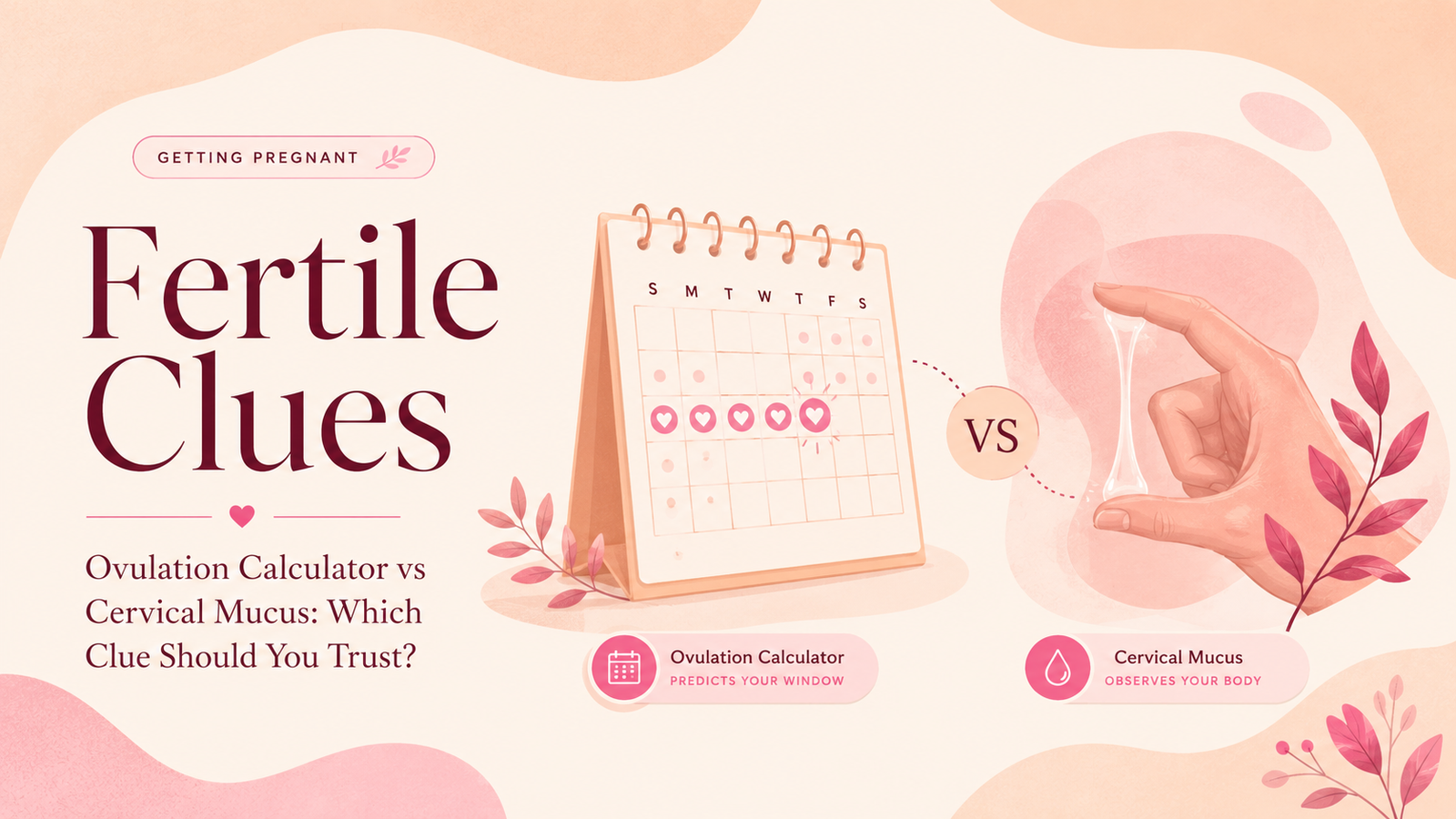
If you are trying to conceive, it is very normal to open an ovulation calculator, count ahead from your last period, and wonder, “Is this actually my fertile window?” Then you might notice slippery discharge, a positive ovulation test, a twinge on one side, or a temperature shift, and suddenly TTC tracking feels less like a calendar and more like detective work.
The question behind ovulation calculator vs cervical mucus is simple: which clue deserves more trust when you are planning sex around ovulation?
The honest answer is that neither clue is perfect on its own. An ovulation calculator is useful because it gives you a fast estimate, especially when your cycles are fairly regular. Cervical mucus tracking is useful because it is based on what your body is doing right now. But mucus can be confusing, calculators can be too simple, and real cycles do not always follow textbook timing.
That is where a calmer, combined approach helps. Flow & Glow is designed to make cycle tracking feel less cold and more useful, so you can log dates, symptoms, body signs, and patterns in one place. If you want a gentle iPhone companion for this, you can track your cycle with Flow & Glow while you learn what your fertile clues tend to look like over time.
This guide compares the ovulation calculator, cervical mucus tracking, LH tests, and other ovulation signs, then shows you how to combine them without turning your whole life into a fertility spreadsheet.
The Short Answer: Trust Patterns, Not One Clue
When people compare ovulation calculator vs cervical mucus, they often want a winner. But TTC tracking works better when you stop asking one clue to do the whole job.
A calculator is a map. Cervical mucus is a weather report. LH tests can be a traffic alert. Symptoms are notes from the road. None of them is the full journey by itself.
For many people with regular cycles, a calculator can point to the days most likely to matter. If your cycle is usually 28 days, ovulation is often estimated around the middle of the cycle. But “often” is not the same as “always.” Ovulation can happen earlier or later, even in people who usually have predictable periods.
Cervical mucus can add more current information. As estrogen rises before ovulation, mucus may become wetter, clearer, more slippery, and more stretchy. This kind of mucus can help sperm move and survive. That makes it one of the more useful natural ovulation signs for timing sex.
Still, mucus is not a lab confirmation. Some people produce very little visible mucus. Some notice several patches of slippery mucus before ovulation. Some see changes because of sex, arousal fluid, infections, medications, hydration, lubricants, or recent hormonal changes.
So the practical answer is this:
Use the calculator to know when to start paying attention. Use cervical mucus and other signs to refine the timing. Use repeated patterns to build confidence.
What an Ovulation Calculator Actually Tells You
An ovulation calculator estimates fertile days using cycle length and the date your last period started. It usually assumes that ovulation happens a certain number of days before your next period. Many tools use a rough average, then highlight a fertile window around that estimated ovulation date.
You can try Flow & Glow’s ovulation calculator if you want a quick starting point before adding body signs.
A calculator can be helpful when you want to answer questions like:
- When should I start watching for fertile mucus?
- Which days should we prioritize sex if we are trying this cycle?
- When should I begin LH testing?
- Is my fertile window likely to fall this weekend or next week?
- How does my average cycle length change the estimate?
But a calculator cannot see what your ovaries are doing. It does not know if this cycle is affected by stress, travel, illness, sleep changes, breastfeeding, recent contraceptive changes, or a naturally late ovulation.
Calculator strengths and limits
| Ovulation calculator clue | What it does well | Where it can fall short |
|---|---|---|
| Uses period dates | Fast, simple, easy to start | Depends on accurate cycle history |
| Estimates fertile window | Helps you plan sex and LH testing | Cannot confirm ovulation |
| Works best with regular cycles | Good for spotting likely timing | Less reliable with variable cycles |
| Gives a clear date range | Reduces guesswork | May miss early or late ovulation |
| Easy to use monthly | Good habit builder | Can create false certainty |
A calculator is not useless just because it is an estimate. It is useful because estimates help you plan. The mistake is treating the estimate like a guarantee.
If your cycle usually ranges from 26 to 30 days, the calculator may be reasonably close. If it ranges from 24 to 45 days, it may give a window that is too narrow, too early, or too late. In that case, your body signs and longer-term patterns matter more.
What Cervical Mucus Actually Tells You
Cervical mucus is fluid made by glands in and around the cervix. It changes across the cycle, especially as estrogen rises before ovulation and progesterone rises after ovulation.
Many people notice mucus more clearly when they wipe, check underwear, or pay attention to the feeling at the vulva during the day. You do not have to do internal checks if that feels uncomfortable. External observation can still give useful clues.
Cervical mucus tracking is about noticing quality, not just quantity. The key features are sensation, color, stretch, and texture.
Common patterns can look like this:
| Mucus observation | Common description | What it may suggest |
|---|---|---|
| Dry or little mucus | No noticeable wetness | Often less fertile, but not a rule |
| Sticky or tacky | Paste-like, crumbly, gluey | Usually lower fertility than slippery mucus |
| Creamy | Lotion-like, smooth, white or cloudy | Fertility may be rising for some people |
| Watery | Wet, thin, slippery | Often closer to fertile days |
| Egg-white-like | Clear, stretchy, slippery | Often one of the most fertile mucus types |
If you want a deeper visual-style guide, Flow & Glow has a full cervical mucus tracking guide that explains common types and what they may mean when TTC.
Why fertile mucus matters
Around ovulation, cervical mucus can become more sperm-friendly. It may help sperm move through the cervix and survive longer in the reproductive tract. That is why the days before ovulation are important. You do not need to wait until the exact day of ovulation to have sex when trying to conceive. The fertile window includes the days leading up to ovulation because sperm can survive for a limited time in fertile-quality mucus.
For many TTC couples, this is a relief. You are not trying to hit one magical hour. You are trying to cover a fertile window.
Why mucus can be confusing
Cervical mucus is useful, but it can also be messy, literally and emotionally.
You might feel unsure because:
- You do not see much mucus.
- You see creamy mucus for many days.
- You have more than one patch of slippery mucus.
- You are not sure if fluid is mucus, semen, lubricant, or arousal fluid.
- You recently stopped hormonal contraception.
- You are breastfeeding or recently postpartum.
- You have irregular cycles.
- You have discharge changes that feel unusual for you.
This is why mucus should be treated as a clue, not a verdict. It can help you time sex, especially when it becomes slippery or stretchy, but it cannot prove that an egg was released.
Ovulation Calculator vs Cervical Mucus: Direct Comparison
Here is the clean comparison.
| Question | Ovulation calculator | Cervical mucus tracking |
|---|---|---|
| What kind of clue is it? | Estimate based on dates | Real-time body sign |
| Best for | Planning ahead | Refining fertile timing |
| Needs regular cycles? | Works better with regular cycles | Can still help with irregular cycles, but may be harder to interpret |
| Can it confirm ovulation? | No | No |
| Can it identify fertile days before ovulation? | Estimates them | Often gives useful clues as they happen |
| Main weakness | Can be wrong if ovulation shifts | Can be ambiguous or affected by other factors |
| Best use | Start your TTC plan | Adjust your plan based on body signs |
If you are deciding which clue to trust more, the answer depends on your cycle pattern.
If your cycles are regular
If your cycles are usually close in length, an ovulation calculator can be a helpful first layer. It can tell you when to start having sex every 1 to 2 days, when to watch for fertile mucus, and when to begin LH tests if you use them.
Cervical mucus then helps you fine-tune. If your calculator says fertile days start on cycle day 11, but you notice slippery mucus on cycle day 9, it may be wise to start earlier. If the calculator predicts ovulation on day 14, but you do not see fertile mucus until day 17, your body may be running later this cycle.
If your cycles are irregular
If your cycles vary a lot, cervical mucus can be more useful than a fixed calendar estimate because it gives current information. But it can also be harder to interpret because irregular cycles may include multiple attempts to ovulate. That can mean several waves of fertile-looking mucus before ovulation actually happens.
In this case, a calculator can still help you organize your notes, but it should not be treated as the main authority. Wider tracking windows, mucus notes, LH tests, and clinician guidance may be more helpful.
If you recently stopped hormonal contraception
After stopping hormonal birth control, it can take time for cycles and mucus patterns to settle. Some people resume predictable cycles quickly. Others have delayed or irregular ovulation for a while.
A calculator may be less accurate if it is based on withdrawal bleeds or only one natural period. Cervical mucus may also feel unfamiliar at first. Track gently for a few cycles if you can, and do not panic over one confusing month.
If you are postpartum or breastfeeding
Postpartum and breastfeeding cycles can be unpredictable. Ovulation may return before the first period, and mucus patterns may not feel like your pre-pregnancy patterns. If avoiding pregnancy matters, do not rely casually on a calculator or mucus. If trying to conceive, use body signs as clues, but consider personal guidance if cycles stay unclear.
If you have PCOS patterns or very long cycles
With very long or unpredictable cycles, date-based tools can be especially limited. Cervical mucus can still be useful, but repeated patches of fertile-looking mucus may happen. LH tests can also be confusing for some people because hormone patterns may lead to multiple positives or near-positives.
This does not mean tracking is pointless. It means you need more context, more patience, and sometimes medical support. If periods are very infrequent, absent, or unpredictable, it is reasonable to talk with a qualified clinician.
How to Combine Calculator, Mucus, and LH Tests
The strongest home tracking approach is layered. You start with the easiest clue, then add signs that bring you closer to what is happening now.
Think of it like this:
- Calendar estimate: When might the fertile window happen?
- Cervical mucus: Is my body showing fertile-type fluid now?
- LH test: Is there a hormone surge that often happens before ovulation?
- Temperature pattern: Did my temperature shift after suspected ovulation?
- Repeated cycle notes: Does this pattern repeat over time?
LH tests detect a hormone rise that often happens before ovulation. They can be helpful when paired with mucus, especially if you are trying to decide whether today or tomorrow should be a priority day. But LH tests still do not guarantee ovulation happened. They detect a surge, not the egg release itself.
For a practical side-by-side explanation, read Flow & Glow’s guide to LH tests and ovulation signs.
A simple TTC tracking plan
Here is a simple plan that works for many people who are not using medical fertility treatment:
| Cycle phase | What to do | Why it helps |
|---|---|---|
| Period starts | Log cycle day 1 | Creates a clear starting point |
| After period ends | Check calculator estimate | Gives a planning window |
| Several days before predicted fertile window | Start noticing mucus | Fertile mucus may appear before the estimate |
| When mucus becomes watery or slippery | Prioritize sex every 1 to 2 days if possible | Covers the days before ovulation |
| Near predicted ovulation | Add LH tests if helpful | Can identify a likely surge |
| After suspected ovulation | Keep notes, avoid over-checking | Helps future pattern recognition |
| Next period or positive test | Review the cycle | Turns one month into useful data |
This is not a rulebook. It is a starting structure. If timed sex becomes stressful, simplify. Having sex every 2 to 3 days across the cycle can still cover fertile days for many couples, especially if cycles are somewhat regular.
What the Fertile Window Really Means
The fertile window is the small group of days in a cycle when pregnancy is most possible from sex. It includes the days before ovulation and the day of ovulation. The reason the days before ovulation matter is that sperm can survive for a limited time when conditions are supportive, while the egg has a shorter window after ovulation.
That is why waiting for “confirmed ovulation” is not the goal when TTC naturally. By the time ovulation is confirmed with a temperature shift, the most fertile days may have already passed. Instead, you are looking for signs that ovulation may be approaching.
A fertile window calculator can help you understand this timing, especially when combined with mucus changes and other signs.
Best days to prioritize
If you are trying to conceive, the highest-value days are usually the days leading up to ovulation and the day ovulation may happen. In real life, that means:
- Start earlier than the estimated ovulation day.
- Do not wait for a perfect sign.
- Treat slippery, watery, or egg-white-like mucus as a useful “pay attention” signal.
- If using LH tests, consider the positive day and the following day important.
- If schedules are hard, aim for every 1 to 2 days during the likely fertile stretch.
You do not need to make TTC feel like a military operation. Good timing helps, but stress, pressure, and performance anxiety can make the process harder emotionally. The goal is useful awareness, not perfect control.
Practical Tracking Prompts
If you are using Flow & Glow or a simple notes app, these prompts can make your tracking more useful without overcomplicating it.
Daily mucus prompt
Ask yourself:
- What did I notice when wiping today?
- Did I feel dry, damp, wet, or slippery during the day?
- Was the mucus sticky, creamy, watery, or stretchy?
- Was there a clear “most fertile-looking” day?
- Did anything happen that could confuse the observation, such as sex, lubricant, or arousal fluid?
Use plain words. You do not need perfect terminology. “Wet and stretchy,” “white lotion,” or “dry all day” is enough.
Calculator prompt
At the start of each cycle, note:
- First day of period.
- Usual cycle length range.
- Predicted fertile window.
- Predicted ovulation day.
- Date you plan to start watching mucus.
- Date you plan to start LH tests, if using them.
This helps you use the calculator as a planning tool rather than a final answer.
LH test prompt
If you use ovulation tests, note:
- Date and cycle day.
- Time of test.
- Result, such as negative, rising, positive, or unclear.
- Mucus type that day.
- Whether you had sex that day or the day before.
Do not test yourself into a spiral. More data is not always more peace.
Pattern review prompt
At the end of the cycle, ask:
- Did fertile mucus appear before, during, or after the calculator window?
- Did the LH test line up with slippery mucus?
- Was this cycle shorter, longer, or typical for me?
- Did illness, travel, stress, sleep, or medication changes happen?
- What would I adjust next cycle?
This review is where tracking becomes powerful. One confusing cycle may not tell you much. Three to six cycles can reveal patterns.
Which Clue Should You Trust in Common TTC Scenarios?
Here are realistic situations and how to think through them.
The calculator says fertile, but you have no mucus
This can happen. You may have missed the mucus, not produce much visible mucus, be earlier than the calculator thinks, or have a less obvious pattern that cycle.
What to do:
- Keep having sex every 1 to 2 days if you are in the likely fertile window and it feels manageable.
- Watch for wetter or slippery sensations, not only visible mucus.
- Consider LH tests if you want another clue.
- Review after the cycle rather than assuming something is wrong.
You have egg-white mucus earlier than expected
This may mean your fertile window is earlier than the calculator predicted. It may also be one patch of fertile-type mucus before ovulation fully approaches.
What to do:
- Treat slippery or stretchy mucus as worth acting on.
- Have sex that day if trying to conceive and it works for you.
- Keep watching for continued mucus changes or an LH surge.
- Update your future expectations if this repeats.
You get a positive LH test, but mucus is dry
A positive LH test can happen without obvious mucus. You may not notice mucus externally, or it may have peaked earlier. Some people also get confusing LH patterns.
What to do:
- Consider the positive LH day and the next day useful timing days.
- Note the mismatch for future cycles.
- If repeated positives happen without clear cycles or periods, consider personal guidance.
Mucus stays creamy for many days
Creamy mucus can happen before fertile mucus, after ovulation, or during cycles where signs are less clear. It can also be your normal pattern.
What to do:
- Notice whether it becomes wetter, clearer, or more slippery.
- Track sensation, not only appearance.
- Use LH tests if the timing is unclear.
- Do not assume creamy mucus means you missed ovulation.
You see several patches of fertile mucus
This can happen if the body gears up to ovulate more than once before ovulation finally occurs. It may be more common with irregular cycles.
What to do:
- Treat each slippery patch as potentially fertile if you are TTC.
- Use LH tests to add context.
- Keep a wider fertile window in your planning.
- Ask for medical advice if cycles are very long, absent, or unpredictable.
Limits and When to Get Help
Cycle tracking can be empowering, but it has limits. A tracking app, ovulation calculator, cervical mucus observation, or home LH test cannot diagnose infertility, confirm every ovulation event, or explain all cycle changes.
It is sensible to seek personal medical advice if:
- You are under 35 and have been trying for 12 months without pregnancy.
- You are 35 or older and have been trying for 6 months without pregnancy.
- You have very irregular periods or no periods.
- You have bleeding between periods or after sex.
- You have severe pelvic pain.
- You have discharge with strong odor, itching, pain, or irritation.
- You have a known condition that may affect ovulation and want TTC support.
- You feel overwhelmed and need a clearer plan.
In the US and UK, guidance often encourages earlier support when age, cycle irregularity, known reproductive conditions, or symptoms are part of the picture. You do not have to wait until you feel desperate to ask questions.
Also, if you are using fertility awareness to avoid pregnancy, get proper instruction from a trained professional. A casual calculator plus mucus checks is not the same as a taught method.
A Gentle Way to Use Flow & Glow for TTC Tracking
Flow & Glow’s bigger promise is not “log everything or you are doing it wrong.” It is support that helps you understand your cycle and feel more grounded day to day.
For TTC, that can look like:
- Logging your period start date.
- Checking the estimated fertile window.
- Adding notes about cervical mucus.
- Tracking symptoms, mood, energy, and body changes.
- Reviewing patterns without judging yourself.
- Pairing TTC timing with cycle wellness, movement, and rest.
The useful mindset is: “What is my body showing me this cycle?” not “Why can’t I control this perfectly?”
If you are trying to conceive, it is easy to turn every sign into a pass or fail. Try to keep the data supportive. Your mucus, calculator window, LH test, and symptoms are information. They are not a measure of your worth, effort, or future.
Bottom Line
In the ovulation calculator vs cervical mucus debate, the most useful answer is not either-or.
Trust the ovulation calculator for planning. Trust cervical mucus for real-time clues. Trust repeated patterns more than one isolated sign. If cycles are irregular or TTC has been taking longer than expected, trust yourself enough to ask for support.
A calculator can tell you when to start looking. Cervical mucus can tell you when your body may be moving into fertile days. LH tests can add another layer. Together, they give you a clearer, kinder way to time sex without expecting any single clue to be perfect.
Article information
- Written by Flow & Glow Editorial
- Medically reviewed by Dr. Jennifer Martinez, MD, FACOG
- Published on June 30, 2026
- Updated on October 7, 2026
Key takeaways
- An ovulation calculator estimates your fertile window from cycle dates. It is helpful, but it cannot know exactly when you ovulate.
- Cervical mucus tracking reflects hormone-related changes in your body, but it does not confirm ovulation by itself.
- Slippery, stretchy, clear, or egg-white-like mucus often appears near the most fertile days.
- The best TTC tracking approach usually combines dates, mucus, LH tests, symptoms, and repeated cycle patterns.
- A fertile window calculator can be less reliable if your cycles are irregular, recently postpartum, recently off hormonal contraception, or affected by conditions that change ovulation timing.
- If you are under 35 and have been trying for 12 months, or 35 or older and have been trying for 6 months, it is reasonable to ask a qualified clinician about next steps.
- If you have very irregular cycles, no periods, severe pain, unusual bleeding, or concerns about discharge, get personal medical advice rather than relying only on tracking.
Frequently asked questions
Is cervical mucus more accurate than an ovulation calculator?
Cervical mucus can be more current because it reflects changes happening in your body during that cycle. An ovulation calculator is based on past dates and averages. But cervical mucus is not always easy to read, and it does not confirm ovulation by itself. The most useful approach is to combine both.
Can an ovulation calculator be wrong?
Yes. An ovulation calculator can be wrong if you ovulate earlier or later than expected. This is more likely with irregular cycles, recent illness, stress, travel, postpartum changes, breastfeeding, recent hormonal contraception changes, or naturally variable cycle lengths. Treat calculator dates as estimates, not guarantees.
What cervical mucus is best for getting pregnant?
Mucus that feels slippery, wet, clear, stretchy, or egg-white-like is often associated with the most fertile days. Watery mucus can also be a fertile sign for some people. If you are TTC and notice this type of mucus, it is usually a good time to prioritize sex if it works for you.
Should I have sex when I see egg-white cervical mucus?
If you are trying to conceive, egg-white-like cervical mucus is a useful sign to act on. It often appears close to ovulation, and the days before ovulation can be especially important. You do not need to wait for an exact ovulation day. Sex every 1 to 2 days during fertile-type mucus is a common practical approach.
What if my cervical mucus does not match my ovulation calculator?
Give more attention to your current body signs, especially if mucus becomes slippery or stretchy outside the predicted window. The calculator may be early or late for that cycle. Keep tracking, consider LH tests for more context, and review whether the mismatch repeats over several cycles.
Are LH tests better than cervical mucus tracking?
LH tests and cervical mucus tracking answer different questions. LH tests detect a hormone surge that often happens before ovulation. Cervical mucus shows fluid changes that may support sperm survival and movement. Neither confirms ovulation alone, but together they can give a stronger picture than either clue by itself.
When should I get medical advice while TTC?
Consider medical advice if you are under 35 and have been trying for 12 months, or 35 or older and have been trying for 6 months. You may want help sooner if your periods are very irregular or absent, you have severe pain, unusual bleeding, concerning discharge, or a known condition that may affect ovulation.
References
- 1. American Society for Reproductive Medicine. (2022). Optimizing natural fertility: A committee opinion Source
- 2. American College of Obstetricians and Gynecologists. (2024). Fertility awareness-based methods of family planning Source
- 3. Office on Women's Health. (2021). Your menstrual cycle Source
- 4. Cleveland Clinic. (2022). Cervical mucus Source
- 5. National Health Service. (2023). Trying to get pregnant Source
- 6. Manhart, M. D., Duane, M., Lind, A., Sinai, I., & Golden-Tevald, J. (2013). Fertility awareness-based methods of family planning: A review of effectiveness for avoiding pregnancy using SORT Source
- 7. MedlinePlus. (2023). Ovulation home test Source
Editorial and medical disclaimer
Flow & Glow health content is educational and is not a substitute for diagnosis, treatment, or personal medical advice from a qualified clinician.
Our editorial standards, reviewer process, sourcing approach, and correction process are explained in the Editorial Policy. You can also review our authors and medical reviewers, healthcare professional information, contact page, and privacy policy.