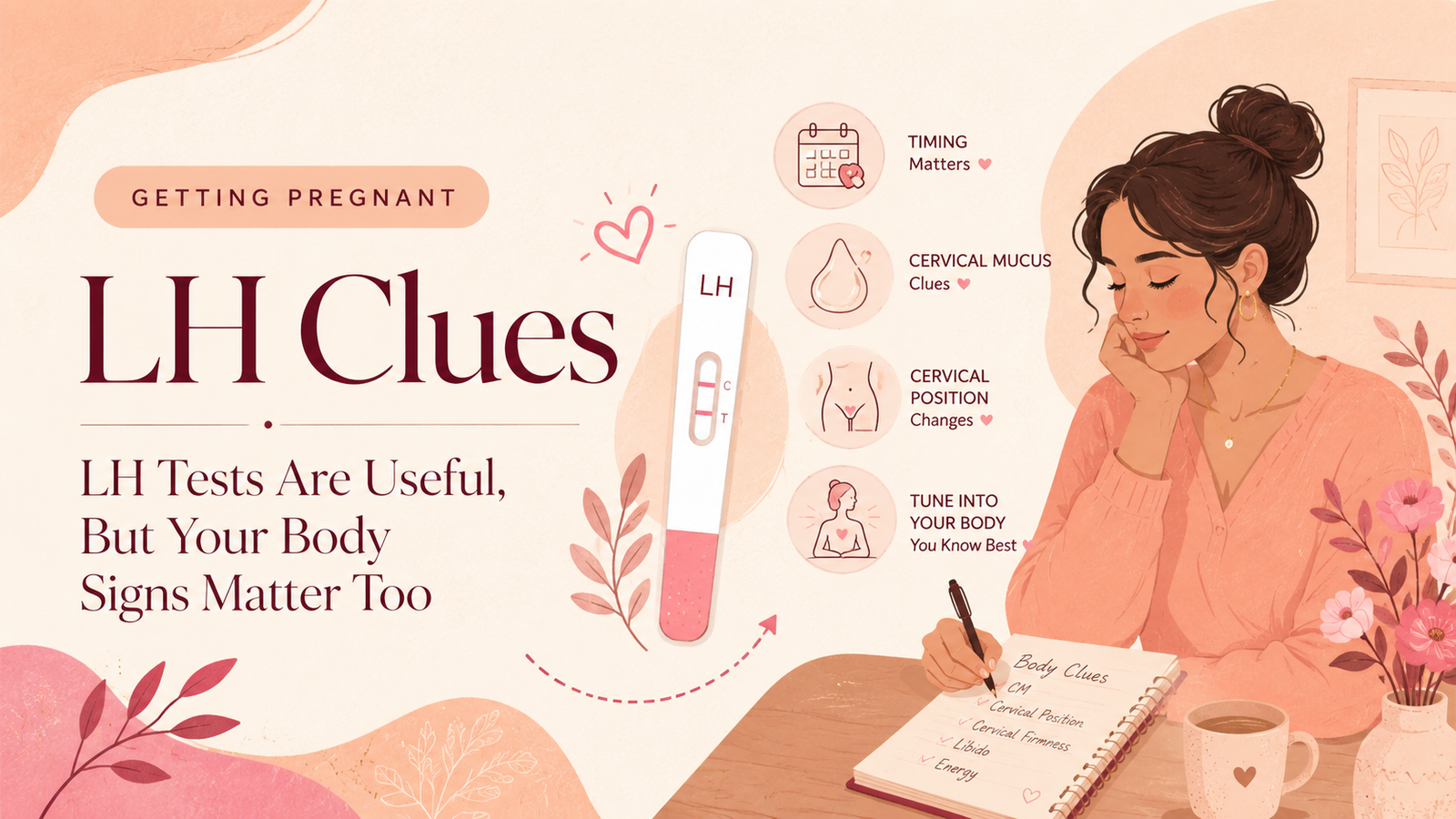
LH Tests Are Useful, But Your Body Signs Matter Too
LH tests can predict a hormone surge, but body signs make ovulation tracking clearer. Learn how LH, cervical mucus, timing, and BBT fit together.
If you want a private place to log what you notice across cycles, Flow & Glow can help you track the pattern without turning it into a panic spiral.
What an LH Test Actually Measures
LH stands for luteinizing hormone. It rises sharply in the middle of your cycle and signals your ovary to release a mature egg. An ovulation test strip detects that hormone in your urine. When the test line is as dark as or darker than the control line, the strip reads as positive, which means LH has surged.
The surge is a trigger, not the event itself. Ovulation typically follows somewhere between 12 and 36 hours after the strip first turns positive, although the exact gap varies between people and even between cycles for the same person. So a positive strip is really saying, your body has decided to try to ovulate soon. It is not saying, an egg has been released. That distinction is small in words and huge in practice.
LH also exists in your body at low levels all month. It is the spike, not the presence, that matters. Different brands of strips have different sensitivity thresholds, which is one reason two strips taken minutes apart can look slightly different. Strip color also fades as the test dries, so the read in the first ten minutes is the one that counts.
There is a second hormone worth naming here. Estrogen rises before LH and helps prepare the egg and the cervix. Some digital tests track both estrogen and LH and call the estrogen rise a high reading and the LH surge a peak reading. That is useful context if you are using a more advanced kit, but the core idea is the same. Estrogen warms up. LH peaks. Ovulation usually follows.
What a Positive LH Test Confirms (and What It Does Not)
A positive LH test confirms one thing: your LH level crossed a threshold at the moment you tested. That is meaningful, but it is narrower than people often assume.
A positive strip does not confirm that:
- An egg was actually released. Some cycles produce an LH surge without ovulation. These are called anovulatory cycles, and they are more common than most people realize, especially in the years after starting periods, after stopping hormonal birth control, around perimenopause, and in conditions like PCOS.
- Pregnancy is possible only on the day of the positive. Sperm can survive in fertile cervical fluid for up to about five days. The sex you had two or three days before your strip turned positive may matter more than the sex you have the night of the peak.
- Your cycle will repeat the same way next month. LH timing shifts with stress, sleep, illness, weight changes, travel, and ordinary monthly variation.
- A negative the next day means the window closed. The fertile window starts before the surge and stays open for a short stretch after.
There is also the opposite problem. Some people ovulate without ever catching a clear positive on a strip, either because they tested at the wrong hour, missed a short surge, or have low baseline LH levels. A negative strip is not proof that ovulation did not happen. That is where the body itself becomes the more reliable reporter.
The Body Signs That Fill in the Story
This is where strips alone start to fail and your own observation starts to win. None of these signs is perfect, and not everyone gets all of them clearly. The point is that two or three signs lined up together are more trustworthy than any single line on a test.
For a broader walkthrough of the full picture, this guide to ovulation signs goes deeper on each one. The shorter version is below.
Cervical Mucus Changes
Cervical mucus is the body sign that tracks fertility in close to real time. Right after your period, mucus is usually scant and dry. As estrogen climbs, mucus increases and turns creamy or lotiony. As you approach ovulation, it shifts again into a clear, slippery, stretchy texture that often gets compared to raw egg white. That stretchy fluid is the signal that the cervix is open for business, because that texture lets sperm survive and move.
You can check mucus by noting how your underwear feels through the day, by wiping with toilet paper before you pee, or by gently checking with a clean finger. The most fertile pattern is two or more days of clear, stretchy fluid, with the last day of that pattern often being the most fertile. If you want a focused read on the egg white phase, this short read on egg white discharge lays out what is normal, what is not, and how to track it without guesswork.
After ovulation, progesterone rises and dries mucus out again. That sudden shift from slippery to sticky or dry is itself a quiet sign that ovulation has likely come and gone.
Basal Body Temperature
Basal body temperature, or BBT, is your temperature when your body is fully at rest. After ovulation, progesterone causes a small but consistent rise, usually around 0.2 to 0.5 degrees Celsius or 0.4 to 1 degree Fahrenheit. This rise stays up until your next period begins, or in the case of pregnancy, stays elevated longer.
BBT does not predict ovulation. It confirms it after the fact, which is its limit and its honesty. To make BBT useful, you need a basal thermometer that reads to two decimal places, a consistent time of measurement first thing in the morning before you sit up or speak, and at least three to four hours of sleep before measuring. Travel, alcohol, illness, and a poor night of sleep will all throw the reading off.
BBT is best paired with another sign, not used alone. It is also more useful in cycles you analyze in retrospect than in the moment you are trying to time sex.
Cervical Position and Feel
This sign takes practice and is optional, not essential. The cervix sits inside the vagina and changes through the cycle. Around ovulation, the cervix tends to feel higher, softer, more open, and slightly wetter. The shorthand for fertile is sometimes high, soft, open, wet. After ovulation, it usually drops lower, feels firmer, and closes.
You check it with a clean finger, ideally at the same time each day and in the same position. If this sign feels invasive, skip it. The other signs will carry you fine.
Mid-Cycle Cramps or Ovulation Pain
Some people feel a one-sided, low pelvic twinge or ache around ovulation. It can last minutes or up to a day or two. It is often felt on the side that is ovulating that month and can switch sides cycle to cycle. Light spotting can sometimes happen at the same time.
This is a useful but rough signal, because not everyone gets it, and similar discomfort can come from other things. If you do get it and it lines up with a positive strip and slippery mucus, treat it as a reasonable confirmation. If pain is sharp, severe, comes with fever or fainting, or feels very different from your usual pattern, that is not a tracking signal anymore. That deserves a medical conversation.
Libido, Mood, and Energy Shifts
Many people notice a clearer pull toward sex in the days right before ovulation. Mood often lifts, energy steadies, skin can look better, and you may feel a little more outgoing. These are not random. Estrogen and small testosterone changes drive them.
These shifts are subtle and easy to attribute to other things. They are most useful when you start noticing them in your own pattern over two or three cycles. Combined with mucus, they make a strong informal read.
Breast Tenderness and Bloating
After ovulation, progesterone can cause breast tenderness, mild bloating, and a slightly heavier feeling in the lower belly. This is more of a post-ovulation marker than a fertile-window signal. It tells you the second half of your cycle is underway, which can help you confirm that ovulation likely happened that month.
How LH Tests and Body Signs Work Together
The strongest read on a fertile window is rarely one signal. It is several signals saying the same thing within a couple of days of each other.
A high-confidence picture usually looks like this. Mucus has shifted to clear and stretchy for at least a day. The LH strip has turned positive. You notice a mid-cycle twinge or a libido bump. A day or two later, mucus dries up and your basal temperature begins to climb and stay up. Together, that pattern is a solid read that ovulation happened in roughly that window.
A confusing picture might look like this. LH strips show a positive, but mucus never reaches egg white quality. Or mucus is clear and slippery for several days, but the strip never turns clearly positive. In those cases, the safer move is to act on the body signs as if you are in your fertile window, because mucus quality is the better real-time indicator of whether the cervix is welcoming sperm.
In other words, strips raise a hand and say, surge coming. Mucus opens the door. Temperature later confirms whether anyone walked through. You want all three voices in the room, even if one is louder some months than others.
A Realistic Tracking Plan You Can Actually Stick To
You do not need to track every sign every day. A sustainable plan beats a perfect plan you abandon in three weeks. Here is a baseline that works for most cycles.
Start by knowing the rough length of your cycle. Count from the first day of one period to the first day of the next. If your cycles are reasonably regular, ovulation usually falls somewhere in the middle, but predictions are estimates, not promises.
Track at least two body signs daily. The two highest-yield signs are cervical mucus and one of the following: BBT, ovulation pain, or libido and mood. Mucus is non-negotiable in this plan, because it is the only sign that tells you in real time whether the fertile window is open.
Use LH strips strategically, not daily all month. A common approach is to begin testing about three to five days before your estimated ovulation day and continue until you get a clear positive followed by a clear negative. Test in the early afternoon if you can, with reduced fluid intake for a couple of hours beforehand. Morning urine is often too dilute or, paradoxically, too concentrated to catch a clean surge for LH specifically.
Log everything in one place. A scattered system invites doubt. A single timeline lets you see how strips, mucus, and other signs cluster together across a cycle. After two or three cycles, your own pattern starts to teach you more than any general guide can.
Do not retest a positive strip ten times. Once a clear positive shows up, your action plan is the same whether you confirm it three more times or not. Save the strips, save the worry, and use the day instead.
When LH Strips Get Confusing
LH strips fail more often than the packaging implies, and how they fail is patterned. Knowing the patterns saves you from a month of self-doubt.
Cycles With PCOS
In polycystic ovary syndrome, baseline LH levels can run higher than average and can pulse irregularly. That means strips can show repeated positives or near-positives across the month without ovulation following. If you have PCOS or suspect you do, strips are less reliable than mucus, BBT, and clinical evaluation. They are not useless, but you cannot trust a positive on its own.
Coming Off Birth Control
After stopping hormonal birth control, it can take weeks or months for cycles to settle. The first few post-pill cycles may have unclear surges, light periods, or shifted timing. Strips during this period often look messy. Give your body a few cycles before drawing conclusions, and lean on mucus and how your body feels rather than chasing a clean strip pattern.
Shift Work, Travel, and Sleep Disruption
LH is influenced by your circadian rhythm. Night shifts, jet lag, and broken sleep can flatten or shift the surge. Test at consistent times when you can, and pay extra attention to mucus during disrupted weeks.
Reading Faint Lines
A faint test line is not a positive. Ovulation strips require the test line to be as dark as or darker than the control line. Gradually darkening lines across a few days suggest that your surge is approaching. Light lines that never reach the control line do not count as a confirmed surge. If you find yourself squinting at the strip in different lights, you are not getting more information, you are getting more anxiety.
Timing Sex Without Turning It Into a Job
The biggest mistake people make with ovulation tracking is treating it like a single bullseye on a target. The fertile window is wider than ovulation day, and the most fertile days are usually the two or three days before ovulation, plus ovulation day itself. Sperm can wait. Eggs do not wait long.
A widely supported plan for most couples trying to conceive is having sex every one to two days through your fertile window. That spacing keeps fresh sperm available without exhausting either of you. If timing every other day across a five day stretch feels too clinical, the gentler version is to make sure you have at least three encounters across your fertile window, including the day before and the day of the LH peak.
For a deeper look at why frequency matters more than precision, this guide to how often to have sex when trying to conceive walks through how to think about cadence without sex becoming a chore. The honest answer is that pleasure and presence still matter, even when there is a goal in the room.
Also remember: the fertile window is not just ovulation day. Sex earlier in the window is often more productive than sex on the exact peak. This piece on the fertile window explains why the few days before ovulation often do more heavy lifting than ovulation day itself.
What This Looks Like Across a Full Cycle
Here is a rough sketch of how a tracked cycle might unfold for someone with an average 28 day cycle. Real cycles are messier, but the shape gives you something to anchor to.
Days 1 to 5 are your period. No strips needed. You can still log flow, cramps, mood, and energy if it helps you see your own pattern over time.
Days 6 to 9 are usually drier with little mucus and low fertility. Save your strips. Note any mucus changes if you see them.
Days 10 to 12 are when many people start to see creamy mucus shift toward clearer, wetter fluid. This is a reasonable time to start LH testing in the early afternoon. Notice libido and energy here too.
Days 13 to 15 often hold the fertile window. Mucus may peak in egg white quality. LH may surge. Some people feel a one-sided twinge. This is when frequency of sex matters most.
Days 16 to 18 typically show mucus drying back up. BBT, if you track it, starts rising and stays elevated. This is the quiet confirmation that ovulation likely happened.
Days 19 to 28 are the luteal phase. Strips are not useful here. You may notice breast tenderness, mild bloating, or shifts in mood. If your next period arrives roughly on schedule, the cycle was likely ovulatory.
If your cycle is longer or shorter than 28 days, the same shape applies, just stretched or compressed. Tracking across two or three cycles will show you your version of this map.
When to Stop DIY Tracking and Talk to a Clinician
Tracking is a powerful tool, but it has limits. Some patterns deserve a professional, not another strip.
Consider booking an appointment if:
- You have been having well-timed, unprotected sex for 12 months under age 35, or 6 months at age 35 or older, without pregnancy.
- Your cycles are consistently shorter than 21 days or longer than 35 days.
- You bleed very heavily, soak through pads or tampons faster than once an hour, pass large clots, or experience fainting or breathlessness with your period.
- Your periods come with pain that interferes with school, work, or daily life, especially if pain has gotten worse over time.
- You have severe pain, fever, foul-smelling discharge, or pain during sex that is new or worsening.
- You suspect pregnancy and have any pain, bleeding, dizziness, or shoulder pain. This is especially important to take seriously.
- You have a known condition like PCOS, endometriosis, thyroid disease, or a history of pelvic surgery, and you want a clearer plan.
- You are postpartum and your cycles are not returning, or you are bleeding in patterns that feel off.
Self-tracking and clinical care are not in competition. The data you gather, including mucus patterns, cycle length, and how strips behave, can make a clinical visit far more productive. Bring your notes.
Putting It Together
LH strips are useful. They are not the whole truth. They tell you when a hormone moved. They cannot tell you what your body did with that hormone, whether the cervix is open, whether the timing of sex was right, or whether the cycle will produce an egg at all.
Your body has been quietly broadcasting fertility information your whole life. Mucus that turns clear and stretchy. A small bump in libido. A faint mid-cycle twinge. A steady rise in basal temperature after ovulation. None of those signs are dramatic. Together, they are louder than any test strip.
The goal of tracking is not to control your cycle. It is to know it well enough that you can make calm, informed choices about timing, conception, or simply understanding your own rhythm. Strips are one voice. Your body is another. Listen to both, write things down, and stop letting a single faint line decide your entire week.
If you want a quieter, more honest read on your cycle, pair the strips you already use with two body signs you trust, log them in one place, and watch the pattern teach you over a few months. That is what good tracking actually looks like.
Article information
- Written by Emma Hart, MS in Science Writing
- Medically reviewed by Dr. Jennifer Martinez, MD, FACOG
- Published on June 9, 2026
- Updated on October 7, 2026
Key takeaways
- An LH test detects a surge in luteinizing hormone that usually triggers ovulation within roughly 12 to 36 hours.
- A positive strip suggests ovulation is likely coming. It does not prove an egg was actually released.
- Cervical mucus that turns clear, slippery, and stretchy is one of the most reliable real-time fertility signs.
- A small, sustained rise in basal body temperature after ovulation can confirm that ovulation likely happened, but only in retrospect.
- The fertile window is wider than ovulation day. Sex in the few days before ovulation matters more than chasing the exact peak.
- LH strips can mislead in PCOS, post-pill cycles, shift work, illness, and stress, which is why body signs are not optional.
- Tracking should fit your life. Two body signs plus strategic strip use is plenty for most cycles.
Frequently asked questions
Does a positive LH test mean I ovulated?
Not exactly. A positive strip means your LH level crossed a threshold at the moment you tested, which usually triggers ovulation within roughly 12 to 36 hours. It does not prove that an egg was released. Some cycles surge without ovulation. The clearest confirmation that ovulation actually happened is a small, sustained rise in basal body temperature in the days after the positive, paired with a shift from slippery to dry mucus.
Should I keep having sex after a positive ovulation test?
Yes, having sex the day of and the day after a positive strip is a good idea, but the days before the positive often matter even more. Sperm can survive in fertile cervical fluid for up to about five days, so sex every one to two days through the fertile window gives you the strongest chance. Do not save up for the peak. Spread it across the window.
Can I rely only on cervical mucus instead of LH strips?
For many people, yes. Cervical mucus is the most reliable real-time fertility sign, because it directly reflects whether the cervix is open and welcoming sperm. Strips add useful confirmation, especially if your mucus patterns are unclear, but if strips stress you out and your mucus pattern is clear, focusing on mucus and a second sign like BBT or libido can be enough.
How many days before ovulation does LH start to rise?
LH typically begins climbing 1 to 2 days before ovulation, with a clear peak usually 12 to 36 hours before the egg releases. Some people have a fast, sharp surge that lasts only a few hours, while others have a slower climb across a day or two. This is one reason testing twice a day around your expected window catches the surge more reliably than testing once.
Why are my LH tests always positive?
Persistently positive or near-positive strips often point to conditions where baseline LH is naturally higher, such as PCOS. They can also happen if you test very close to a previous surge, if you are perimenopausal, or if you are using a very sensitive brand. If strips consistently look positive and your cycles are irregular or absent, that is a good reason to talk to a clinician rather than buy more strips.
Can stress or illness delay an LH surge?
Yes. Major stress, illness, fever, intense exercise changes, sudden weight changes, travel across time zones, and disrupted sleep can all delay ovulation in a given cycle. A delayed LH surge usually means a delayed ovulation, not a missed one. Keep tracking through the cycle rather than assuming the window closed, and watch mucus closely for the real-time signal.
What time of day should I take an LH test?
Early afternoon is often the most reliable window, roughly between noon and 6 p.m., with reduced fluid intake for an hour or two beforehand. Morning urine is sometimes too dilute or too concentrated to give a clean read. Some people test twice a day, once in the early afternoon and once in the early evening, around the days they expect to surge. Follow the instructions on your specific brand for the cleanest result.
References
- American College of Obstetricians and Gynecologists. (n.d.). Fertility awareness-based methods of family planning Source
- American Society for Reproductive Medicine. (2022). Optimizing natural fertility: A committee opinion Source
- Cleveland Clinic. (n.d.). Ovulation Source
- National Health Service. (n.d.). How can I tell when I am ovulating? Source
- Office on Women's Health. (n.d.). Trying to conceive Source
- Wilcox, A. J., Weinberg, C. R., & Baird, D. D. (1995). Timing of sexual intercourse in relation to ovulation. New England Journal of Medicine, 333(23), 1517-1521 Source
Editorial and medical disclaimer
Flow & Glow health content is educational and is not a substitute for diagnosis, treatment, or personal medical advice from a qualified clinician.
Our editorial standards, reviewer process, sourcing approach, and correction process are explained in the Editorial Policy. You can also review our authors and medical reviewers, healthcare professional information, contact page, and privacy policy.