How Often to Have Sex When Trying to Conceive
Sex frequency trying conceive: wondering how often to have sex when trying to conceive? Learn the science of fertile windows, timing, and frequency to support your...
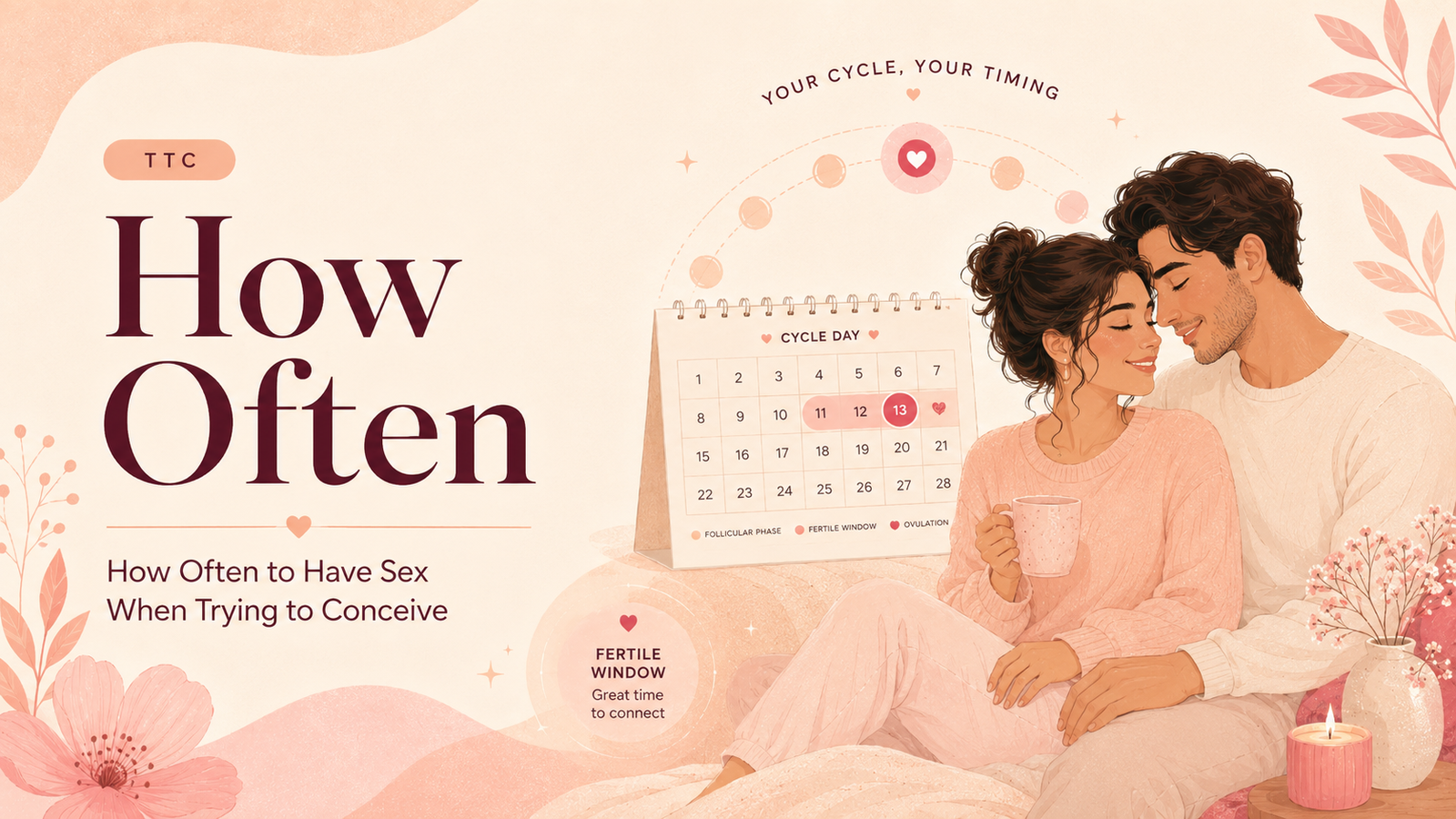
When someone asks how often to have sex when trying to conceive, the truthful answer is shorter than most articles let on. You do not need to count every act, set alarms, or treat your relationship like a fertility lab. What matters is that sperm is present in the reproductive tract during the days when an egg is most likely to be released, and that you are giving yourself enough cycles to actually conceive rather than judging the project on one or two months.
The honest answer to how often
A reasonable rhythm for most people is sex every one to two days during the fertile window, and a comfortable, less frequent pace outside it. Some people prefer daily sex during the window. That is also fine if it works for both partners and does not strain the relationship. Some people prefer every other day across the entire cycle. That works too, because it covers the window automatically without any tracking at all.
The biggest mistake is not frequency. It is missing the window entirely because of work travel, conflict, exhaustion, or trying to wait for the exact ovulation day. The next biggest mistake is letting timing pressure damage the part of your life that brought you here in the first place. The plan that you can actually live with over six months is better than the perfect plan you abandon after three.
What the fertile window actually is
Your ovary releases an egg roughly once per cycle. That egg can be fertilized for about twelve to twenty four hours after it is released. Sperm, by contrast, can live in fertile cervical mucus for up to about five days. That mismatch is the whole reason the fertile window stretches several days before ovulation, even though the egg itself is only viable for a single day.
Counting backwards, the fertile window covers about six days. Five days before ovulation, the day of ovulation, and the hours in between. The day before ovulation and the day of ovulation tend to have the highest probability per act of intercourse, but every day inside that window has a real chance.
If you want a clearer walkthrough of how that timing breaks down across a typical cycle, read the fertile window explainer. It maps the window for short, average, and long cycles and explains how to estimate your own window without obsessing over a single day.
A practical implication is that you do not need to wait for a positive ovulation predictor strip or perfect mucus to start having sex. Frequency in the days leading up to ovulation is what fills the tract with sperm so that when an egg arrives, it has somewhere to go. Waiting for the picture perfect day often means having sex too late.
Every day, every other day, or whenever
There are three reasonable approaches to TTC sex frequency. Pick the one that fits your life and your nervous system, not the one that sounds the most optimized on paper.
Every other day across the whole cycle
This is the lowest stress approach. You do not track anything, you do not schedule peaks, you just have sex every other day for the whole cycle or at least the second half of the follicular phase through ovulation. This pattern reliably covers the fertile window without any work and is associated with very strong per cycle pregnancy rates in healthy couples under 35.
The downsides are limited. You may have more sex than you would choose otherwise, which can be a benefit or a drag depending on the relationship. You also might miss the exact peak day if your cycle is unusual, but that almost never matters across a normal three to six month TTC horizon. If you do not like calendars and tests, this is the most humane plan.
Every one to two days inside the fertile window
This is the middle path and the most common clinical recommendation. You estimate your window using cycle length, discharge, or LH testing, then aim for sex every day or every other day across that window, with normal frequency outside it. It balances coverage and reasonable effort, and it gives you breaks during weeks when conception is biologically impossible anyway.
This pattern works well for people whose cycles are roughly regular. If you do not yet know your cycle length, or your cycles are erratic, this approach can get stressful because you are constantly recalculating when the window starts. In that case, the every other day pattern across the whole cycle is friendlier and just as effective.
Daily during the fertile window
Daily sex during the fertile window is fine. It does not meaningfully harm sperm count in most people, and it gives every possible day a chance. The downside is fatigue, especially if either partner already feels pressure. If daily sex feels good for both of you, do it. If it feels like a chore by day three, drop back to every other day. The data does not require daily, and forcing it past your comfort tends to backfire.
There is no extra credit for hitting daily sex when every other day already covers the window. The goal is consistent coverage across cycles, not a perfect score within one.
The sperm meets egg plan, explained without dogma
There is a popular TTC schedule called the sperm meets egg plan. It blends every other day sex earlier in the cycle with daily sex around expected ovulation, then tapers off. People like it because it gives a clear structure without requiring daily sex for the entire month.
A typical version starts every other day around day eight of the cycle, switches to daily sex when an LH surge or fertile mucus appears, and continues daily for two to three days after the surge, then stops or returns to normal. The idea is that you fill the tract with sperm before the egg arrives and then keep refreshing it for a couple of days through likely ovulation.
The honest read on this plan is that it is reasonable for some couples and overwhelming for others. It tends to help when you have a fairly clear cycle pattern and a partner who is happy with structured sex during a defined window. It tends to backfire when it turns the bedroom into a calendar, especially after several cycles without conception. Use it as a useful template, not a rule that must be followed exactly. If you and your partner enjoy a structured plan, lean in. If you start to dread day fifteen, drop the schedule and shift to every other day with no labels.
A practical note. The plan only works if you actually know roughly when ovulation happens. If your cycles are unpredictable, build a basic baseline first with a couple of months of cycle tracking before trying to layer on a strict frequency plan.
Reading your body so you do not chase a single day
If you do not want to track at all, every other day across the whole cycle is enough. If you want to be smarter about timing without becoming obsessive, your body gives you signals well before any test does.
Cervical mucus changes through the cycle. After your period, mucus tends to be minimal or sticky. As estrogen rises before ovulation, it becomes wetter, stretchier, and more transparent. The clearest pre ovulatory sign for many people is egg white discharge, which looks like raw egg white and stretches between fingers without breaking easily. When you see that, you are very likely in the most fertile part of your window.
Other body signs include a small dip in temperature followed by a sustained rise after ovulation, mild one sided pelvic twinges sometimes called mittelschmerz, a slight increase in breast tenderness, and rising libido in the days leading up to ovulation. None of these are perfect markers on their own. Together, they can confirm what your cycle math is already telling you.
The point is not to ovulate flawlessly. The point is to notice the window opening so you can prioritize sex in those days instead of in the wrong week. If you only learn one body sign, learn mucus. It is free, it is private, and it is one of the earliest signals you have.
LH tests, predictor kits, and confirming the window
Ovulation predictor kits measure luteinizing hormone in urine. LH surges roughly twelve to thirty six hours before ovulation, which is why a positive test is one of the most useful practical signals to start the most fertile days of intercourse.
Using LH well usually means testing daily once you are within a few days of expected ovulation, then having sex on the day of the positive test, the next day, and ideally one more day after that. Some people pair LH with discharge and basal body temperature for higher confidence across the cycle. For a structured rundown of how to combine tests with body signs, see LH tests and body signs.
A few honest cautions. LH tests can show false positives in people with PCOS or naturally high LH baselines. Tests can be missed if you only check once per day and your surge is short. And a positive LH does not guarantee that an egg actually released. Most people ovulate after a true surge, but not in every cycle. If you are not seeing any positive LH after months of testing, that itself is useful information to bring to a clinician rather than a personal failing.
The smart use of LH is as a confirming signal, not a religion. You do not need a kit to conceive. Plenty of people get pregnant without ever using one. You just need to be near the window often enough.
The private tracker that keeps the pressure off
Once a couple has been trying for more than a few months, what often hurts most is not the timing. It is the way TTC can colonize every conversation, every cycle, and every disappointment. The bedroom turns into a project. Sex becomes a test. Hope becomes a thing you ration.
A private tracker that lives quietly on your phone, not on your fridge, gives you a place to keep cycle length, ovulation signs, intercourse days, mood, and notes without putting all of it in your partner's face. The free Flow & Glow app is built to be that quiet companion. It does the math, predicts the window, remembers your patterns, and lets you log discharge, LH results, and how you feel without performing any of it. Your partner does not need to see your spreadsheet, and you do not need to bring up day fourteen at dinner every month.
This matters more than people admit. The data is yours. The conversations you choose to have about it are also yours. Keeping those separate from the act of having sex tends to make both healthier. A tracker should help you protect intimacy, not replace it.
Protecting intimacy when frequency becomes pressure
Here is something most TTC guides skip. Frequency advice does not work if it kills your sex life. If sex starts feeling like an audit, the entire plan unravels and the calendar wins.
A few practical ways to keep intimacy alive while you are trying:
Decouple sex from outcomes. Most acts of intercourse during the fertile window do not result in conception, even in fully fertile couples. That is normal cycle to cycle math. Do not treat each negative test as evidence that something is wrong. Aim for consistency across cycles, not perfection within one.
Have non TTC sex too. Sex outside the window keeps intimacy from being purely instrumental. It also keeps both partners regulated and connected, which makes window sex easier when it matters. The cycles where you only have sex during the window can quietly teach your body and your relationship that intimacy is an obligation, not a connection.
Skip a day if you need to. Missing one act inside the window does not ruin the cycle. If one of you is exhausted, sick, or wrung out emotionally, take the night. Have sex the next day instead. Resentful sex is worse than skipped sex.
Take the running count out of the conversation. If you are tracking, do it for yourself. Share what is useful for planning, not the score. Saying I think this week is a good time is fine. Saying we have to have sex tonight because the app says so is the fastest way to sour an evening. Most people respond better to invitation than to scheduling.
Move when the room gets heavy. If TTC has been heavy lately, change the setting. Travel, get back to date nights, swap routines. The bedroom can get associated with anxiety quickly, and a small change in context can reset it.
Name the pressure out loud. If one of you is starting to dread fertile week, say it kindly. Most partners would rather know than feel a slow chill. A short, honest conversation is almost always lighter than weeks of silent strain.
When timing gets harder than the textbooks suggest
Plenty of cycles are not textbook. If yours fall into any of the categories below, the basic frequency advice still applies, but the way you read your window will look different.
Irregular cycles. If your cycle length varies by more than a week, the every other day approach across the whole cycle is the simplest plan. You do not have to guess the window. You just cover it.
Long cycles. If your cycles are forty plus days, ovulation tends to be later than the classic day fourteen. Track LH and discharge more closely or shift your window expectations. Every other day still covers it without math.
Short cycles. If your cycles are twenty one to twenty five days, ovulation can be early. Some people ovulate around day eight or nine. Start watching for fertile mucus a few days after your period ends, and consider starting LH testing earlier than the kit instructions suggest.
Cycles after coming off hormonal birth control. The first cycle or two off the pill, ring, patch, or implant can be unpredictable. Most people return to a normal pattern within a few months. Use every other day sex as a default while you wait for your rhythm to settle.
Recent miscarriage or pregnancy loss. Cycles can take time to return to baseline. Be gentle with yourself about timing pressure, and ask your clinician what is reasonable for you. Many people are encouraged to try again as soon as they feel ready, but the answer should come from someone who knows your history.
Chronic conditions like PCOS, thyroid issues, or endometriosis. Cycle variability and ovulation patterns can be different. Lean on a clinician for a personalized plan rather than guessing. General TTC advice still applies, but you may benefit from earlier monitoring.
Known male factor concerns. If a partner has had a prior semen analysis showing low count or low motility, your clinician may give specific guidance about timing between ejaculations. Do not assume daily is best in that case. Get the guidance and follow it.
When to talk to a clinician
The general rule is to seek a fertility workup after one full year of well timed intercourse without conception if you are under 35, or six months if you are 35 or older. There are reasons to go in sooner.
Talk to a clinician earlier if you have very irregular or absent cycles, known reproductive conditions, a history of pelvic surgery, two or more pregnancy losses, severe pelvic pain, painful periods that disrupt daily life, suspected endometriosis, or known male factor concerns.
Seek care promptly for severe pelvic pain, heavy bleeding outside your period, fever, foul vaginal odor, dizziness, signs of infection, possible STI exposure, signs of early pregnancy paired with severe abdominal pain, or anything that feels off and persistent. These are not TTC timing issues. They are health issues that deserve a real look.
Going in earlier does not mean something is wrong. It means you get answers and options faster. A basic workup is usually a hormone panel, an ovulation check, a semen analysis for the partner, and an imaging study of the uterus and tubes. Most people are reassured by the results. Some find a fixable issue. Either way, you are not waiting alone, and you have not failed by asking.
A simple plan you can actually follow
If you want one paragraph to keep in your head, here it is. Have sex every one to two days during the rough window of the five days before and the day of expected ovulation. If you do not want to track at all, have sex every other day across the whole cycle. Use cervical mucus and LH tests as helpful confirmations, not as instructions you must obey. Protect intimacy. Skip a day when you need to. Track quietly. Give it three to six cycles before you grade yourself, and a full year before you treat it as a fertility question, or six months if you are 35 or older.
That plan is boring on purpose. The reason most people do not conceive in any given month is not strategy. It is biology and time. Your job is to stay near the window often enough to give biology a fair chance, and to keep your life intact while you do.
Article information
- Written by Emma Hart, MS in Science Writing
- Medically reviewed by Dr. Alicia Williams, PhD, LMFT, CST
- Last medically reviewed on May 24, 2026
- Published on May 24, 2026
- Updated on September 24, 2026
Key takeaways
- The fertile window is about six days long, ending on the day of ovulation, with the day before ovulation usually carrying the highest per act probability.
- Having sex every one to two days during the fertile window is enough for most healthy couples; daily sex in that window is also fine if both partners are into it.
- Skipping the window matters far more than skipping a single day inside it.
- Sperm can survive in fertile cervical mucus for up to about five days, which is why sex a few days before ovulation can still result in pregnancy.
- Tracking cycle length, cervical mucus, and LH surges gives you a clearer window without daily anxiety.
- Stress, pressure, and calendar style sex can hurt intimacy and motivation, so protecting your relationship is part of the plan, not separate from it.
- See a clinician for severe pelvic pain, very irregular or absent cycles, fever, foul odor, heavy bleeding, dizziness, possible infection or STI exposure, or if pregnancy is not happening after a full year of trying, or six months if you are over 35.
Frequently asked questions
How often should I have sex when trying to conceive?
Aim for sex every one to two days during your fertile window, which is roughly the five days before ovulation and the day of ovulation itself. If you do not want to track, sex every other day across the whole cycle covers the window without any math. Daily sex during the window is also fine if it suits both of you. The goal is consistency across cycles, not perfect timing inside one.
Does daily sex lower sperm count?
For most healthy men, daily sex during the fertile window does not meaningfully reduce sperm count or fertility. Sperm production is continuous, and concentration stays in a useful range with daily ejaculation. If a known male factor is in play, your clinician may give different guidance based on a semen analysis. Without that, daily during the window is safe and effective.
Is every other day really as good as daily?
For practical purposes, yes. Comparisons of daily and every other day intercourse during the fertile window show very similar pregnancy rates in healthy couples. Every other day is easier to sustain emotionally and keeps both partners less fatigued. If daily feels good, do it. If it feels like a chore, drop back. Both schedules cover the window well, and neither is meaningfully better for most couples.
How do I know when my fertile window is?
Estimate it by tracking cycle length over a few months. The fertile window roughly ends on the day of ovulation, which is often around twelve to sixteen days before your next period starts. Pair that math with body signs like wet, stretchy cervical mucus, and confirm with LH tests if you want more confidence. The window opens about five days before ovulation and closes the day of ovulation.
What if I do not know when I ovulate?
Default to every other day sex across the whole follicular phase, from the end of your period until you expect ovulation, and add a few more days after that to be safe. Watch for cervical mucus changes and consider LH testing once you have a rough sense of your cycle length. If you cannot detect any pattern after several months of careful tracking, ask a clinician for help mapping it.
Can stress about timing reduce my chances?
Stress alone does not usually cause infertility, but it can disrupt cycles, libido, sleep, and intimacy in ways that make TTC harder. The bigger risk is that pressure makes you avoid sex in the window, fight with your partner, or quit too early. Keep the calendar private, protect intimacy, skip days when you need to, and try to judge the project across months rather than single cycles.
When should we see a doctor about not conceiving?
See a clinician after twelve months of well timed unprotected sex without conception if you are under 35, or six months if you are 35 or older. Go in sooner if you have irregular cycles, painful periods, known reproductive conditions, prior pelvic surgery, recurrent pregnancy loss, severe pelvic pain, or known male factor concerns. Earlier visits are not a sign of failure. They get you answers faster.
References
- American Society for Reproductive Medicine. Optimizing natural fertility: a committee opinion Source
- American College of Obstetricians and Gynecologists. Fertility awareness based methods of family planning Source
- Wilcox AJ, Weinberg CR, Baird DD. Timing of sexual intercourse in relation to ovulation Source
- NHS. Trying to get pregnant Source
- Mayo Clinic. How to get pregnant Source
- Stanford JB, White GL, Hatasaka H. Timing intercourse to achieve pregnancy Source
Editorial and medical disclaimer
Flow & Glow health content is educational and is not a substitute for diagnosis, treatment, or personal medical advice from a qualified clinician.
Our editorial standards, reviewer process, sourcing approach, and correction process are explained in the Editorial Policy. You can also review our authors and medical reviewers, healthcare professional information, contact page, and privacy policy.