The Sperm-Meets-Egg Plan: Does It Work?
SMEP is a structured TTC timing routine many couples follow online. Here is what it involves, what it cannot guarantee, a simpler version that covers the same window, and when to move to clinical care.
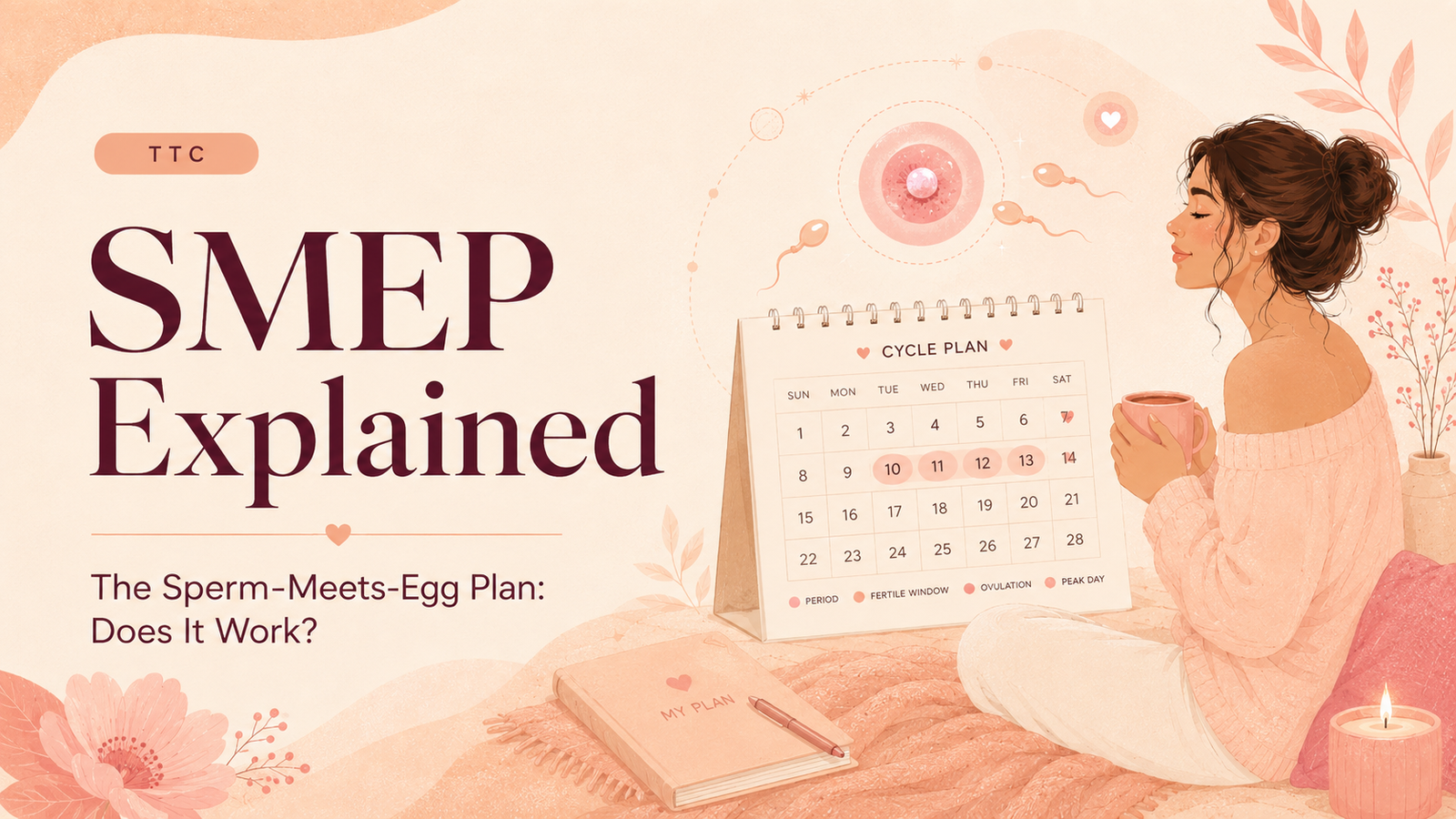
The sperm meets egg plan started in TTC forums and spread because it gave anxious couples something concrete to do. The standard version usually looks like this. Starting around cycle day 8, have sex every other day. Around cycle day 10, begin testing for the LH surge with ovulation tests. When a test turns positive, have sex that day, the next day, and the day after. Then take a single follow-up session about 48 hours after the last positive test, to cover any late ovulation. After that, rest.
What the Sperm-Meets-Egg Plan Actually Says
The plan exists because most people who are new to TTC are not sure when their fertile window opens, how long sperm survives, or whether ovulation has actually happened. The schedule answers all of those worries at once. By blanket-covering the days before, during, and just after a positive ovulation test, you almost cannot miss a typical fertile window in a 28 to 32 day cycle.
That is the strength of SMEP. It is also where the trouble starts.
You can install Flow & Glow and get most of the same fertile-window awareness without turning your calendar into a list of obligations. The point of any TTC tracker is to make your fertile days easier to see, not to add another thing to perform.
Why the Timing Logic Makes Sense
Sperm can live in fertile cervical fluid for several days. The egg itself only lives for around 12 to 24 hours after ovulation. So the days that give the highest chance of conception are the days before ovulation, when there are healthy sperm already waiting in the reproductive tract when the egg arrives.
This is the core of every credible TTC timing recommendation. The window of usefulness opens about five days before ovulation, climbs through the two days right before ovulation, peaks on the day before ovulation or ovulation day itself, and then drops sharply once the egg has been released.
SMEP works backwards from that biology. Every-other-day sex during the run-up keeps fresh sperm available. Daily sex around a positive ovulation test maximizes the chance that sperm are present when the egg arrives. The 48-hour follow-up handles the cases where ovulation happens slightly later than the surge suggests.
So in a sense, SMEP is a clever way to cover all the bases without needing a perfect read on your cycle. It is timing insurance, written for people who are not sure where ovulation will land.
For more on how that window actually works, see this breakdown of the fertile window.
What the Evidence Actually Shows
Here is the honest part. No high-quality study has tested the sperm meets egg plan as a branded protocol against other timed-intercourse approaches. There is no randomized trial that says SMEP beats sex every other day, or sex every day during the fertile window, or simply having sex regularly with no schedule at all.
What we do have is decades of fertility research on timing of sex and conception. The headline finding is consistent. Couples who have sex during the fertile window get pregnant at much higher rates than couples whose timing misses the window. Within the window, the per-cycle chance peaks in the two days before ovulation. Once ovulation passes, the chance drops sharply.
Studies that compare frequency strategies usually compare daily sex to every-other-day. Daily sex during the fertile window tends to produce a small advantage in per-cycle pregnancy rate compared with every other day, but the difference is modest, and both approaches do well. There is no good evidence that daily sex meaningfully hurts sperm quality in healthy people. There is also no evidence that you need a complicated schedule with switches and follow-ups to get a good outcome.
Translation. SMEP is not magic. It is one timing pattern among several reasonable ones. If it gives you peace of mind, that is a real benefit. If it makes you feel like you are constantly behind on a schedule, that is a real cost.
The Fertile Window Is the Real Target
If you strip SMEP back to its useful core, it is just a way to make sure you are covering the fertile window. The five days before ovulation plus ovulation day. That is where almost all natural conceptions happen.
So a simpler question replaces the plan. Are we getting sex into that window at least every one to two days?
If the answer is yes, you have done the part you can control. The biology of any specific cycle is mostly out of your hands. Whether ovulation happens slightly early or late, whether the egg is viable, whether implantation goes through, those are not things you can micromanage with a schedule.
Some people find that the fertile window approach is calmer because it asks for a small amount of awareness, not a strict regimen. You watch for signs that ovulation is approaching. You make sure you have sex within that window. You stop when the window closes. Then you live your life.
If you want to get sharper at noticing those signs, this guide can help: track ovulation.
What Counts as Enough Sex
Couples often ask whether they are doing too little, or too much. The research-backed answer is reassuring. Across most studies, having sex every one to two days during the fertile window covers the per-cycle chance well. Daily sex is fine if it works for you. Every other day is fine. What does not work is going more than a couple of days without sex during the window.
For more on frequency itself, here is a deeper read on how often to have sex when trying to conceive.
Notice that this is not the same as the SMEP recipe. The plan asks for very specific cycle days. The evidence asks for a general pattern across the fertile days. The pattern is what matters. The exact days are a personal choice based on what you can sustain.
Ovulation Tests, Read Honestly
SMEP leans heavily on ovulation predictor kits. These tests, sometimes called LH tests, detect a surge in luteinizing hormone that usually precedes ovulation by about 12 to 36 hours. A positive test is one of the better short-notice signals that ovulation is coming.
But there are some caveats worth knowing before you build your whole month around an LH stick.
First, LH tests detect a surge, not the act of ovulation. In some cycles the body has an LH rise without releasing an egg. This happens occasionally even in healthy cycles. So a positive test is a hint, not proof.
Second, the surge can be short or long. Some bodies have a sharp peak you can only catch by testing more than once a day. Others have a slow climb. A single positive test in a day is the standard rule of thumb, but it is not perfect.
Third, certain conditions affect baseline LH and can make tests harder to read. People with PCOS may have higher baseline LH and see frequent positives that are not true surges. People on certain hormonal medications may not see reliable signals at all.
Fourth, the timing of testing matters. Test in the same general window each day. Read at the same time after the test runs. Compare visually to the control line if you are using line tests. Use digital tests if line interpretation feels stressful.
Most importantly, an LH test is one signal. Cervical mucus, basal body temperature trends, and your own body cues all contribute to the bigger picture. Treating any single signal as a verdict tends to add anxiety without adding accuracy. For a broader look at body cues, see this guide on ovulation signs.
How to Run SMEP Without the Burnout
If you still want to try SMEP because the structure feels reassuring, here is how to soften it.
Start from the spirit of the plan, not the letter. The point is to cover the fertile window. That does not require any particular start date. If your cycles are usually 28 to 32 days, starting attentive timing around cycle day 8 to 10 is reasonable. If your cycles are usually 24 days, you would shift earlier. If your cycles are usually 35 days, you would shift later. A blanket calendar day rule will not fit every body.
Use the every-other-day frame as a floor, not a ceiling. If you naturally feel like having sex on an off day, that is fine. If you really need a rest day, take it. Skipping one off day will not undo the plan.
Treat LH tests as helpful, not authoritative. If you get a positive, take that as a strong cue to keep sex in the next two to three days. If you do not get a positive, do not assume you missed ovulation. Some cycles just do not surge in a way the strips catch well.
Drop the catch-up session if it adds dread. The 48-hour follow-up exists in case of late ovulation. It is fine to include or skip based on how the cycle has actually felt.
Build in real recovery. Pleasure, connection, and rest are not separate from TTC. A relationship that resents sex is a much bigger problem than a missed day.
Talk about it. Out loud. Many couples on SMEP discover that one partner is silently exhausted while the other is silently anxious. Naming what you are doing, why, and how you are feeling about it usually defuses a surprising amount.
When SMEP Tends to Help
The plan suits some people genuinely well. If you tend to procrastinate around fertile days, a written schedule can pull you toward the right behavior. If you and your partner like clear plans and checklists in other parts of life, treating TTC the same way may feel normal and even fun. If you have very regular cycles and you are early in your TTC journey, the calendar logic lines up cleanly with your real fertile window.
It can also help during the first two or three cycles of trying, when you are still learning your own body. Once you start to recognize your ovulation pattern, you can usually drop the strict version and keep the parts that work.
When SMEP Tends to Backfire
If sex starts to feel like homework, the plan is doing more harm than good. If one partner feels watched or graded, the resentment may cause you to skip the very days that matter. If your cycles are irregular, calendar-based start dates can be wrong by a week or more, and you can end up testing too late or wearing yourself out testing too early.
If you have a history of disordered eating, OCD-style tracking, or trauma around sex, the level of scheduling SMEP encourages can be triggering. There is no rule that says TTC has to look a specific way. A calmer approach is not lazy.
If you have been trying for longer than a year with regular cycles, or six months if you are over 35, the issue is unlikely to be a missed timing day. That is a moment for evaluation, not a more intense version of the same plan.
A Gentler Way to Plan
For most healthy couples, the recipe that works without burning anyone out is straightforward. Pay light attention to ovulation signals so you know when your fertile window opens. Have sex during the fertile window every one to two days, whatever feels natural and sustainable. Do not force a particular day. Do not turn a missed day into a crisis. Do not interpret a long cycle as a personal failure.
In practice, that looks like this. You notice the cervical mucus shifts that suggest fertility is rising. You glance at your tracker and see your predicted ovulation window. You have sex during the window without checking a list. You let the rest of the cycle be normal life.
A tracking app should help you do this with very little effort. Open it. See where you are in the cycle. Close it. Live your day. Anything that turns the app itself into a chore is working against the goal.
When to Seek Help
There is no perfect cutoff, but a few patterns are reasonable triggers to talk to a clinician.
You are under 35 and have been actively trying for 12 months with no pregnancy. You are 35 or older and have been actively trying for 6 months with no pregnancy. Your cycles are very irregular, very short, very long, or absent. You have severe period pain, very heavy bleeding, sudden changes in bleeding, or recurring unusual discharge. You have a known condition that can affect fertility, such as PCOS, endometriosis, thyroid disease, prior pelvic surgery, or a partner with a known sperm issue. You have had repeated pregnancy loss. You suspect a possible pregnancy and have severe one-sided pain, heavy bleeding, fainting, or shoulder-tip pain.
None of these are signs that something is definitely wrong. They are reasons to get a real picture rather than guessing.
Severe pain, heavy bleeding, sudden changes, repeated unusual discharge, intense mood symptoms, signs of infection, possible pregnancy with worrying symptoms, or a TTC timeline that fits the patterns above all warrant care from a qualified clinician rather than another month of self-managed timing.
The Honest Bottom Line
The sperm meets egg plan can work. So can sex every other day during the fertile window. So can sex every day during the fertile window. So can a relaxed pattern that simply makes sure you are not skipping the window. The thing all of these approaches share is fertile window coverage. The thing they do not share is required pressure.
Use the plan if it lowers your anxiety. Drop it if it raises it. Trust the biology, not the brand name. And let any tracking tool you use be the calm version of awareness, not the loud one.
Article information
- Written by Emma Hart, MS in Science Writing
- Medically reviewed by Dr. Jennifer Martinez, MD, FACOG
- Published on June 4, 2026
- Updated on September 24, 2026
Key takeaways
- SMEP is a community protocol, not a guideline from any medical body. The timing intuition is fine. The specific rules are not from a study.
- The fertile window is roughly the five days before ovulation plus ovulation day. The peak per-cycle chance sits in the two days before ovulation.
- Sex every one to two days during that window covers timing well for most couples.
- Ovulation tests usually catch the LH surge that arrives before ovulation, but they are signals, not perfect predictors.
- A plan that fuels stress, exhaustion, or shame around sex can quietly hurt your TTC experience more than a missed day ever could.
- Most healthy couples under 35 conceive within a year. Earlier evaluation is reasonable if cycles are very irregular or there are known fertility risks.
- A good tracking habit should make your fertile window feel obvious, not turn your relationship into a project plan.
Frequently asked questions
Is the sperm-meets-egg plan recommended by doctors?
No major medical body specifically recommends SMEP. Most clinical guidance focuses on having sex during the fertile window every one to two days. SMEP is a community-built schedule that happens to cover the fertile window, so it is not wrong, but it is not an official protocol.
How is SMEP different from just having sex every other day?
Plain every-other-day sex during the fertile window is the simpler version of the same idea. SMEP adds specific cycle days, mandatory daily sex once an ovulation test turns positive, and a follow-up session 48 hours later. The differences are small in terms of biology, but bigger in terms of structure and pressure.
Do I have to use ovulation tests for SMEP to work?
The standard version of SMEP relies on a positive ovulation test to trigger the daily phase. Without tests, you would lean more on cervical mucus changes, basal body temperature trends, and predicted ovulation dates from your tracker. Tests can help, but they are not required for good fertile-window coverage.
Can SMEP cause fertility problems if it does not work right away?
No. Following SMEP for a few cycles does not damage fertility. The reason couples sometimes feel worse after several months of SMEP is emotional, not physical. If sex starts to feel like a duty, that can affect frequency and intimacy in ways that quietly undermine the plan.
How long should I try SMEP before changing strategies?
If a particular plan is making you anxious, you can change strategies any cycle. If you are looking for a general rule, two to three cycles is a reasonable window to see whether SMEP feels sustainable. If it feels exhausting, switch to a simpler fertile-window pattern. If your overall TTC timeline reaches a year, or six months at 35 or older, that is a separate signal to seek evaluation.
Does SMEP work better for irregular cycles?
Not really. SMEP relies on calendar days that assume a fairly typical cycle length. If your cycles vary widely, calendar starts can be off and ovulation tests may be harder to time. People with irregular cycles often do better with a flexible approach focused on real-time signs rather than a fixed schedule.
Can stress from SMEP affect my chances of getting pregnant?
Acute everyday stress is unlikely to be the deciding factor in any single cycle. Chronic, heavy stress, sleep deprivation, or relationship distress can affect cycle regularity and intimacy over time, and that can affect timing. A plan that consistently raises your stress without obvious upside is working against you.
References
- American College of Obstetricians and Gynecologists. (2024). Fertility awareness-based methods of family planning Source
- American Society for Reproductive Medicine. (2022). Optimizing natural fertility: a committee opinion Source
- National Institute for Health and Care Excellence. (2017). Fertility problems: assessment and treatment Source
- NHS. (2023). How can I tell when I am ovulating? Source
- Office on Women's Health. (2024). Trying to conceive Source
- Wilcox, A. J., Weinberg, C. R., and Baird, D. D. (1995). Timing of sexual intercourse in relation to ovulation. New England Journal of Medicine Source
- Wilcox, A. J., Weinberg, C. R., and Baird, D. D. (1995). Timing of sexual intercourse in relation to ovulation. PubMed record Source
Editorial and medical disclaimer
Flow & Glow health content is educational and is not a substitute for diagnosis, treatment, or personal medical advice from a qualified clinician.
Our editorial standards, reviewer process, sourcing approach, and correction process are explained in the Editorial Policy. You can also review our authors and medical reviewers, healthcare professional information, contact page, and privacy policy.