Can Orgasms Help Period Cramps? What Women Want to Know
Orgasm period cramps relief can vary, but muscle relaxation, endorphins, comfort, and personal preference may all matter.
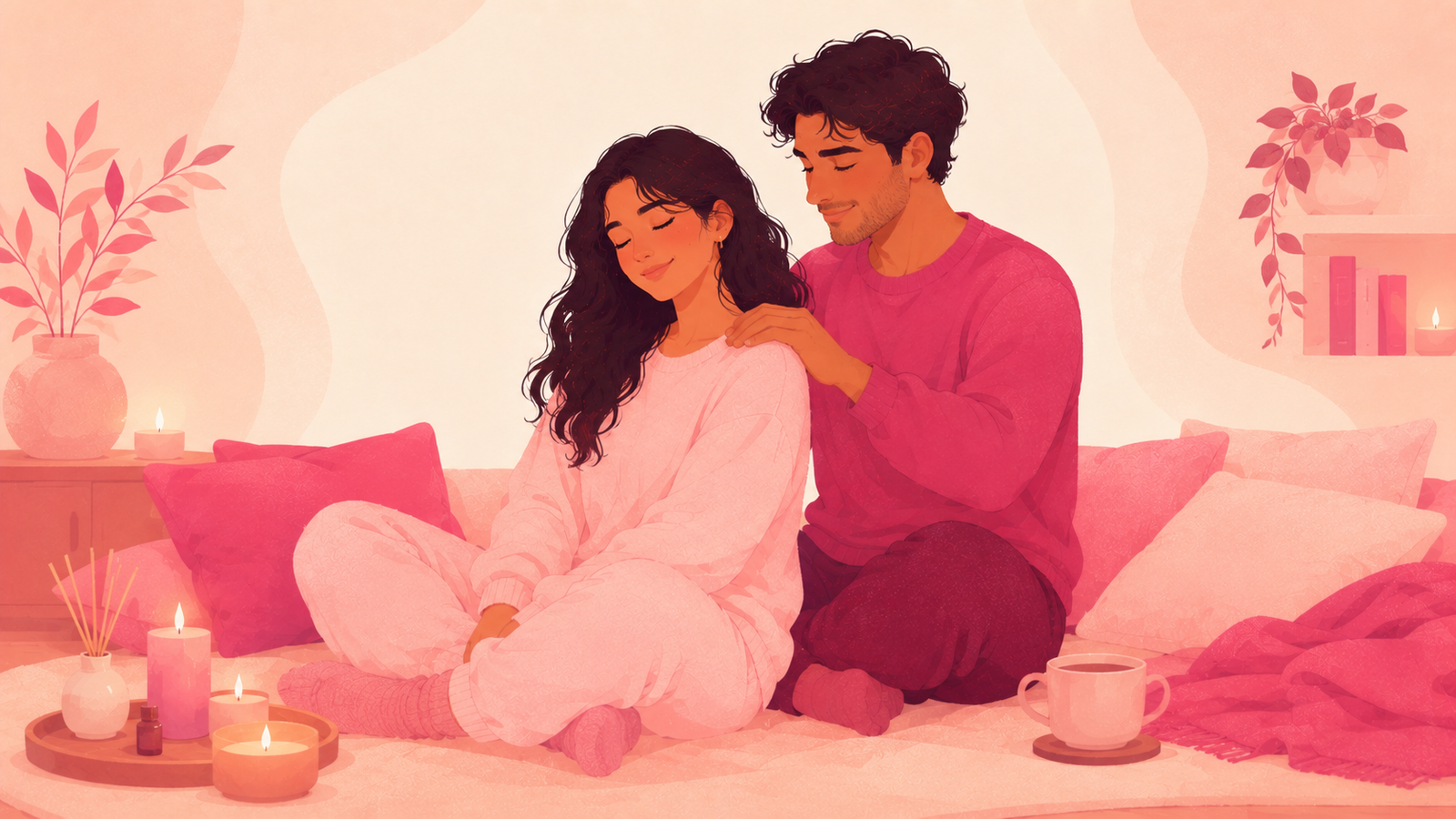
Yes, some people genuinely feel that an orgasm takes the edge off period cramps for a little while. Others feel no change at all. And a small group notice their cramps spike for a few minutes around climax before easing back. All three of those experiences are normal. None of them mean your body is broken or that you are doing anything wrong.
The honest short answer
The reason the answer is not a simple yes or no is that menstrual pain is not one thing. It is a mix of uterine muscle contractions, inflammatory messengers, blood flow changes, posture, sleep, stress, and how your nervous system happens to be reading pain that day. Orgasm touches some of those levers and not others. So it can help, partly, sometimes, and only for a window.
That is a real benefit. It is also not a treatment. The goal of this article is to give you a clear picture of what is actually happening in your body, what is safe, what to expect, and what to take seriously, so you can make calm choices the next time your uterus is having a mood.
You can keep that picture handy inside the Flow & Glow app, which is designed to help you notice your own cramp patterns over time instead of guessing in the middle of a bad day.
What is actually happening when you cramp
A period cramp is not a random ache. Your uterus is a muscle, and during your period it squeezes to help shed its lining. Those squeezes are driven by signaling chemicals that also turn up inflammation and sensitivity in the surrounding tissue. The higher those messengers run, the more your uterus contracts, and the more those contractions can pinch off blood flow to the muscle itself for a moment. Less blood flow, more pain signaling. That short, hungry squeeze is a big part of what you feel as a cramp.
Layered on top, your pelvic floor often tightens in response to the discomfort. Your back muscles brace. Your breathing gets shallow. You sit in a hunched shape that protects your belly. Each of those layers adds to the experience even though they are not the original cause.
When people ask whether orgasm can help, they are really asking whether climax can interrupt that whole stack of squeezing, bracing, and amplified sensitivity. The answer for many people is, a little, for a little while.
How orgasm might shift cramp intensity
Orgasm is a strong, rhythmic, full body event. A few things happen at once that are at least plausibly useful when you are crampy.
First, the muscles in your pelvic area contract and then release. That release can feel like the difference between a clenched fist and an open hand. If part of your cramp pain was your pelvic floor and lower belly bracing on top of the uterine contractions, the post climax drop in tone can feel like an exhale you did not know you were holding.
Second, climax is associated with a surge of the body's own feel good and pain dampening chemistry. That includes things that quiet pain signaling for a short window, plus a mood shift that genuinely changes how intensely your brain reads the same signals. It is not numbness. It is more like turning down the volume.
Third, arousal increases blood flow to the pelvis. Better blood flow can ease the local oxygen starvation that contributes to cramp pain. After climax, that flow slowly settles, and many people describe the next twenty to sixty minutes as warmer, looser, and softer in the belly.
Fourth, there is a real psychological piece. Doing something pleasurable that you chose, in a body that was hurting, is a small act of agency. Reclaiming any part of a hard cycle day can lift your mood enough to lower how big the pain feels.
None of that is magic. The relief is often partial. It usually fades inside an hour. It does not work every time. But for a slice of people, it is one of the few things that reliably helps a little, which is worth knowing.
Why results vary so much
If your friend swears orgasms melt her cramps and yours barely flinch, both of you are telling the truth. Differences come from a long list of normal factors.
Baseline pain matters. A mild cramp has more room to drop than a severe one. If your pain is at a low simmer, even a small dampening effect can feel like real relief. If your pain is at a roar, the same chemistry might only move you from a nine to an eight, which is real but not impressive.
Cramp source matters. Some cramps are primarily from heavy uterine contractions, where the muscle release after orgasm might help more. Other cramps are tied to inflammation in deeper tissue, where orgasm chemistry barely touches the root cause.
Cycle day matters. Many people find that the first day or two of bleeding are the most intense, and that comfort tools work better as the flow eases. That can be true for orgasm too. It does not mean you cannot try on day one. It means do not be surprised if the same approach hits differently on day three.
Your nervous system matters. Stress, sleep debt, and anxiety all raise your overall pain volume. If you are exhausted and tense, your body has less room to drop into the post climax softness that gives relief. If you can pair an orgasm with a warm room, a heating pad, hydration, and a few slow breaths, you stack the deck in your favor.
Your relationship with your body matters. People who feel safe, unhurried, and unjudged in their own pleasure tend to get more out of any pleasure based comfort tool. People who feel rushed, ashamed, or anxious about period sex or masturbation often do not get the full release, even physically.
This is one reason your experience can shift across years. Period cramps that change over time can reflect cycle changes, contraception changes, life stress, pelvic floor changes after childbirth, and many other things. What worked at twenty might not be what works at twenty eight. That is normal.
Solo play during your period
For most people, masturbation period cramps relief is the lowest stakes version of this whole conversation. There is no partner to coordinate with, no mess to negotiate, no pressure to perform. You can do it for thirty seconds or twenty minutes, in pajamas, in bed, with a heating pad still nearby.
A few practical notes that help.
Take the pressure off outcome. The goal is not to force an orgasm to fix your cramp. The goal is to be kind to your body. If climax happens and helps, great. If it does not, you still spent a few minutes warm and connected to yourself, which is its own kind of comfort.
Pay attention to position. Lying on your side with a pillow between your knees, or on your back with knees bent and feet flat, often feels more sustainable than positions that compress your lower belly. If a position makes your cramp worse, switch.
Mind the pelvic floor. If you tend to clench your jaw, shoulders, or pelvic floor when you are tense, you may also clench during arousal. Try a long exhale before and after, and notice if you can let your belly go soft. The release part of muscle release is where the relief lives.
Hygiene is simple. A towel under you handles most of it. Wash your hands and any toys with mild soap and water before and after. Toys made for body safe materials are easiest to clean. If you use a menstrual cup or disc, you can usually leave it in for external play, though some people remove it for comfort. Tampons are a different story, see the FAQs.
If you bleed heavily and find any of this uncomfortable, skip it that day. There is no rule that says you have to.
Partnered sex during your period
For people in a partnered situation, period sex is a very normal choice that some couples enjoy and others avoid. Both are fine. The right answer is whatever feels good to both of you and does not violate anyone's limits.
Period sex cramps relief is similar to the solo version, with extra variables. Communication is the biggest one. Tell your partner where you are at, what you want, what you do not want, and what the signal will be if you want to stop. A safe word or a clear let us pause phrase is useful any time, but especially when pain is in the room.
Position matters even more than usual. Anything that puts pressure on your lower belly, or that drives motion deeper than feels right, can take you from crampy and curious to crampy and miserable in seconds. Side lying, partner behind, and shallow angles often feel kinder. Slower, gentler, and more rhythmic tends to beat fast and athletic when your uterus is already complaining.
Practical setup. A dark towel underneath solves most of the mess concern. Choose lighting and bedding you do not mind. Pads come off. Tampons should come out before penetrative sex to avoid pushing them further in. Menstrual cups and discs vary by brand, some are designed to stay in during certain kinds of sex, others are not. If you are not sure, take it out and rinse it after.
Pregnancy and infection points. You can still get pregnant during your period in some situations, especially if your cycle is short or irregular, so contraception still counts. Some sexually transmitted infections can pass more easily when blood is present in either direction, so barrier methods are smart unless you and your partner are tested and in a clearly defined relationship. None of this is about shame. It is about staying free to enjoy yourself without surprises later.
If a partner pushes for period sex when you do not want it, or makes you feel gross for bleeding, that is a partner issue, not a body issue. You always get to say not today.
Comfort, hygiene, and setup
A small amount of setup can change the whole experience.
Warmth helps. A heating pad on your lower belly or low back before and after climbs onto the same pathway that orgasm uses to relax tissue. Warmth alone is one of the most reliably comforting tools for menstrual pain. Pairing it with anything else, including orgasm, usually beats either one alone.
Hydration helps. Cramps often get worse when you are dehydrated. A glass of water before and another after is small effort with real payoff.
Movement helps, gently. A slow walk, light stretching, or hip circles can ease the tightness that builds up when you have been curled up all day. You do not need a workout. You need to remind your body that it can still move.
Eating something matters. Trying to coax your body into a relaxed state on an empty stomach, especially when your blood sugar is dipping, is harder. A snack with protein and something starchy can steady your nervous system.
Privacy and pace matter. If you live with people, lock the door, put on music or a sound machine, give yourself permission to take up time. Nothing kills relief like feeling rushed or watched.
Permission matters too. Some people grew up with strong messages that period sex or any sex during bleeding is dirty, wrong, or off limits. If those messages are loud, it is okay to start by simply asking, do I actually believe that, or did I inherit it. You do not have to do anything you do not want. You also do not have to keep beliefs that no longer serve you.
When orgasm makes cramps worse
Sometimes the answer to does an orgasm help my cramps is, no, it made them worse for a few minutes. That can be confusing if you went into it hoping for relief.
A few things might be going on. Orgasm causes uterine contractions of its own. If your uterus is already cramping, those extra contractions can briefly intensify what you feel. The spike is usually short, often less than ten minutes, and the post climax relaxation that follows can still leave you better than baseline. For some people, though, the spike lingers, and that is real.
If your cramps reliably get worse after orgasm, in a way that is meaningfully more painful and lasts longer than a few minutes, that is a useful piece of information. It does not automatically mean something is wrong, but it is the kind of pattern worth bringing to a clinician, especially if your cramps have also been changing in other ways.
You are also allowed to simply opt out. There is no requirement that anyone use orgasm as a cramp tool. If it does not feel good or worth it, do something else.
Other cramp relief that actually helps
Because orgasm is unreliable as a treatment, it is worth having a small stack of other tools that you trust.
Heat is the workhorse. A heating pad, warm bath, or wearable patch can rival over the counter pain relievers for some people.
Movement at a level that feels good, not punishment level workouts, but a walk, light yoga, stretching, swimming, or gentle cycling, can reduce cramp intensity over the day. If you push to exhaustion you can flare your pain instead.
Over the counter anti inflammatory medications are widely studied for menstrual pain and work well for many people when used as directed. Take them with food, on schedule rather than waiting until pain is at peak, and follow the label. Talk to a clinician if you need them often or in higher doses.
Sleep, hydration, and steady meals across the month all change how loud your cramps feel when they arrive.
Some people find that magnesium, omega three rich foods, or reducing very processed foods at certain points in the cycle takes some edge off, though the evidence varies and individual response varies more.
Mind based tools matter too. Slow breathing with a longer exhale, body scans, and short guided practices for pain can shift your nervous system in a way that takes minutes and costs nothing.
For anyone whose cramps are interfering with work, school, sleep, or daily life every single cycle, no comfort tool stack is enough by itself. You deserve an appointment and a real conversation with a clinician.
Pain red flags worth taking seriously
Most period pain is uncomfortable but normal. Some patterns are different and should not be left to ride out.
Pain that is severe enough to make you cancel work, school, or normal activities every cycle. Pain that does not respond to any of the usual tools. Pain that has become worse over months or years instead of staying about the same. Pain that is mostly on one side. Pain that hits at times outside your period. Pain during or right after sex that is sharp, deep, or new. Pain paired with very heavy bleeding, soaking through protection in an hour or less. Bleeding that lasts much longer than usual for you. Fainting, dizziness, or shortness of breath with your period. Fever, chills, or unusual discharge with pain.
Any of those is a reason to make an appointment, not a reason to feel embarrassed. You are not being dramatic. You are being a careful narrator of your own body. Bring notes if you have them. A clinician who has months of cramp data, flow data, and pain notes will help you faster than a clinician working from your memory of the last cycle alone.
This is also a fair time to reconsider contraception, if you use any, and to ask whether your current method is helping or aggravating your pain.
How to know what is actually working for you
The hardest part of cramp relief is that you are usually trying to evaluate it in the middle of feeling bad. Your brain is fogged by pain, you are tired, and you remember the cycles where nothing helped much more than the cycles where things were okay.
That is why short notes across a few cycles beat in the moment guessing. Pain rating before, what you tried, pain rating an hour later, and a single line about how it felt. Repeat across three or four cycles and you start to see patterns no one else can see for you.
Useful things to note. Which days were the worst. What time of day pain peaked. What you ate and how you slept. What you tried, and in what order. Whether orgasm, partnered or solo, helped, hurt, or did nothing. Whether stress at work or in relationships seemed to amplify pain. Whether your cramps are shifting over time in a way that feels like a quiet trend.
You can keep all of that in a notebook, a notes app, or as period tracker notes inside your cycle app. The point is not to be perfect about it. The point is to have data when you are sitting across from a clinician, or when you are deciding what to try next month.
If you do try orgasm as a comfort tool, treat it like any other experiment. Try it on a calm day with low expectations. Notice how you feel before, during, and an hour after. Notice if it helped, did nothing, or made things worse. Write one sentence. Move on. Do it again next cycle. That is how you get an honest answer about your own body, not somebody else's.
A grounded last word
Orgasms can help period cramps for some people, some of the time, in a small but real way. That is the honest version. It is not a cure. It is not a moral statement. It is one tool among many.
The bigger lesson under all of this is that your body deserves curiosity and care, not pressure. You do not owe anyone an orgasm to prove your period is manageable. You do not owe anyone period sex. You do not owe anyone a brave face about pain that is bigger than it should be. You are allowed to try things, drop them, change your mind, and bring your real experience to a real clinician when something is off.
The more you know your own pattern, the easier it gets to make calm decisions when the next cycle shows up.
Article information
- Written by Jessica Morrison, MS in Health Communication, CHES
- Medically reviewed by Dr. Alicia Williams, PhD, LMFT, CST
- Published on June 11, 2026
- Updated on October 7, 2026
Key takeaways
- Orgasm can shift cramp intensity for a little while because of muscle release, mood changes, and the body's natural pain dampening chemistry.
- The effect is short, partial, and very personal. It is not a guaranteed fix and it is not the same for everyone or every cycle.
- Solo play and partnered sex during your period are both safe for most people when you are comfortable, consenting, and reasonable about hygiene.
- Cramps that are severe, new, one sided, getting worse over months, or paired with very heavy bleeding deserve a real medical visit, not a home remedy.
- Tracking what helps and what does not, across several cycles, beats guessing in the moment.
Frequently asked questions
Does an orgasm really help with period cramps or is that a myth?
It is not a myth, but it is also not a cure. Many people feel a real, partial, short term drop in cramp intensity after an orgasm because of muscle release, mood shift, and the body's natural pain dampening chemistry. The effect is usually mild and lasts under an hour. Others feel no change or a brief uptick. All of those experiences are normal. Treat orgasm as one comfort tool among several, not a treatment.
Is it safe to masturbate during my period?
For almost everyone, yes. Masturbation during your period is safe and very common. Use a towel if you want easier cleanup, wash hands and any toys with mild soap and water, and choose positions that do not press hard on your lower belly. If something hurts in a way that is more than a cramp twinge, stop and try again another day. Listen to your body and skip it on days when even gentle touch is too much.
Can sex during my period make my cramps worse?
It can, briefly, for some people, because climax and arousal cause their own uterine contractions on top of period contractions. The spike is usually short. Many people report that the relaxation phase afterward leaves them at or below their starting pain level. If your cramps reliably and meaningfully worsen after sex, that is a pattern worth noting and bringing to a clinician, especially if other things about your cycle are changing too.
Can I still get pregnant if I have period sex?
Yes, in some situations. It is less likely than mid cycle, but not zero, especially if your cycle is short, irregular, or if you have unprotected sex toward the end of bleeding when ovulation could be closer than expected. If you are not actively trying to conceive, use contraception that you trust for period sex the same as you would any other time. If you are trying to conceive, your fertile window is generally outside your period, but plenty of people get useful data from tracking across the full cycle.
Should I leave my tampon, cup, or disc in during sex?
Tampons should come out before penetrative sex. They are not designed to handle penetration and can be pushed deeper, making them harder to remove. Menstrual cups and discs vary. Some discs are designed to stay in for certain kinds of penetrative sex. Many cups should come out. Check the product instructions for your specific brand. For external play and partnered touch that is not penetrative, you can usually leave any of them in if you are comfortable.
How do I know if my cramps are normal or if I should see a clinician?
Some discomfort during your period is expected. The patterns to take seriously are pain severe enough to interrupt your daily life every cycle, pain that does not respond to usual comfort tools, pain that is getting worse over months or years, one sided pain, pain outside your period window, sharp or deep pain during sex, very heavy bleeding, bleeding lasting much longer than usual for you, fainting, fever, or unusual discharge with pain. Any of those deserve an appointment. Bring your notes.
What is the most reliable cramp relief tool besides orgasm?
Heat is the most consistent for the most people. A heating pad or warm bath on your lower belly or back can be genuinely strong relief. Layer in steady hydration, gentle movement, regular sleep, and steady meals across the cycle, not just on cramp days. Over the counter anti inflammatory medication, used as directed and ideally on a regular schedule once cramps start, works well for many people. Slow breathing and short body scans cost nothing and can lower how loud your nervous system reads pain. If none of that is enough, talk to a clinician about whether something more is going on.
References
- American College of Obstetricians and Gynecologists. (n.d.). Dysmenorrhea: Painful periods Source
- Cleveland Clinic. (n.d.). Dysmenorrhea Source
- Mayo Clinic. (n.d.). Menstrual cramps: Symptoms and causes Source
- National Health Service. (n.d.). Period pain Source
- National Library of Medicine. (n.d.). Physiology, endorphins. StatPearls Source
- Office on Women's Health, U.S. Department of Health and Human Services. (n.d.). Menstrual cycle Source
Editorial and medical disclaimer
Flow & Glow health content is educational and is not a substitute for diagnosis, treatment, or personal medical advice from a qualified clinician.
Our editorial standards, reviewer process, sourcing approach, and correction process are explained in the Editorial Policy. You can also review our authors and medical reviewers, healthcare professional information, contact page, and privacy policy.