Male Fertility Myths Keeping You From Getting Pregnant
Half of all fertility challenges involve a male factor, but common myths keep couples from testing and finding answers sooner. Here is what the research actually says.
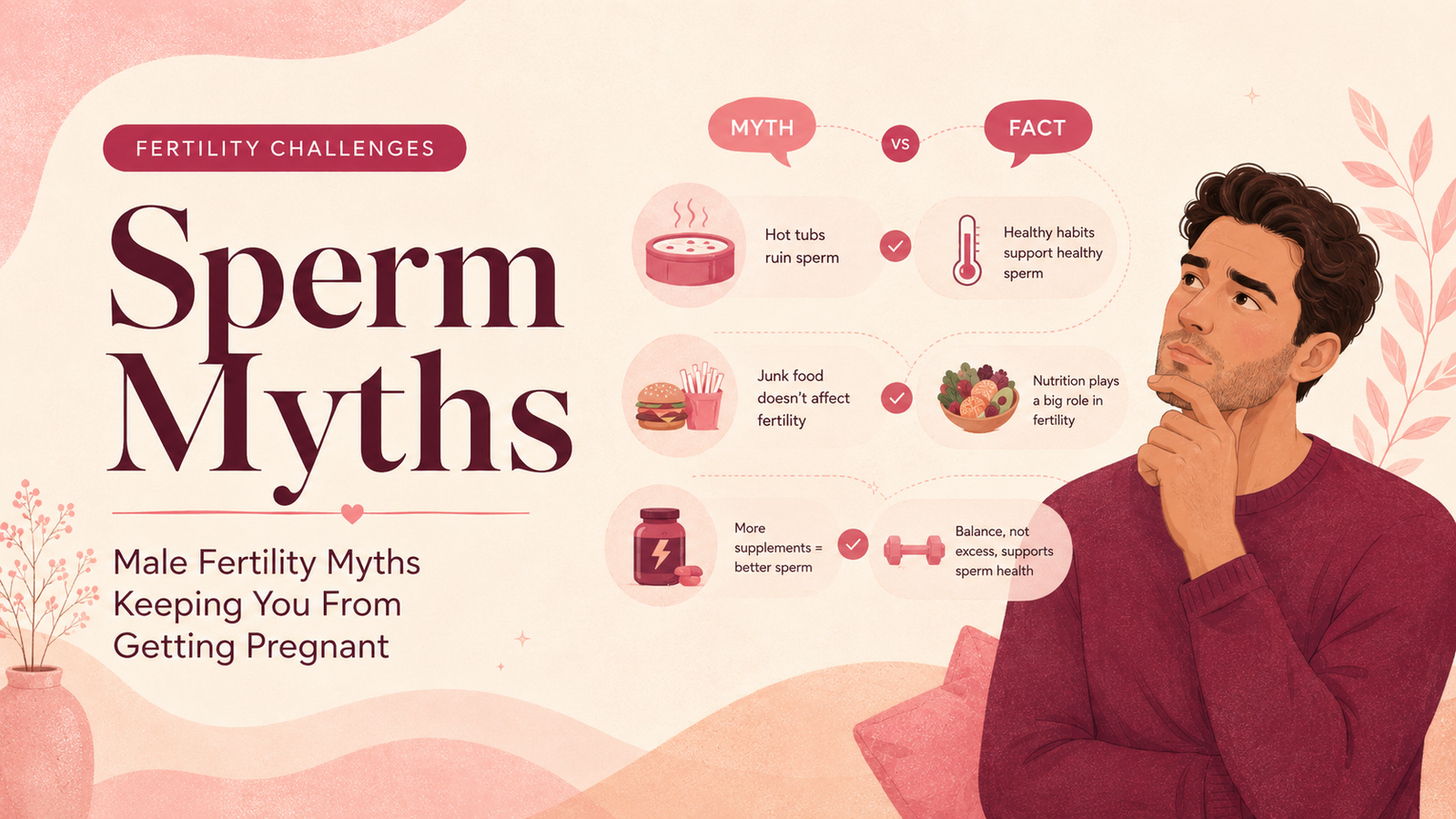
When a couple starts trying for a baby, the cultural script is loud. Track your period. Watch for ovulation. Read about your cervix. Take prenatal vitamins. Cut back on caffeine. Watch your stress. Most of this advice is aimed at one body, and almost all of it lands on the partner with a uterus. That focus is not wrong. Cycle awareness is genuinely useful, and you do need to know your fertile window if you want each cycle to count.
Why his half of the fertility picture gets so little airtime
But the script leaves out a quiet truth. Male factor is involved in about half of cases where conception takes longer than expected. Sometimes it is the main reason. Sometimes it is one factor in a stack of small ones. Either way, because the wider conversation skips this half, couples often spend many months tracking one body in detail while never asking a single question about the other. Then, when nothing happens, the assumption tends to be that something must be wrong with her, even though the available information did not actually support that conclusion.
This is the gap Flow & Glow wants to help you close. Tracking your cycle still matters, and knowing your ovulation signs still gives you a real edge. But so does knowing the basics of sperm health, so that neither of you is carrying the full weight of the question alone. Let us walk through the male fertility myths that come up most often, why they stick, and what is actually true.
Myth 1: Infertility is mostly a woman's problem
This is the most stubborn myth on the list, and it is the one that sets every other myth in motion. The widely repeated estimate is that in couples having a hard time conceiving, female factors are involved in roughly a third of cases, male factors in roughly a third, both partners in another third, and a small slice has no clear cause. Other framings group those numbers a little differently, but every credible version of the picture lands on the same point. Male factor is in about half of the cases, either alone or alongside something else.
Why does the myth stick? Some of it is older social scripts about fertility being a woman's domain. Some of it is that ovulation can be tracked and pregnancy tests can be taken at home, while sperm cannot be observed from the couch. And some of it is simply that nobody wants to imply the issue is with their partner, so the conversation defaults to her body by habit.
The practical fix is small. When you start trying, talk about both of your bodies the same way. Treat sperm health as a routine part of the question, not a fallback after months of disappointment. The earlier you both see the picture as shared, the easier the rest of the process gets.
Myth 2: If he ejaculates normally, his sperm is fine
A normal looking ejaculation tells you that the plumbing is working. It does not tell you about sperm count, how well sperm move, what shape they are, whether they are alive, or whether there are antibodies interfering with them. Two partners can both produce semen that looks the same to the eye, while one of those samples has many millions of healthy, motile sperm and the other has very few.
This matters because it is the myth that keeps couples from getting a semen analysis. They assume that since sex feels normal and ejaculation happens, there is nothing to investigate. The test is simple, often available through a primary care doctor or a urologist, and the result either reassures you or gives you a direction. Either outcome is better than guessing for another six months.
Myth 3: Boxers good, briefs bad
The underwear debate has somehow become the headline of male fertility advice. The honest version is more boring. The testicles sit outside the body because sperm production runs slightly cooler than core temperature. Anything that meaningfully and repeatedly raises that local temperature can nudge sperm production in the wrong direction. Tight underwear on its own is rarely the main driver, and switching from briefs to boxers will not fix a real underlying issue.
What is more relevant is sustained heat exposure. Long hot tub or sauna sessions, day after day, can affect sperm production. Resting a laptop directly on the lap for hours, every day, can do the same. Working in a job that requires sitting in a very hot environment for long stretches can contribute. None of these single moments will sterilize anyone. The pattern, repeated over months, is what matters. If the heat exposure is occasional, it is unlikely to be the reason you are not getting pregnant.
Myth 4: Stress does not affect male fertility
Chronic stress affects a lot of things in the body, and sperm health is on that list. Stress can shift hormone patterns, affect sleep, push people toward more alcohol or fewer balanced meals, and reduce sex drive at exactly the moment you need to be having sex during your fertile window. None of this means stress causes infertility on its own, and you do not need to feel guilty about feeling stressed. It does mean that taking some of the pressure off the TTC process itself, where you can, tends to help.
That is easier said than done. Many couples find that switching from a daily "did it work" mindset to a weekly check in, focusing on the fertile window rather than every single day, and keeping the rest of their life full of normal things, brings the stress down. Stress will not vanish, but it will stop running the whole show.
Myth 5: Young men are immune to fertility issues
Younger bodies do tend to have higher fertility on average, for both partners. But "younger" does not mean "guaranteed." Sperm quality can be affected by genetics, infections, anatomical issues like varicoceles, hormone problems, certain medications, and lifestyle factors at any age. A man in his late twenties is not automatically fertile, and a man in his late thirties is not automatically infertile.
This myth quietly hurts younger couples who assume that because they are both in their twenties, time is endless and there is no reason to investigate when months pass without a pregnancy. Time is on your side compared to older couples, but it is not infinite, and if something is going on, you want to know sooner rather than later. The general guideline many clinicians use is that if you are under thirty five and have been trying for about a year without success, it is reasonable to seek an evaluation. If either of you is over thirty five, that timeline is usually shortened to about six months. Those numbers are not laws. They are a starting point for a conversation.
Myth 6: Male age does not matter
It does, just less dramatically than female age. Sperm quality, count, and the rate of certain genetic changes shift gradually as men get older. The change is usually not as steep as the changes that happen in eggs over time, but it is real, and at very advanced paternal age it can affect both the chance of conception and certain pregnancy outcomes.
The takeaway is not that older men should panic. It is that "his age does not matter at all" is not accurate. If you are both in your thirties or beyond, both partners deserve a thoughtful conversation with a clinician about timeline and options, not just the partner with ovaries.
Myth 7: Daily sex during the fertile window is the only way
You do not need daily sex to get pregnant. You need well timed sex within your fertile window, which is roughly the five days before ovulation and the day of ovulation itself. Sex every one to two days during that window is generally enough to give sperm a steady, healthy chance to meet an egg. Daily can work too, and is fine for most people, but it is not required.
Forcing daily sex through the entire cycle, every cycle, often backfires. It creates pressure, can drive both partners toward feeling like sex is a chore, and can lead to people opting out at the moment that actually matters. Watching for cervical mucus changes and using your cycle pattern to predict your window is more useful than a sex quota. If you want a closer look at how often to have sex when you are trying, that detail helps, but the headline is calm and simple. Aim for the window, not for every day on the calendar.
Myth 8: Lifestyle changes will not move the needle
Lifestyle changes do not fix every fertility issue. Some causes of low sperm count or motility are structural, hormonal, or genetic, and they will not respond to a different breakfast. But for many men, baseline lifestyle factors do nudge sperm quality in either direction over time.
Reasonable habits include not smoking, keeping alcohol moderate rather than heavy, sleeping enough, getting some movement most days, eating in a way that broadly supports cardiovascular and metabolic health, and treating any underlying issues like sleep apnea or unmanaged blood sugar. There is no magic food, no superfood, no overnight protocol, and no supplement that has been shown to be a silver bullet for all men. What actually works is the boring, real basics, repeated over months.
The reason patience matters is biology. New sperm take roughly three months to mature. Whatever change you make today will mostly show up in samples taken three months from now, not three weeks from now. That is why couples sometimes feel like nothing is moving in the short term, even when the long term picture is shifting.
Myth 9: A semen analysis is overreacting
A semen analysis is a basic, low friction test. It looks at the volume of the sample, the concentration of sperm, the percentage that move, the percentage with normal shape, and a few other markers. It does not feel pleasant to think about as a step, but it is a quick way to either remove a possibility or get useful information.
Asking for one is not a sign that you have given up on natural conception. It is a sign that you are gathering information early, the same way you gathered information about your cycle when you started tracking it. Many couples wish, in hindsight, that they had done a semen analysis sooner, before assuming timing alone was the issue. If your partner is hesitant, frame it as "let us rule things out together" rather than "let us prove something is wrong with you." It is far easier to ask now, calmly, than to ask later, after months of frustration.
Myth 10: If he has a child already, he is still fine
Past fertility is a useful data point, but it is not a guarantee about today. Sperm health can change over the years. Infections, medications, hormonal shifts, weight changes, varicoceles that have grown, certain procedures, and the slow effect of aging can all shift a person's fertility profile from one decade to the next. A man who fathered a child without trying at twenty four is not automatically the same fertility story at thirty seven.
If you are blending past fertility with current TTC frustration, it is still worth asking the question rather than assuming the past covers the present. The same applies in reverse. A partner who has not had a child before is not automatically infertile. Most younger men do not actually know their fertility status until someone is trying to conceive with them.
Myth 11: Supplements will fix it
The supplement aisle for "male fertility" is loud, expensive, and mostly under regulated. Some ingredients have modest evidence behind them in specific situations, particularly for men with documented deficiencies or with certain oxidative stress patterns in their sperm. Many products mix those ingredients with a long list of fillers, market themselves with strong claims, and cost a lot for what they actually deliver.
The honest middle ground is this. If your partner's lifestyle is broadly reasonable and there is no documented deficiency, supplements are unlikely to be the thing that flips a fertility result. If there is a known reason, a clinician can recommend something specific rather than guessing. Spending three hundred dollars a month on a "male fertility blend" without ever doing a semen analysis is the wrong order of operations.
Myth 12: Stress about fertility is only her problem
Going through TTC is hard for both partners. The partner with ovaries usually carries most of the visible work: tracking, testing, scheduling, often appointments, and the monthly disappointment of a negative pregnancy test. The other partner carries a different load that is less visible: feeling helpless, not wanting to push, sometimes feeling reduced to a delivery system on certain days of the month, and quietly worrying about their own role.
Letting both stress loads be real, naming them out loud, and protecting the relationship from becoming a fertility project is part of how couples make it through. The point of trying to conceive is the eventual pregnancy, but the daily work of TTC is happening to the relationship now, and how you treat each other during it tends to matter more than any single piece of advice you read online.
What you can actually do together
The most useful things a couple can do tend to be quiet.
Learn the cycle together. Even if one partner does the day to day tracking, the other partner can know roughly where the fertile window is and why it matters. Knowing your fertile window also stops the every day or bust pressure.
Have sex about every one to two days in the fertile window. That is enough for most couples.
Treat sperm health as part of the normal picture from day one. Mention it without drama. If the conversation gets stuck, frame it as gathering information, not assigning blame.
Run through the boring lifestyle list together. Limit heavy drinking, do not smoke, get enough sleep, move your body in a way you can actually maintain, and address any health conditions on either side that have been ignored.
Give changes about three months to show up. New sperm take that long to mature, so you will not see this month's habits in this month's sperm.
If you have been actively trying and timing well for about a year without a pregnancy, ask for an evaluation, especially if both partners are under thirty five. If either partner is over thirty five, that timeline is closer to six months. If there is a known issue on either side, a known irregular cycle, a history of certain infections, or any other concern, ask sooner.
When to talk to a clinician
Some patterns deserve attention sooner rather than later, for either partner.
If your cycles are very irregular, very heavy, very painful, or unusually short or long, that is worth a conversation. If you have a history of conditions that can affect fertility, like PCOS, endometriosis, thyroid issues, or pelvic infections, mention them. If your partner has had any procedures involving the testicles, a history of undescended testes, mumps after puberty, certain chemotherapies, or significant testicular pain or swelling, those matter too.
You should also seek care for severe pelvic pain, very heavy bleeding, repeated post sex bleeding, signs of infection, possible pregnancy alongside concerning symptoms, or anything about birth control that has felt warning sign serious. If your gut is telling you that something is not right, that is enough reason to ask.
A good clinician will not make either of you feel like you are overreacting for asking questions. If your current clinician does, find a different one if you can.
Wrapping up
Male fertility myths persist for the same reasons most fertility myths persist. They sound confident. They are easy to repeat. They take pressure off the people repeating them. And they make a complicated, emotional process feel smaller. The cost is real, though. Every month a couple spends working with a half right or fully wrong idea is a month that could have been spent gathering actual information.
You do not need to overcorrect into thinking everything is about him now. You just need a balanced picture. Cycle awareness still matters. Sperm health still matters. Boring habits still matter. Asking for a semen analysis is not extreme, and asking for an evaluation when timelines stretch is not giving up. The faster you treat both halves of the picture as normal parts of the conversation, the faster you can make decisions instead of guessing your way through another six months.
Article information
- Written by Emma Hart, MS in Science Writing
- Medically reviewed by Dr. Jennifer Martinez, MD, FACOG
- Published on June 5, 2026
- Updated on July 31, 2026
Key takeaways
- Male factor is involved in roughly half of cases where couples take longer than expected to conceive.
- A normal looking ejaculation tells you almost nothing about sperm count, shape, or movement.
- Underwear style matters less than people say, while sustained heat exposure matters more than people think.
- Sperm quality can shift with sleep, alcohol, smoking, weight, infection, and certain medications, but no single change is a silver bullet.
- Male age affects fertility too, just on a slower and quieter curve than female age.
- A semen analysis is a simple test, not an extreme step.
- Lifestyle changes usually take about three months to show in sperm, because that is how long new sperm take to mature.
- TTC works best when both partners learn the basics together and share the work of timing, testing, and follow up.
Frequently asked questions
How long should we try before worrying about male fertility?
For most couples under thirty five, a year of regular, well timed sex without conception is the usual point to seek an evaluation. For couples where either partner is over thirty five, that drops to about six months. If there is a known reason to suspect a problem on either side, ask sooner. These timelines are starting points, not rules, and a clinician can tell you what fits your specific story.
Does my partner need to stop drinking completely to improve sperm quality?
Probably not. Heavy or frequent drinking can affect sperm health over time. Moderate drinking has a smaller effect for most men. The honest direction is to reduce heavy drinking and keep things modest, rather than to insist on full abstinence and then quietly give up because the goal felt too big. The pattern matters more than the perfect plan.
Can a man have normal sex and still have a fertility problem?
Yes. Erections, ejaculation, and sexual function are partly separate from sperm count, motility, and shape. Two people can have completely normal sex lives, and one of them can still have a sperm related issue that only shows up on a semen analysis. This is exactly why a semen analysis is part of a real fertility workup, even when nothing seems wrong from the outside.
Are hot tubs and saunas really a problem?
Occasional use is unlikely to be the reason a couple is not conceiving. The concern is sustained, regular heat exposure over weeks and months, which can affect sperm production. If your partner uses a hot tub every day for long stretches and you are actively trying to conceive, cutting back is reasonable. If they go in once in a while, that is unlikely to be the main story.
Will switching from briefs to boxers fix male fertility issues?
If there is a real underlying issue, no. Underwear style alone does not fix low sperm count, poor motility, or structural problems. If your partner is more comfortable in looser underwear during TTC, that is fine, but do not expect it to undo a problem that has another cause. Save the energy for changes that actually move the needle.
How long do sperm health changes take to show up?
About three months, give or take. New sperm take roughly that long to develop from start to finish, so a lifestyle change made this week will mostly affect samples taken about three months from now. This is also why a single bad weekend will not ruin anything, and a single good week will not undo months of patterns.
Is a semen analysis painful or embarrassing?
It is not painful, and it does not have to be embarrassing. The test involves providing a sample, either at the clinic or at home depending on the lab's instructions, and then waiting for results. The hardest part is usually the mental hurdle of asking for the test in the first place. Once it is done, you have actual information instead of guesses, and that almost always feels better than the unknown.
References
- American Society for Reproductive Medicine. (2020). Diagnostic evaluation of the infertile male: a committee opinion. Retrieved from Source
- American Society for Reproductive Medicine. (2022). Optimizing natural fertility: a committee opinion. Retrieved from Source
- Mayo Clinic. (n.d.). Male infertility. Retrieved from Source
- Cleveland Clinic. (n.d.). Male infertility. Retrieved from Source
- NHS. (n.d.). Infertility causes. Retrieved from Source
- Eunice Kennedy Shriver National Institute of Child Health and Human Development. (n.d.). How common is male infertility, and what are its causes? Retrieved from Source
Editorial and medical disclaimer
Flow & Glow health content is educational and is not a substitute for diagnosis, treatment, or personal medical advice from a qualified clinician.
Our editorial standards, reviewer process, sourcing approach, and correction process are explained in the Editorial Policy. You can also review our authors and medical reviewers, healthcare professional information, contact page, and privacy policy.