Can Summer Heat Mess With Your Period?
Hot weather may affect sleep, stress, hydration, and routines around your cycle. Learn what can shift a period and what to track.
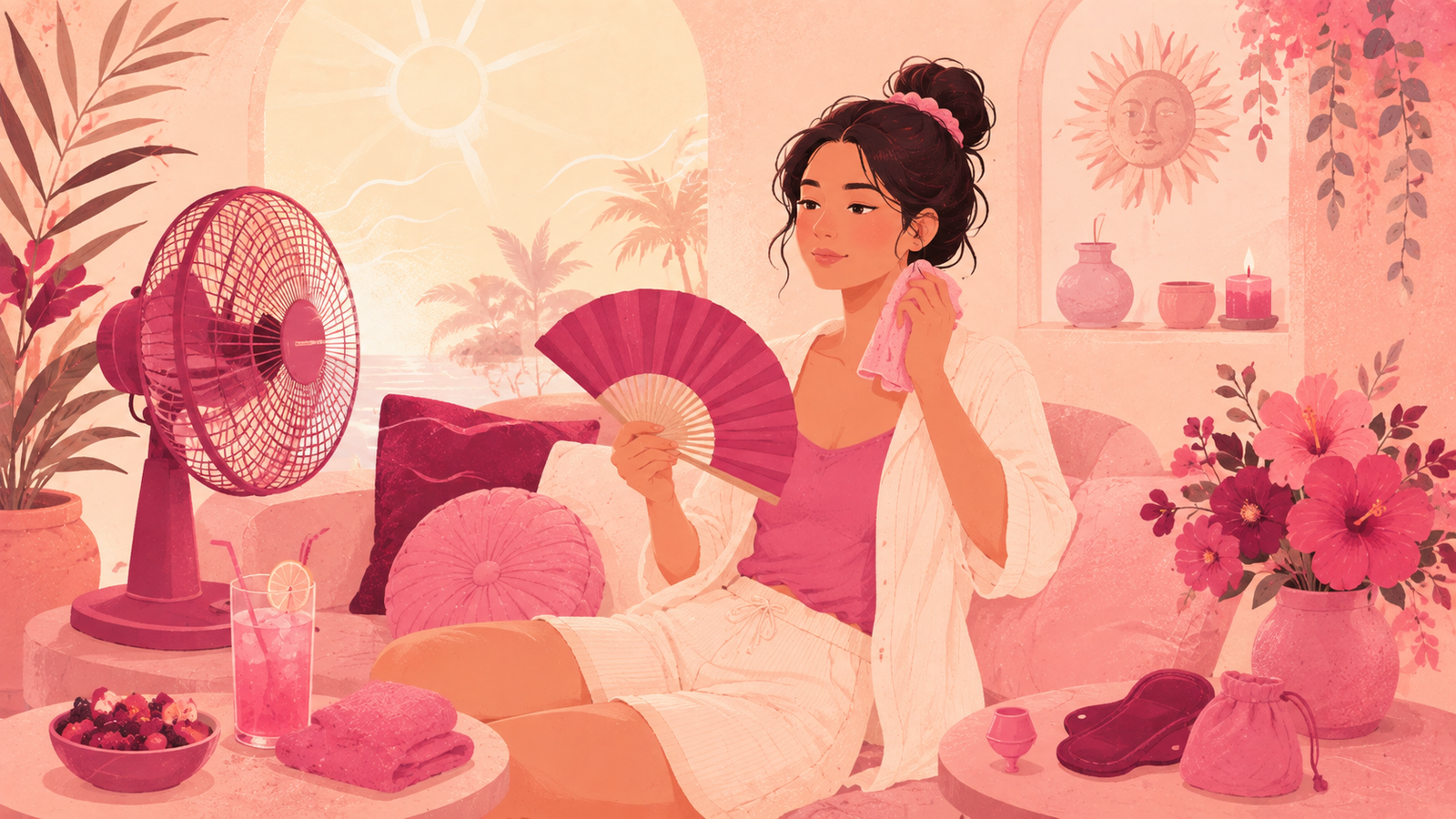
The short version is this: ambient temperature does not have a direct hotline to your ovaries. Your menstrual cycle is run by a chain of signals between your brain and your reproductive organs, and that chain does not have a thermometer at the start of it. So heat itself, the act of standing in the sun or sitting in a 95 degree room, is not what changes your period in the way many people assume.
The Straight Answer On Heat And Your Period
But the question is not silly. Most people who ask it have noticed something real. Their period came earlier than expected during a heat wave. It felt heavier on vacation. It skipped a beat after a sweaty week at a music festival. That is not in their head. The link is real, but it runs through indirect paths, not through heat as a hormone.
Think of summer as a stressor stack. You change your sleep, your water intake, your meal timing, your activity, your alcohol, your travel, your schedule, your stress level, and your exposure to other people who are sick. Each of those is a small variable. Stack enough of them together and your brain pulls back a little on the precision of your cycle, the way it would in any other high stress season.
So when you wonder if summer heat can mess with your period, the better question is what specifically about summer is messing with it. That is the question we can actually answer, and the one you can do something about.
This is also where a calm, friendly tracker earns its place. Flow & Glow is designed to help you log the small daily things that move your cycle so you can see the pattern instead of guessing. Once you have a few cycles logged with notes on sleep, hydration, travel, and workouts, the picture stops feeling random and starts looking like a story you can read.
What Summer Actually Changes
Before we get into the details, here is the short list of what tends to shift during hot months. Each of these has its own section below, but it helps to see the full set first.
- Hydration tends to drop, even when you think you are drinking enough.
- Sleep gets shorter and lighter because of heat, light, and late nights.
- Travel and time zone changes mess with your circadian rhythm.
- Stress rises in different ways, including planning stress and social fatigue.
- Exercise often gets more intense or more sporadic.
- Eating patterns shift toward irregular meals and more alcohol.
- Bugs spread more in shared summer spaces: pools, planes, weddings, group houses.
Any one of these can move your cycle a few days. Two or three of them at once can change how a period feels even if the date does not change.
Hydration And Your Cycle
If there is one summer factor most people underestimate, it is hydration. You lose water through sweat, through faster breathing in heat, and sometimes through stomach issues that pop up after travel or street food. Even mild dehydration changes how your body feels and behaves.
Dehydration does not usually delay or skip a period on its own. What it can do is make your cycle feel worse around it. Cramps can sting more when your blood volume is on the low end. Headaches and dizziness around your period get amplified. Bloating gets weirdly worse, not better, because your body holds on to fluid when it senses you are running dry. Fatigue piles up. And the energy crash some people feel before their period can feel twice as heavy.
A practical baseline is to drink to thirst plus a little extra in hot weather, with electrolytes when you have been sweating for more than an hour, working outside, or recovering from a stomach bug. Plain water is fine for most days. Sports drinks and salted snacks help when you have been losing real volume.
The signs you are running dry are simple. Pee that is dark yellow most of the day. A dry mouth that does not go away. Headaches that match your sweatiest days. Feeling more tired than the day warrants. These usually clear up within a day of consistent fluids and a bit of salt, and they often clear up some of your premenstrual symptoms too.
If you find that your period feels harder every summer in the same way, look at your water and electrolytes first. That is the cheapest fix and the one most likely to actually help.
Sleep Loss And Cycle Shifts
Sleep is the second big lever, and it is the one people protect least in summer. Long evenings, late dinners, hot bedrooms, bright mornings, vacation schedules, and weddings all chip away at the consistent sleep your cycle quietly depends on.
Your cycle is run by hormonal signals that are sensitive to your circadian rhythm. Melatonin, cortisol, and the reproductive hormones that drive ovulation are all on a daily timing system. Mess with the timing, and the system can wobble. A week of late nights and early wake ups can be enough to nudge ovulation by a day or two, which then nudges your period by a day or two.
The most common pattern is this: a week of poor sleep, followed by a period that arrives slightly off schedule. Sometimes early, sometimes late, depending on where in your cycle the sleep loss landed. If sleep was bad in the second half of your cycle, premenstrual symptoms tend to feel worse and the period can come a few days early. If sleep was bad in the first half, ovulation can shift and your period can run late.
A good summer sleep baseline looks like this: a cool dark bedroom even if the rest of the house is hot, a consistent wake time, less alcohol within three hours of bed, and a buffer between screens and lights out. If you cannot do all of that, prioritize wake time. Consistent wake time anchors the rhythm even when bedtimes drift.
If this side of your summer is the messy one, our piece on tired before period walks through how pre period fatigue shows up and what helps when sleep debt and PMS overlap.
Travel And Time Zone Effects
Travel is the single most reliable way to shift a summer cycle. You change your sleep, your light exposure, your meal timing, your hydration, your activity, and your stress all at once, often by several hours. Your brain responds the way it does to any big rhythm change, by dialing back the precision of nonessential timing systems for a while. Your cycle is one of those systems.
West to east travel tends to be harder on cycles than east to west, because losing hours of sleep is more disruptive than gaining them. Long haul flights compound the effect, especially with poor airplane sleep and a few days of jet lag on either end. Even short cross country trips can shift things, particularly if they include late nights, alcohol, and a busy itinerary.
A late period after a trip is very common and usually not a sign of anything wrong. The body simply needs a few days to recalibrate. If you are sexually active and there is any chance of pregnancy, a missed or very late period is worth a pregnancy test even when travel is the likely explanation. The two are not mutually exclusive.
If your period is consistently a few days early or late around big trips, that is useful information, not a problem to fix. Our explainer on cycle length changes covers why a healthy cycle can fluctuate within a normal range and how to know when fluctuation is just the system breathing versus when it deserves a closer look.
A few small habits make travel cycles easier. Hydrate generously on the day of travel. Skip alcohol the night before and during long flights. Get morning light at your destination as soon as possible. Try to eat at local meal times within the first day. Walk and stretch. None of these are dramatic, but together they shorten the recovery window and make the next cycle land closer to home.
Heat Driven Stress And Cortisol
Stress is the catch all word for everything that gets your nervous system worked up. In summer, the sources of stress shift. Less work pressure for some people, more social pressure for others, plus planning, packing, family logistics, kids out of school, weddings, parties, group trips, and the slow grind of being too hot for too long.
The stress hormone cortisol is normally on a clean daily rhythm that supports your cycle. When cortisol stays elevated for days or weeks, the brain pulls some attention away from the reproductive system. You can think of it as a body that has decided this is not the right week to spend a lot of effort on a precise ovulation. The result is often a delayed or skipped ovulation, which means a delayed or unexpectedly different period.
The other thing stress does is amplify how your period feels. Cramps feel sharper, mood swings hit harder, sleep is worse, and energy is lower. None of this is in your head. The same hormonal load makes period symptoms more intense, especially when stress overlaps with poor sleep and low hydration.
The fix is not to eliminate stress, which is not realistic in summer or any other season. The fix is to insert small recovery anchors. A walk in the morning. A no plans evening at least once a week. A few minutes of quiet before bed, away from your phone. A daily moment that signals to your nervous system that it is safe to come down. These small inputs add up across a cycle.
If you notice your period showing up earlier than expected during stressful weeks, our piece on what to do when your period came early covers the most common reasons and how to read the signal.
Exercise In The Heat
Movement is great for your cycle. Hot weather workouts are not bad. But the way many people change their exercise in summer can affect periods in two opposite directions.
The first pattern is too little. Hot afternoons make some people skip workouts entirely. If you go from regular movement to long stretches of sitting and travel, you can feel more bloating, more cramping, and more mood swings. The fix is not punishment. It is finding small, doable movement: a morning walk before the heat, a swim, a slow stretch routine in the evening, or a short bike ride.
The second pattern is too much. People who train hard in heat without enough fuel, sleep, and recovery can shift their cycles toward late or skipped periods. This is more common in athletes, people training for events, and people who combine intense workouts with restrictive eating before a beach trip or wedding. The reproductive system reads chronic energy shortage as a signal to pause. A late or missed period in that context is the body asking for more fuel and more rest, not a sign of weakness.
A few practical guidelines for summer training. Hydrate before, during, and after, with electrolytes when sessions go long. Train earlier or later in the day to avoid the worst heat. Eat enough on training days, including carbs. Sleep enough. And if your period changes in a way that worries you, pull intensity back for a cycle or two and see what happens.
Summer Illness, Food Poisoning, And Infection
Summer is a peak season for stomach bugs, travel related illness, and skin infections. Any meaningful illness can shift a cycle, especially when it includes fever, dehydration, and a few days of feeling really bad.
Fever and dehydration together are a real stressor on the system. A bad case of food poisoning that knocks you out for several days can delay ovulation if it lands in the right window, or amplify premenstrual symptoms if it lands in the wrong one. Viral infections, including the routine summer colds that get passed around pools and weddings, can do the same.
A single off cycle after an illness is almost always nothing to worry about. The next cycle usually returns to your baseline. If it does not, that is when it is worth checking in with a clinician, especially if you have other new symptoms like unusual discharge, pelvic pain that does not match a normal period, fever that comes back, or bleeding patterns that are very different from your usual.
Urinary tract infections and yeast infections also tend to spike in summer because of sweat, swimwear, and travel. They do not usually change your cycle date, but they can absolutely make a period feel worse and can be mistaken for period symptoms. If you have new pelvic discomfort that does not match how your period normally feels, it is worth getting evaluated rather than waiting it out.
Birth Control And Summer Routine
If you use hormonal birth control, summer disruptions often hit the routine before they hit the cycle. Missed pills, late starts on a new pack, time zone confusion, and skipped patches or rings are all more common in summer.
Missing pills can cause spotting, an earlier or later withdrawal bleed, and changes in flow. It can also affect contraceptive coverage. If you have missed pills and there is any chance of pregnancy, follow the guidance specific to your method or talk to a pharmacist or clinician about whether emergency contraception is appropriate. Method specific guidance always beats generic advice here.
If you use a non hormonal method, summer is also a time to double check that condoms, diaphragms, and other supplies are not living in a hot car or beach bag, which can affect them. A cool, dry storage spot is always better.
For people who track natural fertility signs, summer can throw off basal body temperature readings because room temperature, sleep timing, and alcohol all shift. If you rely on BBT for any cycle decision, expect more noise in your data during the hot months and read it with that in mind.
Summer Flow Changes: Heavier, Lighter, Spotting
Flow can change in summer too, and it is one of the most common reasons people get spooked.
Lighter periods after travel or stress are common. The cycle ran on lower hormonal output that month, and the lining ended up thinner. One light period in isolation is usually not concerning, especially if there is no chance of pregnancy.
Heavier periods can show up after several stressful or sleep deprived weeks, especially if ovulation was delayed and the lining had extra time to build. The next period catches up. This pattern often shows itself as a late period that is also heavier than usual. Annoying, but usually a normal response.
Spotting between periods can come from a missed pill, a shift in birth control timing, an ovulation that produced lower than usual estrogen, or from new stress. It can also come from a few medical issues that need evaluation. The rule of thumb is that occasional light spotting in someone with otherwise stable cycles is usually fine to watch for a cycle or two. Persistent spotting, spotting with pain, or spotting along with possible pregnancy is worth getting checked.
If you noticed your period feels different this summer in flow rather than timing, log it for two or three cycles before drawing conclusions. One off cycles are normal. Patterns are the thing worth paying attention to.
Tracking Your Summer Cycle
This is where tracking earns its keep. A good summer log does three things. It captures the date and basic shape of your period. It captures the daily inputs that move your cycle. And it shows you the pattern across cycles, not just one bad week.
The minimum to log is the start and end of bleeding, plus a daily note on hydration, sleep, mood, and any travel or workouts. Symptom tags help. So do quick notes on illness, alcohol, and big events. You do not need to capture everything. You need to capture enough that future you can read the story.
When the next cycle lands, look back. Was there a stretch of bad sleep in the two weeks before ovulation? A trip across time zones? A heat wave with low water intake? A bout of food poisoning? Those answers tell you what to expect and what to adjust without forcing you to guess.
If you are using a tracker that gives you predictions, treat them as estimates, not promises. Predictions get better the more data they have and the more stable your cycles are. They get noisier in summer for the same reasons your cycle does. Our piece on cycle calculator accuracy explains how predictions actually work and when to lean on them versus when to take them with a grain of salt.
A simple goal: end the summer with three to four cycles of clean data. By the time the weather cools, you will have a baseline to compare against and a better sense of which summer inputs hit your cycle hardest.
When To Call A Clinician
Most summer cycle changes are normal and resolve within a cycle or two. A few situations are worth getting evaluated.
Call a clinician if you have a missed period and there is any chance of pregnancy. A home pregnancy test is the first step, and a clinician follow up is appropriate if anything is unclear.
Get care for very heavy bleeding, defined as soaking through a pad or tampon every hour for several hours, passing very large clots, or feeling lightheaded.
Get care for severe pelvic pain that is much worse than your normal period pain, especially if it comes with fever, unusual discharge, or pain during sex.
Get care for persistent spotting between periods, especially if it is new for you, or for bleeding that lasts much longer than your usual period.
Get care if your periods have been missing or very irregular for three or more cycles without an obvious explanation, like a new birth control method.
And get care any time something just feels wrong. Trust that signal. Clinicians would rather see you and confirm everything is normal than miss something that mattered.
Putting It Together
So, can summer heat mess with your period? Not directly. But summer absolutely can. The heat itself is rarely the villain. The pile of small disruptions that come with hot weather is what nudges your cycle, changes how PMS feels, or moves your period date by a few days.
The most useful response is not to panic over one off cycle. It is to take care of the daily inputs your body is asking you to protect. More water. More sleep. A buffer around travel. Realistic workouts. Real food. Time to recover from the busy weeks. And honest logging so the patterns become visible.
Do that for a few months and the summer cycle stops feeling like a mystery. It starts feeling like a system that is responding to your life in a way that finally makes sense.
Article information
- Written by Jessica Morrison, MS in Health Communication, CHES
- Medically reviewed by Dr. Sofia Reyes, MD, FACOG
- Last medically reviewed on June 3, 2026
- Published on June 3, 2026
- Updated on October 7, 2026
Key takeaways
- Pure ambient heat is not a direct hormonal trigger for most people, but the lifestyle changes that come with hot weather absolutely can shift your cycle.
- Dehydration, poor sleep, jet lag, stress, intense workouts, and summer illnesses are the usual reasons your period feels off in July or August.
- A period that arrives a few days early or late, or feels heavier or lighter than usual, is often a normal response to a busy summer week and not a sign that something is wrong.
- Travel across time zones is one of the most common reasons a summer period runs late, especially when sleep and meals shift at the same time.
- Hot weather workouts and crash diets right before vacation can both nudge ovulation timing, which then nudges your period date.
- Tracking patterns is more useful than tracking single cycles. One weird summer cycle is data, not a diagnosis.
- See a clinician for severe pain, soaked through pads or tampons every hour for several hours, a missed period with possible pregnancy, fever with pelvic pain, or any change that worries you.
Frequently asked questions
Can hot weather make my period come early?
Heat itself does not pull your period forward. What can pull it forward is the pile of changes that come with hot weather: poor sleep, more stress, dehydration, alcohol, and travel. If those landed in the second half of your cycle, your period can show up a day or two early. One early cycle is usually fine. If your period is consistently arriving early month after month, it is worth tracking sleep, stress, and any new medications, and checking in with a clinician if the pattern does not match your normal.
Can dehydration delay my period?
Mild day to day dehydration is unlikely to delay your period on its own. What dehydration tends to do is make a period feel worse around it: more cramping, more headaches, more fatigue, and more bloating. Severe dehydration, the kind that comes with vomiting, diarrhea, or a heat related illness, is a bigger stressor and can be part of a larger picture that shifts a cycle. The practical move is to drink to thirst plus a little extra in hot weather and use electrolytes after long sweat sessions or stomach bugs.
Why is my period late after a vacation?
Travel is one of the most common reasons for a late summer period. Time zone changes, poor sleep, alcohol, irregular meals, and busy schedules all push the system into recovery mode for a few days, which can delay ovulation and therefore the next period. A delay of a few days to about a week after a major trip is common and usually not a problem. If your period is more than a week late and there is any chance of pregnancy, take a home pregnancy test before assuming travel is the only reason.
Does swimming or being in the pool affect my cycle?
Swimming itself does not change your cycle. Spending time in the water during a period is fine, including with a tampon, menstrual cup, or period swimwear. What can affect how you feel are the longer days, the sun exposure, the chlorine, and the fatigue that often follows a pool day, especially if you skipped meals or drank a lot. Pool water can also raise the risk of yeast infections and skin irritation for some people, which can feel like cycle symptoms but is something separate.
Can a heat wave change how heavy my period is?
A heat wave can change how a period feels, mostly through dehydration, poor sleep, and stress. Some people notice slightly heavier periods after a few stressful weeks because ovulation was delayed and the lining built for a bit longer. Others notice lighter periods if their bodies were running on low sleep and low calories. One cycle of difference is usually fine. If you see a clear change in flow that sticks around for several cycles, especially much heavier or much lighter than your normal, it is worth checking in with a clinician.
How do I know if a late period is from heat or pregnancy?
You cannot tell from symptoms alone. Many summer factors can delay a period, and so can pregnancy. If you are sexually active and have any chance of pregnancy, take a home pregnancy test about a week after your missed period for the most reliable answer. Testing too early can miss an early pregnancy. If the test is negative and you still have not had a period after two more weeks, repeat the test and talk to a clinician. Assuming heat or travel is the explanation without ruling out pregnancy can lead to confusion later.
How long should I wait before getting checked for a weird summer cycle?
For most people, one off cycle is data, not a diagnosis. Two cycles is when patterns start to matter. If you have had three or more cycles in a row that are very different from your normal, or any single cycle that includes severe pain, very heavy bleeding, fever with pelvic pain, or a missed period with possible pregnancy, do not wait. Get evaluated. For everything else, give your body two or three cycles of clean tracking after summer settles down and reassess from there.
References
- American College of Obstetricians and Gynecologists. (2022). The menstrual cycle Source
- Bull, J. R., Rowland, S. P., Scherwitzl, E. B., Scherwitzl, R., Danielsson, K. G., & Harper, J. (2019). Real world menstrual cycle characteristics of more than 600,000 menstrual cycles. npj Digital Medicine, 2, 83 Source
- Centers for Disease Control and Prevention. (2024). Heat and health Source
- Centers for Disease Control and Prevention. (2024). Climate effects on reproductive health Source
- National Health Service. (2024). Dehydration Source
- Office on Women's Health. (2023). Your menstrual cycle Source
Editorial and medical disclaimer
Flow & Glow health content is educational and is not a substitute for diagnosis, treatment, or personal medical advice from a qualified clinician.
Our editorial standards, reviewer process, sourcing approach, and correction process are explained in the Editorial Policy. You can also review our authors and medical reviewers, healthcare professional information, contact page, and privacy policy.