What 'Regular' Periods Actually Mean
What regular periods actually mean depends on your own cycle pattern, not whether every month looks identical.
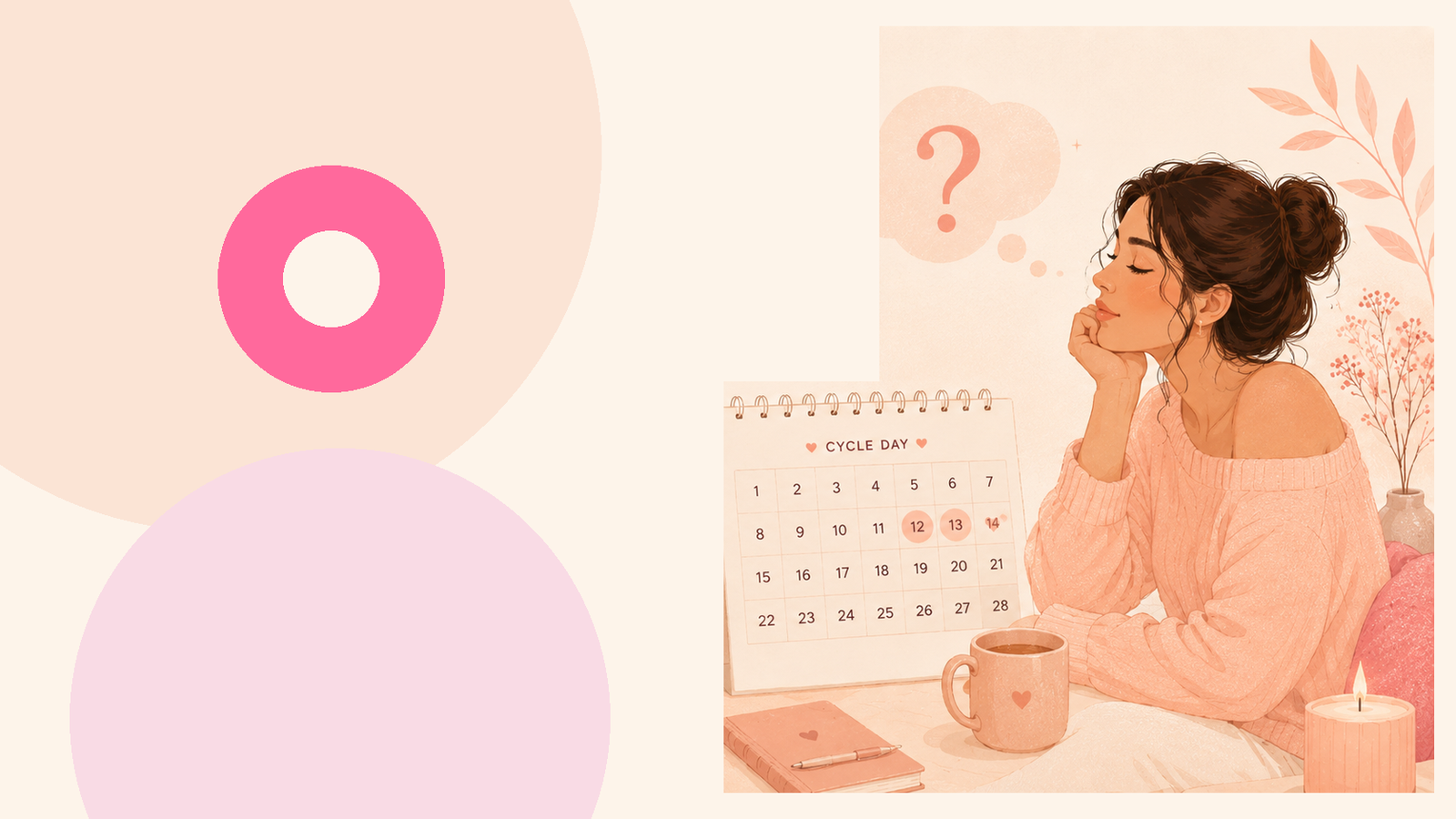
The word regular gets used loosely. In a medical sense, a regular period is one that follows a predictable pattern for you, not for a textbook. Your version of regular might be a cycle that arrives every 26 days. Someone else's regular might be every 32. Both can be perfectly normal as long as the rhythm holds reasonably steady over the course of several months.
What 'regular' really means for your period
The reason this matters: the moment you compare your body to a fixed 28-day chart, you can convince yourself something is wrong when nothing is. Most period education leans on that number because it makes the math easier, not because most people actually run on it. Real cycles are messier and more personal than that. Apps like Flow & Glow can help here because they surface your own pattern over time, instead of measuring you against an idealized cycle.
Throughout this article, when you read 'regular,' picture your own data, your own range, and your own week-to-week experience. That is the definition that actually counts.
Why the 28-day cycle is a myth for most people
The 28-day cycle is more of a teaching shortcut than a biological rule. In real life, most adult cycles run anywhere from 21 to 35 days, and a sizable share of people sit comfortably outside the magical 28-day point without any underlying problem. Large-scale tracking studies looking at millions of cycles consistently confirm this: the average sits closer to the high 20s, but the spread is broad and very normal.
So if your cycle is regularly 33 days, that does not mean it is irregular. It means your regular is 33. If your cycle is 25 days, that does not mean you are 'early.' It means your body's rhythm is shorter. The same logic applies to anywhere in that 21 to 35 range.
There is also a quiet trap with the 28-day idea: it implies ovulation always lands on day 14. That is rarely true. Ovulation timing depends on follicular phase length, which can vary considerably from person to person and even from cycle to cycle. If you want a deeper look at where ovulation actually sits in the picture, the science gets much friendlier when you think in cycle phases rather than a clean halfway-point assumption.
The takeaway: stop measuring yourself against day 14 or day 28. Start measuring yourself against yourself.
What 'regular' looks like in real numbers
To replace the 28-day fantasy, it helps to know what the actual normal ranges are. There is no single perfect cycle, but there are reasonable guardrails.
Cycle length
Counted from the first day of one period to the day before the next period starts. Most adult cycles fall between 21 and 35 days. After your teen years and before perimenopause, that range is generally healthy. If you want a deeper breakdown of what makes a length normal and when length changes are worth noting, see normal cycle length.
Period length
Anywhere from about 2 to 7 days of bleeding is typical. Some people have a quick, light 3-day bleed. Others have a heavier 6-day bleed. Both can fit comfortably into a regular pattern.
Flow
Volume varies a lot, but the rough sanity check is whether you are soaking through pads or tampons unusually fast, passing large clots regularly, or feeling lightheaded or wiped out from blood loss. None of that is your body's version of normal even if it has always been that way for you.
Symptoms
PMS-style symptoms in the days before a period, mild cramping in the first day or two, breast tenderness, mood shifts, and acne flares are all common. Severe pain that interferes with daily life is not the same as expected discomfort.
Cycle-to-cycle variation
Your own length can swing by a few days from one cycle to the next and still be considered regular. Most clinicians treat variation of less than 7 to 9 days between your shortest and longest cycle as within a normal range for adults.
These numbers are not a checklist of perfection. They are a reference range. Your goal is not to land exactly on average. It is to find your own personal pattern inside the normal range, and to notice when something genuinely moves outside of it.
Normal variation versus actually irregular
This is where most worry begins, and it is also where most worry can be reassured. Normal variation and 'irregular' are not the same thing.
Normal variation looks like:
- A 28-day cycle one month, a 31-day cycle the next, a 27-day the month after.
- A slightly heavier flow during a stressful season but no other big changes.
- An extra day or two of light spotting after a busier or sicker month.
- Slightly different PMS symptoms cycle to cycle.
Actually irregular, in the clinical sense, tends to look like:
- Big swings in cycle length, where some months are 22 days and others are 45 days, repeating.
- Missed periods for several months without an explanation like pregnancy, perimenopause, or starting a new birth control method.
- Bleeding that goes on much longer than your usual pattern, more than 7 to 8 days.
- Unusually heavy bleeding that soaks through protection in an hour or that makes you feel weak.
- Frequent bleeding between periods.
A single off cycle rarely qualifies as a real pattern of irregularity. Bodies adjust to travel, illness, stress, intense workouts, dieting, and sleep deprivation in ways that can briefly bend your timing. What matters is whether the off pattern persists across multiple cycles.
If you suspect you fall into the second list, especially across several cycles, the article on irregular periods walks through what counts as irregular, what underlying causes can drive it, and how clinicians typically investigate.
What can quietly shift your 'regular'
Cycles are not isolated from the rest of your life. The body treats reproduction as an optional system that gets dialed up or down based on whether the rest of you seems okay. That is why so many real-life factors can move your timing without anything being broken.
Common shifters include:
Stress
Chronic or acute stress can delay ovulation, which delays the next period. A late period after a brutal work month is one of the most common explanations there is. It does not mean something is wrong. It usually means your body postponed a step until the storm passed.
Travel and time zone changes
Big jet lag, late nights, and disrupted light exposure can shuffle hormone timing for a cycle or two. Long-haul travel especially tends to show up as a slightly longer than usual cycle.
Illness and fever
A high fever or significant illness around the time of expected ovulation can push the next period later than usual. Even an ordinary flu can leave its fingerprints on a cycle.
Sleep loss
Short, broken sleep does not just make you tired. It can interfere with the hormonal signaling that drives ovulation timing. Sustained poor sleep is one of the most overlooked cycle disruptors in busy young adults.
Weight changes
Quick weight loss, low energy availability, and very high training loads can lengthen cycles or cause them to skip. Significant weight gain can have its own effects on cycle length and flow. Both ends of the spectrum can change your pattern.
Intense exercise
Endurance training or a sudden ramp-up in activity, especially paired with calorie deficits, can pause or shorten cycles. Someone training for a long race who suddenly loses their period is a classic example.
Birth control changes
Starting, stopping, or switching hormonal birth control can produce months of unpredictable bleeding while your body recalibrates. This is expected and usually not a sign of damage, though it is worth tracking so you and your clinician have data if something stays off.
Postpartum and breastfeeding
Cycles do not usually return to a predictable rhythm right away after childbirth, especially with breastfeeding. It can take many months to settle. The transition back to your previous regular often happens in stages.
Approaching perimenopause
Even in the late 30s and 40s, cycles can start shifting in length and flow as hormonal patterns change. This is not directly relevant to most 18 to 30 readers, but it is worth knowing as a future reference point.
The reason this list matters: a single irregular cycle is much more likely to be one of these inputs than a serious medical issue. Knowing this can save you from a lot of unnecessary worry, while still helping you see when something persistent or genuinely odd shows up.
A simple way to know your own pattern
You do not need a complicated system to find your regular. You need a small, consistent record of a few inputs over several cycles. The goal is to replace memory with data.
A useful baseline log includes:
- The first day of each period (this defines your cycle length).
- The number of bleeding days.
- A simple flow rating, like light, medium, or heavy.
- Any notable symptoms (cramps, mood, headaches, breast tenderness, acne).
- Any meaningful life inputs (heavy travel, illness, big training week, stressful event).
After about three months of this, you usually start to see your pattern. After six months, you can spot real outliers. After a year, you have a personal baseline that is genuinely useful when something does shift.
What you do not need: perfect precision, every symptom every day, mood ratings on a 10-point scale, or a complex spreadsheet. Light, consistent notes always beat detailed inconsistent ones. For a practical breakdown of what is actually worth writing down and what to skip, see period tracker notes.
If you would rather not log on paper, this is exactly the use case an app is built for. The point is not to gamify your period. It is to remove guesswork so that when you do wonder whether your cycle is normal, you have your own evidence ready to look at.
How to talk about your cycle with a clinician
You do not need to wait until something is wrong to talk to a clinician about your cycle. But when you do, bringing real data makes the conversation much sharper. A useful 60-second summary tends to look like:
- Your usual cycle length range (for example, 28 to 32 days).
- Your typical period length and flow.
- The change you are noticing now (timing, flow, pain, duration).
- How many cycles the change has lasted.
- Anything else that changed in your life around the time the cycle changed (stress, new medication, new birth control, weight changes).
That summary moves the conversation forward faster than 'I think my periods are weird,' and it makes it more likely you get a precise answer instead of a general one.
Specific situations that are worth a non-urgent appointment:
- A clear shift in your pattern lasting three or more cycles.
- A new level of pain that is not relieved by usual measures.
- Bleeding longer than usual, more than 7 to 8 days.
- Bleeding between periods more than once or twice.
- Cycles consistently shorter than 21 days or longer than 35 days, after the initial teen years and outside known life changes.
Specific situations that are worth more urgent attention:
- Soaking through a tampon or pad in an hour for several hours in a row.
- Severe pain you cannot function through.
- Feeling lightheaded, dizzy, or significantly weak with bleeding.
- Possible pregnancy with bleeding or severe abdominal pain.
- Bleeding after sex repeatedly or signs of infection like fever and unusual discharge.
None of this is meant to scare you. The vast majority of cycle questions resolve into 'this is your version of normal' or 'this is a temporary blip.' But knowing the line between routine and urgent gives you confidence to act when it actually matters.
Why 'regular' is mostly a story you build over time
There is one last reframe worth sitting with. Regular is not something a doctor stamps on your chart after a single visit. It is something you build over multiple cycles of paying attention. The story your body tells is not loud. It is steady, and it shows up in small repeating signals.
You learn that your energy dips at the same point most months. You notice that two days before your period, your sleep gets a little choppy. You realize your skin almost always reacts the week before your bleed. You catch that you crave salt in the late luteal week or that your mood softens after ovulation. None of this is in a textbook. All of it is your version of regular.
This is also why so much of cycle awareness is empowering rather than clinical. When you know your pattern, late periods stop feeling like vague threats. Heavy weeks stop feeling random. Mood crashes stop feeling like personality flaws. The information your body is sending is consistent. You just have to be set up to receive it.
That is the whole point. Regular is not a number. Regular is a rhythm. The more clearly you see your own, the more useful every cycle becomes.
Article information
- Written by Jessica Morrison, MS in Health Communication, CHES
- Medically reviewed by Dr. Sofia Reyes, MD, FACOG
- Last medically reviewed on May 25, 2026
- Published on May 25, 2026
- Updated on August 13, 2026
Key takeaways
- Regular does not mean identical. It means predictable within a small window for your body.
- Most adult cycles run 21 to 35 days. Variation of a few days month to month is common and usually fine.
- One off month is rarely a problem on its own. Patterns matter more than single cycles.
- True irregularity tends to look like big swings, very long gaps, or new heavy bleeding lasting several cycles.
- Stress, travel, illness, weight changes, sleep loss, and birth control changes can all nudge timing.
- A simple log of start date, length, flow, and key symptoms beats trying to remember.
- See a clinician for sudden major changes, soaking through protection hourly, severe pain, or missed periods with possible pregnancy.
Frequently asked questions
Is a 30-day cycle still regular?
Yes. Anywhere from 21 to 35 days is considered a normal adult cycle length, so a 30-day cycle is well inside that range. The bigger question is whether your cycle hovers around 30 most months. If it stays in that area give or take a few days, your regular is just a 30-day cycle, and that is completely fine.
How much can my cycle vary and still be considered regular?
Variation of a few days from cycle to cycle is normal. As a rough guide, if the difference between your shortest and longest cycle over the past year is less than about 7 to 9 days, most clinicians still consider that regular. The number alone is less important than whether your overall pattern is steady when you zoom out across several months.
Does an irregular period mean something is wrong?
Not always. A single off month is usually a response to stress, illness, travel, sleep, or training, not a sign of disease. Patterns of irregularity across several months are different. If you keep seeing large swings, missed periods without an obvious explanation, or new heavy bleeding lasting more than a few cycles, that is worth a real conversation with a clinician.
Can stress change my cycle length?
Yes, and it is one of the most common reasons for a delayed period. Stress can push back ovulation, which then pushes back your next bleed. A high-pressure month often shows up as a longer than usual cycle. If your stress eases and your next cycle settles back into your range, that is normal cycle variation, not a problem.
How long should I track before I know my pattern?
Most people start to see a pattern after about 3 months of consistent tracking. After 6 months, you usually have a strong sense of your normal range and your usual symptoms. A full year gives you the most useful baseline, especially when life events or seasons might be shifting things in the background.
Are periods supposed to start at the same time each month?
No, and they are not even on a true monthly schedule for most people. Cycles run on their own length, not on the calendar. A 28-day cycle drifts earlier in the calendar month over time, and a 32-day cycle drifts later. Same day of the month is not the standard. Same length cycle to cycle is the more useful goal.
What counts as a 'skipped' period?
For most people, missing one expected period qualifies as a skipped cycle. The most common explanations are pregnancy, hormonal birth control, big life changes like stress or weight shifts, or temporary disruptions like illness. If there is any chance of pregnancy, take a test before assuming the cause is something else. Two or more missed periods in a row without an explanation is a clear reason to check in with a clinician.
References
- American College of Obstetricians and Gynecologists. (n.d.). The menstrual cycle Source
- Bull, J. R., Rowland, S. P., Scherwitzl, E. B., Scherwitzl, R., Danielsson, K. G., and Harper, J. (2019). Real-world menstrual cycle characteristics of more than 600,000 menstrual cycles. npj Digital Medicine Source
- Cleveland Clinic. (n.d.). Menstrual cycle Source
- National Health Service. (n.d.). Irregular periods Source
- Office on Women's Health. (n.d.). Your menstrual cycle Source
- Reed, B. G., and Carr, B. R. (n.d.). The normal menstrual cycle and the control of ovulation. Endotext Source
Editorial and medical disclaimer
Flow & Glow health content is educational and is not a substitute for diagnosis, treatment, or personal medical advice from a qualified clinician.
Our editorial standards, reviewer process, sourcing approach, and correction process are explained in the Editorial Policy. You can also review our authors and medical reviewers, healthcare professional information, contact page, and privacy policy.