Menstrual Phase Workout: Gentle Movement for Low-Energy Days
A warm, blunt guide to gentle menstrual phase workouts. Low impact ideas, when to rest, and how to track what actually helps your body.
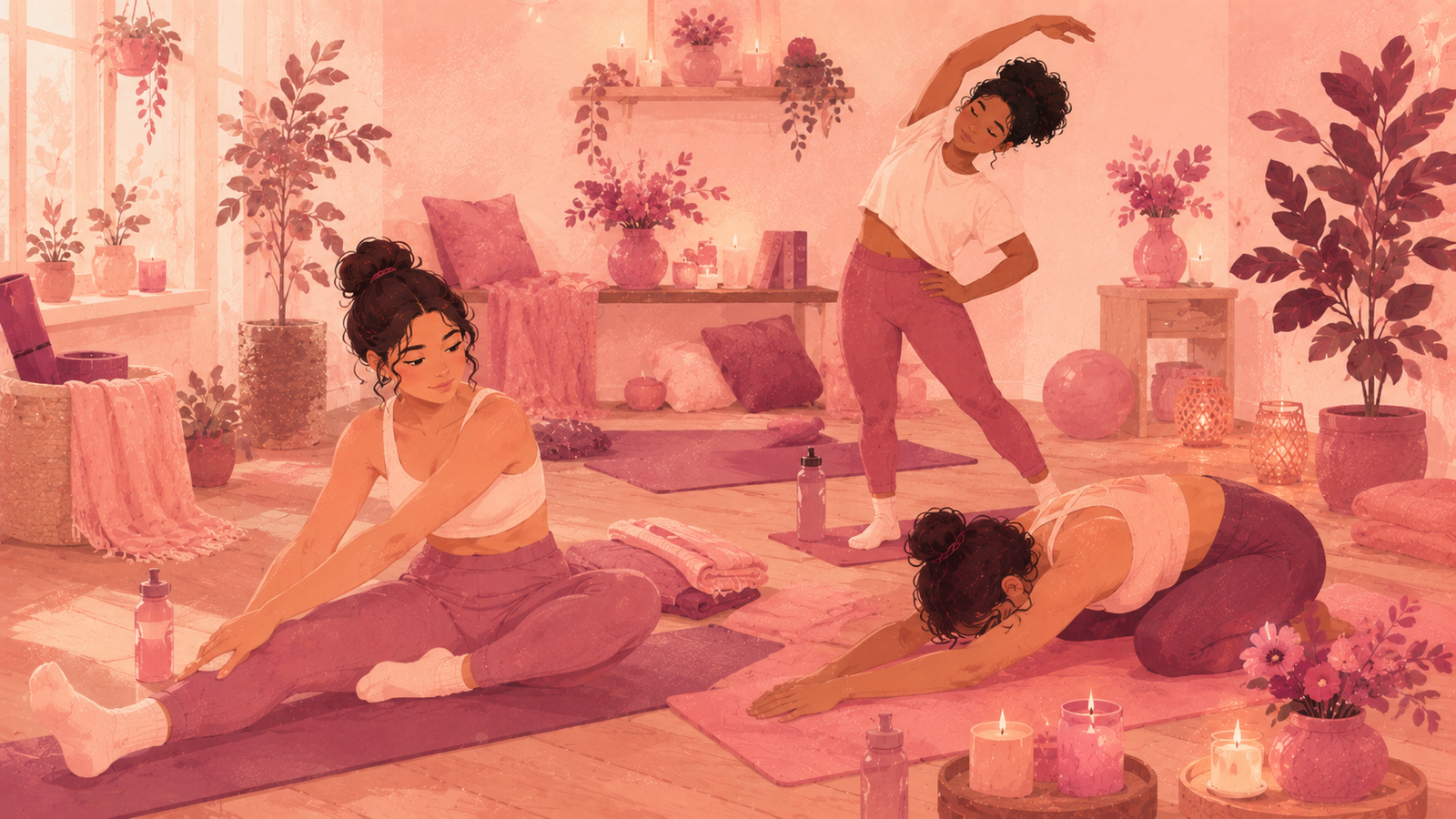
The menstrual phase begins on day one of bleeding. Hormones sit at their lowest point in the cycle, which is part of why energy can dip and mood can feel flat. The uterine lining is shedding, which involves contractions, prostaglandin activity, and sometimes inflammation. None of that is a moral failing. It is a normal physiological event with a real cost to your daily energy budget.
Your body during the menstrual phase
The intensity of these days varies a lot. Some people feel fine by day two and can train at most intensities without issue. Others spend the first 48 hours curled up with a heating pad and a hoodie. Both experiences are normal. A useful menstrual phase workout plan respects that whole range instead of pretending everyone needs the same thing on the same calendar day.
What tends to shift during these days: - Energy availability dips because hormones, sleep quality, and iron status all move. - Pain sensitivity can be slightly higher. - Coordination and balance can feel a little off. - Bloating can change how clothes and certain positions feel. - Mood and motivation can swing low even when life is otherwise fine.
The smartest framing is this: you are not lazy when your body is doing the work of a period. You are doing biological labor. Movement should support that, not override it.
Should you work out on your period at all?
Yes, if it feels okay. No, if it does not. That sounds glib, but it is the honest answer.
The research on exercise during your period is broadly encouraging. Gentle to moderate activity does not harm your cycle, can reduce some symptoms for many people, and is safe to continue if you feel well. There is no rule that says you must skip workouts on period days. There is also no rule that says you must show up.
Two ideas worth letting go of: 1. The idea that you have to push through to prove discipline. 2. The idea that you have to fully rest to be doing it right.
The right answer changes day by day, and even hour by hour. A flexible approach beats a heroic plan that ignores how you actually feel.
This is where a planning tool earns its place. Flow & Glow lets you log how a workout felt next to your symptoms, so patterns can emerge over a few cycles. That kind of personal data is more useful than any general rule on the internet, including the rules in this article.
A simple menstrual phase workout menu
Treat the next section as a menu, not a schedule. Pick the level that matches your energy on the day you are reading it. You can move up or down a level mid-workout if your body changes its mind.
Level zero: full rest
What it looks like: bed, couch, heating pad, hydration, sleep, no guilt.
When to choose it: severe cramps, heavy flow that needs to be managed every hour, migraines, fever, dizziness, vomiting, fatigue that feels different from normal tired, or any day when your gut says rest.
Why it counts: rest is part of training. It is not a failure to skip. It also reduces the risk of pushing through pain that has a medical cause you have not investigated yet. Treat rest days as deposits, not withdrawals.
Level one: very gentle movement
What it looks like: 10 to 20 minutes of slow walking, gentle stretches on the floor, restorative yoga shapes, or simple breathing work.
When to choose it: mild cramps, low energy, normal flow, no other warning symptoms. You are not trying to elevate your heart rate. You are trying to feel slightly better than you did before you started.
Shapes that often feel good at this level: - Child's pose with a pillow under the chest - Knees to chest while lying on your back with slow breathing - Cat and cow at any pace - Seated forward fold with a soft bend in the knees - Legs up the wall for five minutes - A slow loop around your block in comfortable clothes
Level two: easy steady cardio and mobility
What it looks like: 20 to 40 minutes of easy walking, easy cycling, swimming if you are comfortable with period products in water, or a low-impact mobility session.
When to choose it: you feel mostly fine, flow is manageable, cramps are mild or gone.
Aim for the lower end of perceived effort. You should be able to talk in full sentences without panting. If breath becomes choppy or pain spikes, dial it back. There is nothing to prove on day three.
Level three: light strength
What it looks like: a short, controlled strength session. Compound moves, lighter loads than usual, longer rest, fewer total sets.
When to choose it: day three or later, energy returning, no acute pain.
A sensible session shape: - 5 to 10 minutes of warm up - 3 or 4 main movements (a squat, a hinge, a push, a pull) - 2 or 3 sets each, leaving 3 to 4 reps in the tank - Skip max attempts and skip high-skill explosive work - End early if anything feels off
You are not losing fitness by training easy for a few days. You are protecting the energy that lets you train hard the rest of the month.
Level four: business as usual
Some people genuinely feel fine on their period and want to train at their normal intensity. That is allowed. Listen to symptoms in real time and pull back if they show up. The point of energy-based planning is not to force every period into a soft category. It is to stop forcing your worst day to look like your best day.
For a deeper menu organized by energy state instead of phase, see our guide on low-energy workouts.
Cramps and movement
Cramps are the most common reason people skip workouts during their period. Here is the practical truth.
For mild cramps, light movement can sometimes help. Gentle stretching, walking, and warmth often take the edge off. The reasoning is straightforward: easy movement increases circulation, relaxes some tense muscles, and gives your nervous system something else to focus on for a while.
For moderate to severe cramps, the answer is not push harder. Severe pain is information. It is your body telling you that something is asking for more than just a different mindset.
If cramps are getting worse year over year, or if they interfere with school, work, or sleep most cycles, that is worth taking seriously. We have a separate guide on period cramps that walks through when this stops being normal monthly discomfort and starts being something to bring to a clinician.
Movement options that often pair well with cramps: - A 10 minute slow walk in soft shoes - Pelvic tilts on the floor with slow breathing - Hip circles on hands and knees - Standing side bends - A short stretch sequence with long, slow exhales - A warm shower followed by a few minutes of light stretching
Movement options to skip when cramps are loud: - High-intensity intervals - Heavy lifting - Long endurance sessions - Anything that requires holding your breath under load - Inversions if they make you feel worse - Workouts you are only doing because the app or plan said so
Pain boundaries you should not push past
A reasonable menstrual phase workout never crosses these lines.
Stop and reassess if: - Pain spikes sharply during a movement. - You feel dizzy, faint, or nauseated. - Flow becomes much heavier than your normal period, soaking through products every hour or two for several hours in a row. - You pass clots that are larger than a quarter and this is unusual for you. - You feel a pulling, tearing, or sharp pelvic pain that is new. - You feel feverish. - Your breath is shallow and you cannot calm it down with slow inhales. - You feel like something is wrong, even if you cannot name it.
Heavy bleeding, severe pain, dizziness, faintness, fever, or sudden changes in your cycle deserve a clinician's eye, not a tougher workout. Skipping a session in that situation is the smart, mature, athletic choice.
Planning by energy, not by date
This is the single shift that helps most. Instead of telling yourself Monday is leg day no matter what, ask one question first: what is my energy today?
A three-question check before any workout during your period: 1. Did I sleep enough that I feel reasonably rested? 2. Are cramps and flow at a level I can move with? 3. Am I in a good or neutral mood, or am I powering through dread?
If two or three answers are yes, go gentle to moderate. If only one is yes, stay very light or rest. If none are yes, rest is the workout.
Logging this in Flow & Glow across a few cycles tends to reveal patterns you cannot see in a single month. Maybe you always feel awful on day one but bounce by day three. Maybe heavy flow predicts a brutal cramp day. Maybe a poor night of sleep two days before bleeding tanks the whole week. None of these are universal rules. They are your patterns, and they get clearer with consistent logging.
A practical workflow: - Log bleeding days as they happen. - Log workouts with a quick energy score and any symptoms. - After two or three cycles, look back and notice what clusters together.
You will often find that your truly hard days sit in a predictable window. You can plan optional sessions, rest days, and lighter weeks around that window without committing to a rigid schedule.
Food, hydration, and iron
Movement does not happen in a vacuum. A few simple inputs often make a meaningful difference during the menstrual phase.
Eat enough. Under-eating on period days makes everything worse, including cramps, mood, and the energy you have for any workout. Protein, fiber, and complex carbohydrates are friendly defaults. A real meal beats a granola bar.
Hydrate. Bleeding plus light dehydration plus a workout is a recipe for feeling lightheaded. Keep water close.
Mind iron. Iron loss from monthly bleeding is real for many people who menstruate. If you regularly feel exhausted around your period and you have not had iron levels checked in a while, ask a clinician. Treating low iron is not optional vitamin marketing. It can transform how you feel through the whole month, not just the bleeding days.
Caffeine and alcohol can make cramps and sleep worse for some people and feel fine for others. Notice your patterns rather than following a one-size rule from a stranger online.
Sleep before and during your period
Sleep often gets worse in the days leading up to bleeding and on heavy flow nights. Poor sleep then makes workouts feel harder and makes pain feel louder. It is a quiet loop that drains the whole week if you ignore it.
If you notice that your sleep falls apart the week before your period, that is worth treating as its own problem instead of just powering through. Our guide on sleep before your period covers what is common, what is not, and how to set up the boring basics that help most.
A simple rule for menstrual phase workouts: never trade an hour of sleep for an hour of training when your body is already low on resources. You will not get back what you spend.
Common mistakes during period workouts
A few mistakes show up over and over in people who get frustrated with movement during their period.
Mistake one: following a fitness plan that ignores your cycle entirely. Some plans are written for people who do not menstruate, or for athletes whose income depends on training through almost anything. Most people are not paid to push through period pain.
Mistake two: copying a rigid hormone-based plan from social media. The fasted high-intensity on day one is the secret content is not based on how most people actually feel. If a plan tells you to do an aggressive workout on the day you can barely sit up, the plan is wrong, not your body.
Mistake three: not adjusting expectations. Strength can dip slightly on heavy flow days for some people. That is normal. It does not mean you are losing progress. It means a different day is not the day for a personal record.
Mistake four: skipping food before and after. This compounds fatigue and cramps for almost everyone.
Mistake five: ignoring warning signs. Severe pain, heavy bleeding, and faintness are not signs of toughness. They are signs to stop and check in with a clinician.
How Flow & Glow fits into all of this
The point of cycle tracking is not to micromanage every single workout. It is to give you a clearer picture of what your body actually does over weeks and months.
A useful workflow looks like this: 1. Log bleeding days as they happen. 2. Log each workout with an energy score from one to five and any symptoms. 3. After two or three cycles, look back at the pattern.
What you will often see is that your hardest days cluster in a predictable window and your easier days do too. That makes it easier to plan optional sessions, rest days, and lighter training weeks without trying to predict every day in advance.
For a broader look at what tends to feel best on bleeding days, see our roundup on best workouts during your period. It pairs well with this guide and shows specific session shapes you can copy.
When to talk to a clinician
Period workouts are not a substitute for medical care, and pushing through pain can mask problems that deserve attention.
Reach out to a qualified clinician if: - Cramps interfere with school, work, or normal activities most cycles. - Bleeding is so heavy that you soak through pads or tampons every hour for several hours in a row. - You pass clots larger than a quarter regularly. - Your cycle becomes much shorter, much longer, or stops without an obvious reason. - You feel faint, dizzy, or short of breath during normal daily life. - You have fever along with pelvic pain. - You suspect pregnancy, infection, or an STI. - Pain is new, sharp, or one-sided. - You have a known condition like endometriosis or PCOS and your symptoms shift.
Clinicians are not just for emergencies. Workout choices can wait until you have answers. There is no version of fitness that is worth ignoring a serious symptom.
Putting it all together: a sample period week
This is one realistic shape. Yours will differ. Adjust to your own body and your own life.
Day one: rest or very gentle movement. Heating pad, slow walk, restorative shapes. Eat well, hydrate, sleep early.
Day two: still gentle. Maybe a 20 minute walk, some mobility, light stretching. Skip anything that requires bracing hard or holding your breath.
Day three: see how you feel. If energy is returning, try easy steady cardio or a short, light strength session.
Day four: many people start feeling more like themselves. A normal but not maximal session is reasonable.
Day five and beyond: usually back to normal training, with attention to how the rest of the cycle plays out.
The goal is not to look impressive on these days. The goal is to feel functional, to listen to clear warning signs, and to protect the energy that lets you train well across the whole month.
Article information
- Written by Jessica Morrison, MS in Health Communication, CHES
- Medically reviewed by Dr. Sofia Reyes, MD, FACOG
- Published on June 19, 2026
- Updated on August 13, 2026
Key takeaways
- The first 24 to 72 hours of your period often feel heavier than the rest of the cycle, and that is normal.
- Gentle movement can ease cramps for some people, but rest is just as valid a choice.
- Walking, mobility, restorative yoga, and light strength are sensible default options.
- Severe pain, heavy bleeding, dizziness, or fainting are signals to stop and seek care.
- Sleep, hydration, food, and iron status quietly shape how a period workout feels.
- Energy-based planning beats rigid calendar plans during the menstrual phase.
- Skipping a few sessions a month does not undo your fitness.
Frequently asked questions
Is it bad to skip workouts during my period?
No. Resting on heavy or painful days is a reasonable choice, not a failure. Many people who consistently rest on day one feel better and more able to train on day three or four. Skipping a few sessions a month will not undo your fitness, and forcing a workout through severe pain can mask symptoms that deserve attention.
Can I lift weights on my period?
Yes, if you feel up to it. Many people lift comfortably during the menstrual phase, especially from day two or three onward. Some notice their lifts dip slightly on heavy flow days, which is normal and not a sign of lost progress. Drop the load if anything feels off, skip max attempts, and end the session early if pain spikes.
What workouts help period cramps?
For mild cramps, slow walking, gentle stretching, pelvic tilts, hip mobility, and restorative yoga shapes can help some people. Warmth, hydration, and rest also matter. For severe cramps, movement is not the fix on its own, and the right move may be to rest and talk to a clinician about pain management.
Should I do cardio on my period?
Easy cardio is generally fine if you feel up to it. Walking, easy cycling, and easy swimming are sensible options. High-intensity intervals can feel rough on heavy flow days. Save the hard sessions for days when your body says yes instead of forcing them into a calendar slot.
Will exercise make my period heavier?
For most people, no. Light to moderate exercise does not meaningfully change flow. Very intense training paired with chronic under-eating over time can disrupt the cycle, but that is a long-term pattern, not a single workout problem. If you notice unusual changes in flow or cycle length, talk to a clinician.
Is yoga good during the menstrual phase?
Gentle yoga shapes are a popular and reasonable choice during your period. Slower flows, restorative shapes, and breathing work tend to feel best. Skip very intense or very hot styles if they make symptoms worse, and avoid any pose that triggers pain. Comfort beats discipline on bleeding days.
How do I know if my period symptoms are too severe to exercise?
Trust your body. If pain is intense, flow is unusually heavy, or you feel dizzy, faint, feverish, or generally unwell, do not exercise. Symptoms that interfere with daily life over multiple cycles deserve a clinician's attention, not a harder workout. Stopping when something feels wrong is the most athletic thing you can do.
References
- ACOG. Dysmenorrhea: painful periods Source
- Office on Women's Health. Premenstrual syndrome Source
- NHS. Exercise Source
- Cleveland Clinic. Exercising on your period Source
- Armour, M., et al. (2019). Exercise for dysmenorrhea Source
- McNulty, K. L., et al. (2020). Menstrual cycle phase and exercise performance Source
Editorial and medical disclaimer
Flow & Glow health content is educational and is not a substitute for diagnosis, treatment, or personal medical advice from a qualified clinician.
Our editorial standards, reviewer process, sourcing approach, and correction process are explained in the Editorial Policy. You can also review our authors and medical reviewers, healthcare professional information, contact page, and privacy policy.