Free Period Tracker App vs Paid Period Apps: What Actually Matters
Compare free period tracker apps and paid period apps by privacy, symptom notes, predictions, exports, ads, and when upgrading is worth it.
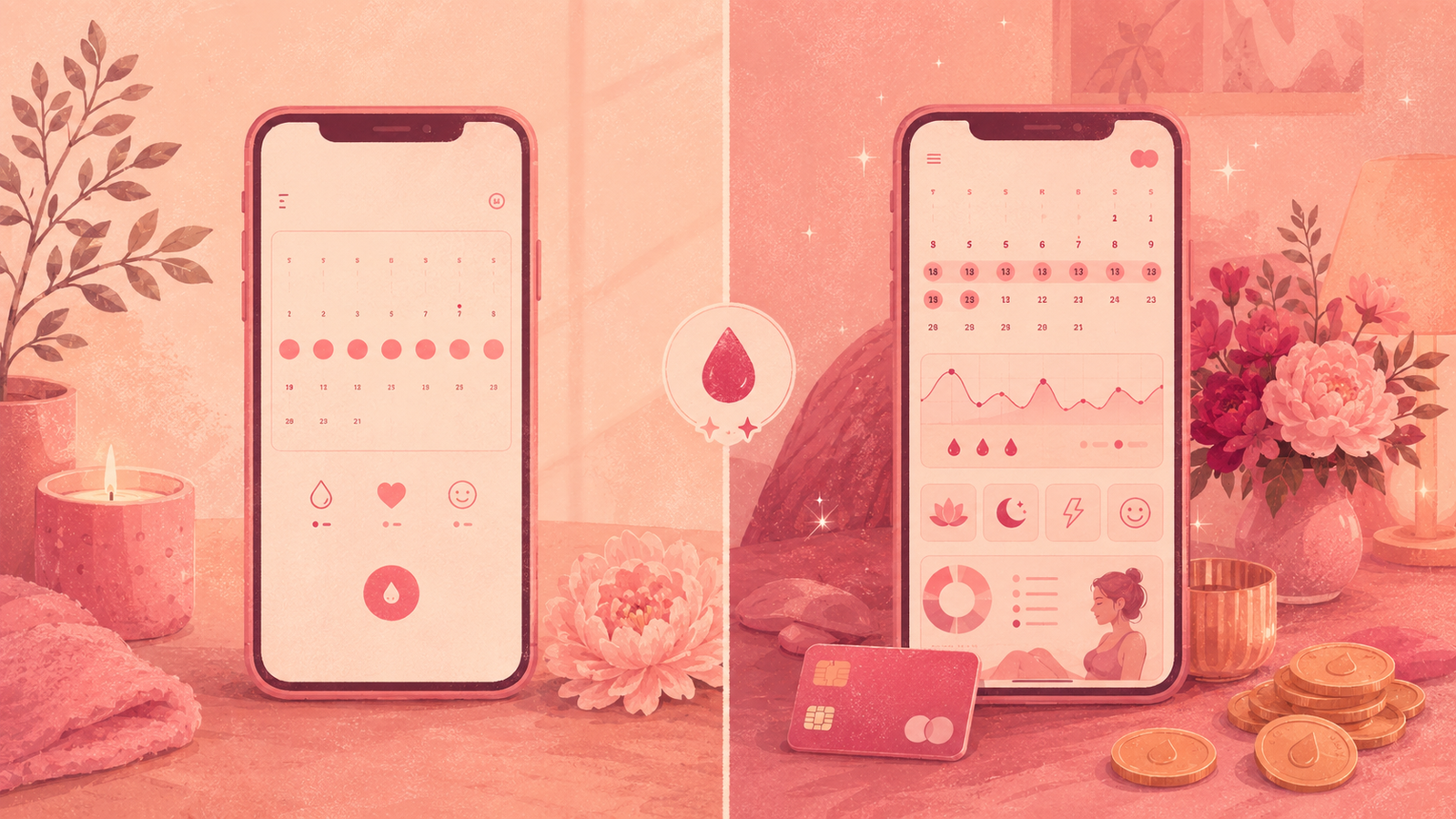
Choosing between a free period tracker app and a paid period app can feel more complicated than it should. Some apps promise accurate predictions, fertility windows, symptom insights, mood tracking, cycle reports, partner sharing, community forums, reminders, wellness coaching, and premium charts. Others keep things simple: log your period, add symptoms, see your estimated next period, and move on with your day.
The real question is not whether free is always enough or paid is always better. The real question is whether the app helps you understand your cycle without making you feel watched, judged, confused, or pushed toward features you do not need.
A good period tracker should make your health information easier to use. It should help you notice patterns, prepare for your next period, track symptoms that matter to you, and keep a record you can share with a clinician if you choose. It should also treat your cycle data as sensitive. That matters whether the app is free, paid, or somewhere in between.
If you are looking for a calmer place to start, Flow & Glow is designed as a period tracker with a health library, symptom notes, and a focus on practical cycle awareness rather than noisy wellness pressure.
This guide compares free period tracker apps and paid period apps in plain language. It explains what actually matters, what is nice but optional, what can be misleading, and how to choose an app that fits your body, privacy comfort, budget, and stage of life.
Why This Choice Feels So Hard
Period tracker apps sit at the intersection of health, privacy, money, convenience, and emotion. You may open the app when you are tired, in pain, worried about a late period, trying to conceive, avoiding pregnancy, managing symptoms, or simply trying to remember when your last cycle started.
That means the app is not just a calendar. It can become a record of intimate health details. It may include bleeding dates, cramps, mood changes, sex, discharge, medication, pregnancy tests, contraception, ovulation signs, headaches, digestive symptoms, sleep, energy, and notes about stress.
When an app asks for that much information, it should earn your trust. The challenge is that many apps look similar on the surface. They may all have pastel colors, a calendar, reminders, and a prediction screen. The differences are often buried in the details: how much you can log, how the app explains predictions, whether it pushes paid features at stressful moments, what happens to your data, and whether the app lets you leave with your history if you change your mind.
Price is only one part of the decision. Free can be generous and useful. Free can also mean ads, data collection, limited controls, or constant upgrade prompts. Paid can mean a calmer experience with better tools. Paid can also mean expensive extras that do not add much clinical value.
The goal is not to find the fanciest app. The goal is to find the one that supports your actual needs.
What A Period Tracker App Should Do Before Anything Else
Before comparing free and paid options, it helps to define the basics. A period tracker should do a few things reliably.
First, it should let you log the first day of your period. This is the anchor point for most cycle calculations. Many people also want to track the last day of bleeding, flow level, spotting, cramps, mood, energy, headaches, breast tenderness, acne, bloating, cravings, sleep changes, bowel changes, and other symptoms.
Second, it should show your history in a way that is easy to understand. You should be able to see cycle length, period length, missed or late periods, and symptom patterns over time. If the app makes you dig through confusing screens just to answer when was my last period, it is not doing its core job well.
Third, it should make predictions carefully. Your next period date is an estimate based on your past data. If your cycles are regular, the estimate may be useful for planning. If your cycles vary, the estimate may shift. The app should not present predictions as certainty.
Fourth, it should help you add context. A late period can happen for many reasons, including pregnancy, stress, illness, weight changes, travel, intense exercise, medication changes, hormonal contraception changes, breastfeeding, and life stage changes. Notes are often more useful than a single prediction.
Fifth, it should respect privacy. Menstrual data is personal. A tracker should make it clear what information is stored, whether it stays on your device or in an account, what data is shared, whether you can delete it, and whether you can export your history.
If an app does these basics well, it may be more useful than a premium app with many extra screens.
Free Period Tracker Apps: What You Usually Get
Free period tracker apps usually offer basic cycle logging, calendar views, period predictions, and reminders. Many also include symptom tracking, mood tracking, fertility window estimates, articles, and simple statistics.
For many people, that is enough. If your main goal is to remember your last period, prepare for your next one, and keep a quick record of symptoms, a free app can be practical and perfectly reasonable.
Free apps can be especially helpful if you are new to tracking. You can learn what you actually use before paying for features. You may discover that all you need is a calendar, a few symptom tags, and a notes section. Or you may realize that you need more structure, more privacy, or better exports.
However, free apps vary widely. Some are simple and respectful. Others rely on advertising, broad data collection, or upgrades that interrupt the experience. A free app may also limit features that become important later, such as detailed symptom history, custom tags, data export, or ad free use.
The main advantage of a free app is access. You can begin tracking without a subscription. The main risk is that the business model may be unclear. If you are not paying with money, it is worth asking how the app is funded and whether that creates tradeoffs you are comfortable with.
Paid Period Apps: What You May Be Paying For
Paid period apps usually promise a more complete experience. This may include advanced insights, deeper symptom tracking, personalized content, data export, ad free use, better design, fertility tools, pregnancy mode, wearable integrations, partner features, coaching, or premium educational content.
Some paid features can be genuinely useful. If you manage recurring symptoms, a paid app with flexible notes and trend views may help you prepare for appointments. If you dislike ads around sensitive health topics, paying for an ad free experience may feel worth it. If you want to download your cycle history before seeing a clinician, export tools can matter.
Paid apps can also reduce friction. A calmer interface, fewer popups, and better privacy controls can make tracking feel less stressful. That has value, especially if you open the app during painful or anxious moments.
Still, paid does not automatically mean better medical quality. A subscription does not guarantee accurate predictions, better privacy, or clinically useful insights. Some paid apps add features that look impressive but do not change your day to day health decisions much.
Before paying, ask what problem the paid feature solves. Does it help you track symptoms more clearly? Does it reduce ads? Does it protect your data better? Does it let you export records? Does it support a specific goal, such as preparing for a medical appointment or understanding irregular cycles? If the answer is mostly it looks nicer, that may still be valid, but it should be a conscious choice.
Accuracy: Free vs Paid Is The Wrong Question
Many people assume paid apps must be more accurate. That is not always true.
Period prediction accuracy depends on your cycle history, how consistently you log, how regular your cycles are, and how the app calculates estimates. If your cycles are usually 28 to 30 days and you log accurately, many basic apps can estimate your next period reasonably well. If your cycles range from 24 to 45 days, predictions will be less reliable no matter how much you pay.
Cycle length can naturally vary. Illness, stress, travel, sleep changes, intense exercise, weight changes, contraception changes, postpartum recovery, breastfeeding, and perimenopause can all affect timing. A tracker can show patterns, but it cannot know everything happening in your body.
Fertility predictions need even more caution. Many apps estimate a fertile window from calendar patterns. Ovulation does not always happen on the same day each cycle. If you are trying to avoid pregnancy, app based fertile window predictions should not be treated as contraception. If you are trying to conceive, they may offer a starting point, but they are not the same as individualized medical advice.
The better question is not free or paid. It is this: does the app explain that predictions are estimates, and does it help you understand your own pattern without overstating certainty?
Privacy: The Feature That Matters More Than It Looks
Period data is sensitive because it can reveal health patterns, reproductive information, sexual activity, pregnancy related concerns, and changes in wellbeing. Even if you personally feel relaxed about tracking, privacy is still worth taking seriously.
A good app should have a clear privacy policy written in understandable language. It should explain what data is collected, why it is collected, whether it is shared, whether advertising partners receive information, where data is stored, and how you can delete your account or data.
Free apps may rely more heavily on advertising or analytics. That does not automatically mean they are unsafe, but it means you should pay attention. Paid apps may have less need to monetize through ads, but they can still collect data. Price alone does not prove privacy.
Look for practical controls. Can you use the app without creating an account? Can you turn off optional tracking? Can you limit notifications? Can you delete entries? Can you delete your account? Can you export data before leaving? Does the app ask for permissions that make sense, or does it request access that feels unrelated?
If privacy is one of your top concerns, read more about what to look for in a private period tracker app. A privacy first tracker should feel calm and transparent, not vague or demanding.
Ads, Popups, And The Real Cost Of Free
A free app may not cost money, but it can still cost attention. Ads, popups, sponsored content, constant upgrade prompts, and emotionally loaded messages can make tracking feel less supportive.
This matters because of when people use period apps. You might open the app when your period is late, your cramps are intense, your mood feels low, or you are trying to make sense of symptoms. That is not the ideal moment for fear based prompts or confusing upsells.
Some free apps place premium prompts around the features people most want during uncertain moments, such as late period explanations, pregnancy related content, or deeper symptom insights. Others show ads that feel poorly matched to sensitive health tracking.
Paid apps often remove ads, which can make the experience feel more private and focused. But not every paid app is free from upselling. Some still push higher tiers, add ons, or partner offers.
When evaluating any app, notice the emotional tone. Does it help you calmly log information? Or does it make every cycle change feel like a crisis? Does it respect your attention? Or does it keep trying to pull you into more screens?
A good app should support your health awareness without turning your cycle into a source of constant worry.
Symptom Tracking: Where The Best Apps Stand Out
Symptom tracking is one of the biggest differences between a basic period calendar and a truly useful health tool.
At minimum, you may want to log cramps, flow, spotting, mood, headaches, acne, breast tenderness, bloating, fatigue, sleep, discharge, digestive changes, and medication use. Some people also track pelvic pain, pain during sex, nausea, dizziness, migraines, anxiety, food cravings, exercise, and stress.
The important thing is flexibility. Your symptoms may not fit a preset list. A good notes feature lets you add detail in your own words. For example, cramps after lunch, spotting after missed pill, migraine day before period, or heavier bleeding than usual. These details can be useful if you later talk with a clinician.
Paid apps sometimes offer richer symptom libraries and trend charts. That can help if you are tracking a condition, trying to understand recurring pain, or preparing for care. But a free app with clear notes can still be powerful.
If symptom tracking is your main goal, choose an app that lets you combine quick tags with written notes. You can learn more about this approach in a guide to using a period tracker with symptom notes.
Notes May Be More Valuable Than Fancy Charts
Charts can be helpful, but they are not everything. Sometimes the most useful feature is a simple note attached to a date.
A chart may show that your cycle was 36 days. A note may explain that you had flu, changed sleep schedules, traveled internationally, stopped a medication, or had a stressful week. A chart may show cramps. A note may explain where the pain was, how long it lasted, what helped, and whether it affected work or school.
This context matters. Bodies are not spreadsheets. A period tracker should help you remember the story behind the data.
Notes can also reduce anxiety. If your cycle is late and you can see that the same thing happened during a previous stressful month, you may feel more grounded. If you notice a symptom getting worse over several cycles, you have clearer information to bring to an appointment.
For many users, a free app with excellent notes is more useful than a paid app with beautiful charts but limited detail. If you like tracking in your own words, see how period tracker notes can support clearer cycle awareness.
When A Free Period Tracker App Is Probably Enough
A free period tracker app may be enough if your cycles are fairly regular and your needs are straightforward. You want to know when your last period started, estimate when the next one might come, record flow and cramps, and get a reminder before your period.
Free may also be enough if you are just starting to track. You may not know yet which features matter to you. Beginning with a simple app can help you build the habit without paying for tools you may not use.
A free app can also work well if you prefer minimal tracking. Not everyone wants to log mood, sex, discharge, medication, sleep, and symptoms every day. Some people only want a period calendar. That is valid.
Free may be a good fit if the app has no intrusive ads, does not pressure you to upgrade, has a clear privacy policy, lets you delete data, and includes enough notes or symptom tags for your needs.
The key is not whether the app is free. It is whether the free version respects you. If basic features are constantly interrupted, important information is locked, or the app feels pushy, the free version may not be the best value.
When Paying For A Period App May Be Worth It
Paying may be worth it if you have specific needs that a free app does not meet.
For example, if you experience recurring symptoms and want to track patterns over several months, premium trend tools may help. If you need to prepare for a clinician visit, exportable reports can be useful. If you want a calmer app without ads, a paid plan may make tracking feel safer and less distracting.
Paid may also be worthwhile if the app offers stronger privacy options, clear data controls, and less reliance on advertising. Again, you still need to read the policy, but paying can support a business model that is less dependent on ad targeting.
Some people pay because they are in a specific life stage. Trying to conceive, postpartum recovery, cycle changes after stopping birth control, perimenopause, or managing irregular cycles may make deeper tracking useful. Still, app insights should be treated as supportive information, not a diagnosis.
Before subscribing, check whether the feature you want is included in the plan. Look at cancellation terms, renewal price, and whether the app offers a trial. If the app offers a trial, test the exact feature you care about before the trial ends.
Features That Sound Important But May Not Matter Much
Many period apps compete by adding more features. Some are helpful. Some are mostly noise.
Daily wellness scores can be interesting, but they may not be medically meaningful. Mood predictions can feel validating for some people and limiting for others. Personalized insights can be useful when they are based on your actual data, but generic content may not be worth paying for.
Community forums can offer emotional support, but they may also spread misinformation or increase anxiety. Partner sharing can be helpful for some relationships, but it should always be optional and under your control. Wearable integrations may add convenience, but they do not automatically make period predictions reliable.
AI style summaries should be read carefully. They may organize your data, but they should not diagnose symptoms or tell you to ignore concerning changes. If an app suggests medical conclusions, it should be cautious, transparent, and clear about when to seek professional care.
A long feature list is not the same as a better app. The best features are the ones that help you take a next step: prepare for your period, understand a symptom pattern, remember important details, protect your privacy, or communicate more clearly with a healthcare professional.
Red Flags In Free And Paid Apps
Some warning signs apply to both free and paid period apps.
Be cautious if the app makes strong accuracy claims without explaining limits. Period predictions are not guarantees. Fertile window estimates should not be presented as a reliable way to avoid pregnancy.
Be cautious if the privacy policy is vague, hard to find, or filled with broad language about sharing data without clear choices. Sensitive health data deserves clarity.
Be cautious if the app asks for permissions that do not seem necessary. A period tracker usually should not need broad access to unrelated phone data for basic tracking.
Be cautious if the app uses shame, fear, or pressure. Your cycle can change for many reasons. An app should not make you feel broken because your body does not match a standard pattern.
Be cautious if useful features are locked at the exact moment you need reassurance, such as after logging a late period or unusual symptom. It is fair for apps to charge for premium tools. It is not helpful when the design uses anxiety to push upgrades.
Be cautious if you cannot easily delete your data or leave the app. A tracker should not make your health history feel trapped.
What To Check Before You Download
Before downloading a period tracker, spend a few minutes checking the basics.
Look at the app store listing. Does it explain what the app does in clear language? Are privacy labels available? Do recent reviews mention ads, bugs, billing issues, or confusing predictions?
Look at the app website. Is there a privacy policy? Does it clearly explain data collection and sharing? Is there a way to contact support?
Check the subscription details. Is the price clear? Is it monthly, annual, or lifetime? Does the app offer a free trial? What happens when the trial ends? Are cancellation steps easy to understand?
Think about your goal. Are you tracking for period reminders, symptom patterns, fertility awareness, irregular cycles, perimenopause changes, postpartum recovery, or appointment preparation? Different goals need different features.
Decide your comfort level with data. Are you comfortable with cloud sync? Do you want local only tracking? Do you want account free use? Do you need export options?
A few minutes of checking can save months of frustration.
How To Compare Apps In Your First Week
If you are deciding between a free and paid app, test them like tools, not like identities. You do not need to commit immediately.
During the first week, log a few normal entries. Add period dates if you have them, or start with your current cycle day if you know it. Try logging symptoms, mood, flow, and a written note. Set a reminder. Check how easy it is to edit an entry.
Then ask yourself practical questions. Can I find my last period start date quickly? Can I add the symptoms that matter to me? Do the reminders feel helpful or annoying? Does the app explain predictions clearly? Are upgrade prompts disruptive? Do I understand what happens to my data?
If you are testing a paid trial, use the premium features during the trial. Export a sample report if that is the reason you might pay. Try the trend view. Check whether the insights actually teach you something or simply restate what you already entered.
The best app should feel easier after a week, not heavier.
Privacy Checklist For Free And Paid Period Apps
Use this checklist before trusting any app with long term cycle history.
Can you use the app without entering more personal information than necessary?
Does the app explain what data it collects?
Does it explain whether data is shared with third parties?
Does it have ads or advertising partners?
Can you control notifications so sensitive information does not appear on your lock screen?
Can you delete individual entries?
Can you delete your account and data?
Can you export your cycle history?
Does the app require permissions that make sense for its features?
Does the company explain security in plain language?
Does the app avoid pressuring you to log information you do not want to share?
If you cannot answer these questions, that does not always mean the app is unsafe. But it does mean you should be careful, especially if you plan to log sensitive details over time.
For a quieter approach to menstrual tracking, it may help to compare apps with a private period tracker without the noise mindset.
The Role Of Period Apps In Medical Conversations
A period tracker can be useful during medical appointments because it turns memory into a record. Many people are asked about cycle length, last period, bleeding pattern, pain, missed periods, spotting, or symptom timing. It can be hard to remember these details on the spot.
A tracker may help you answer questions like: When did your last period start? How long do periods usually last? How heavy is bleeding? Are cycles becoming shorter or longer? Are cramps changing? Do headaches happen before bleeding? Is spotting new? Are symptoms affecting work, school, sleep, or daily life?
However, an app cannot diagnose you. It can show patterns and support conversations, but medical evaluation may be needed for severe pain, very heavy bleeding, bleeding after sex, bleeding after menopause, sudden cycle changes, missed periods with pregnancy possibility, or symptoms that worry you.
If you are concerned, do not wait for an app insight to confirm it. Your lived experience matters. If something feels unusual for you, it is reasonable to seek care.
Special Situations Where App Predictions Can Be Less Reliable
Some life stages and health situations make cycle prediction harder.
In the first few years after periods begin, cycles can be irregular. A tracker may still help you learn patterns, but predictions may change often.
After stopping hormonal contraception, your cycle may take time to settle. The app may need several natural cycles before estimates feel useful.
Postpartum cycles can be unpredictable, especially with breastfeeding. Ovulation can happen before the first period returns, so fertility predictions should be treated carefully.
Perimenopause can bring cycle changes, heavier or lighter bleeding, skipped periods, and new symptoms. Tracking can help you notice patterns, but predictions may be less stable.
Conditions that affect hormones or ovulation can also make cycles irregular. A tracker can support symptom history, but it should not replace medical care.
Stress, travel, illness, sleep disruption, intense exercise, and weight changes can temporarily affect cycle timing. Notes are helpful here because they add context to dates.
In all of these situations, a paid app may offer more tracking tools, but it cannot remove the natural uncertainty. The app should acknowledge that.
Free vs Paid For Teens And New Trackers
For teens and people who are new to periods, simplicity matters. A first tracker should make it easy to log bleeding and symptoms without creating fear or pressure.
A free app may be enough if it has a simple calendar, private settings, and understandable reminders. It should not push sexual health or fertility content in a way that feels confusing or inappropriate for the user. It should also have clear privacy settings and avoid unnecessary data collection.
Paid features are usually not necessary for basic early tracking. The priority is learning what is normal for the individual person: how often periods come, how long bleeding lasts, what cramps feel like, and which symptoms tend to appear.
Parents or caregivers helping a young person choose an app should pay attention to privacy, age appropriate content, ads, and notification wording. The young person should feel ownership and comfort with what is being tracked.
If periods are very heavy, very painful, absent for long stretches, or causing missed school or activities, tracking can help describe the issue, but support from a healthcare professional may be needed.
Free vs Paid For Trying To Conceive
People trying to conceive may be drawn to paid apps because fertility features are often marketed as premium tools. Some tools can be helpful, such as cycle history, ovulation test logging, cervical fluid notes, basal body temperature fields, and timing reminders.
But fertility predictions from an app are still estimates. If the app is based mainly on cycle dates, it may miss changes in ovulation timing. More detailed tracking may improve awareness, but it still does not guarantee accuracy.
A paid app may be worth it if it lets you track multiple fertility signs, export data, and review patterns clearly. It may not be worth it if it simply labels a fertile window without explaining uncertainty.
Trying to conceive can be emotionally intense. Choose an app that does not make you feel blamed or pressured. If tracking becomes stressful, it may help to simplify what you log.
If you have known fertility concerns, irregular cycles, recurrent pregnancy loss, or have been trying for a while without success, professional guidance may be more useful than adding another app feature.
Free vs Paid For Avoiding Pregnancy
This is one area where caution is especially important. Period tracker apps that estimate fertile windows should not be treated as contraception unless you are using a validated fertility awareness method with proper education and careful daily tracking.
Many apps predict fertile days based on past cycle length. That can be too simple for avoiding pregnancy. Ovulation can shift. Sperm can survive for several days. Cycles can vary. Illness, stress, sleep changes, and other factors can affect timing.
If avoiding pregnancy is important, talk with a qualified healthcare professional about contraception options or evidence based fertility awareness methods. Do not rely on a basic period app prediction alone.
Paid fertility features may look more sophisticated, but the same caution applies. Ask whether the app clearly explains how estimates are made and what they should not be used for.
A period tracker can still be useful for recording bleeding, contraception side effects, missed pills, symptoms, and pregnancy test dates. Just keep its limits clear.
Free vs Paid For Irregular Cycles
If your cycles are irregular, tracking can be very useful, but predictions may be less reliable. In this case, the value of an app is less about forecasting the exact next period and more about building a clear history.
You may want to track cycle length, missed periods, spotting, flow changes, pain, acne, hair changes, weight changes, mood, sleep, stress, exercise, medication, and other symptoms relevant to your situation.
A paid app may help if it offers better customization, long term charts, and exportable reports. But a free app with strong notes can still work well.
The most important thing is that the app does not treat irregularity as a personal failure. Bodies vary. Some irregularity can be normal in certain life stages, while some changes deserve evaluation. A good app should help you observe without shame.
If irregular cycles are new, persistent, or accompanied by other symptoms, consider seeking medical advice. Tracking can help you describe what has changed.
What About Cycle Insights And Health Education?
Many period apps include health articles, daily tips, or cycle phase explanations. These can be helpful if they are accurate, balanced, and not overly deterministic.
Be careful with content that says every person feels a certain way during each cycle phase. Some people notice energy, mood, appetite, sleep, or libido patterns. Others do not. Hormonal changes can influence symptoms, but life context matters too.
Good education should help you understand possibilities without boxing you in. It should use cautious language, explain when to seek care, and avoid making you feel that every mood or productivity change is controlled by your cycle.
Paid apps may offer larger content libraries, but quantity is not the same as quality. A smaller library with clear, medically cautious information may be more useful than a huge collection of generic wellness tips.
If an app gives health education, notice whether it separates general information from personal medical advice. It should not claim to diagnose conditions from basic logs.
How To Decide What Actually Matters To You
The best choice depends on your personal priorities. Use these questions to decide.
Do you mainly want reminders and a calendar? A free app may be enough.
Do you need to track symptoms in detail? Look for flexible tags and notes. Paid may help, but it is not required.
Do you want fewer ads and less noise? A paid app or a privacy focused free app may feel better.
Do you need to share information with a clinician? Data export and clear summaries may matter.
Are you worried about privacy? Read policies, check permissions, and choose an app with clear controls.
Are your cycles irregular? Choose an app that handles variation without overpromising predictions.
Are you trying to conceive? Look for detailed tracking, but keep prediction limits in mind.
Are you avoiding pregnancy? Do not rely on a basic app fertile window as contraception.
Do you feel anxious after using the app? That matters. A health app should not consistently leave you feeling worse.
A Practical Comparison Table
| What matters | Free app may be enough if | Paid app may be worth it if |
|---|---|---|
| Period logging | You only need dates and reminders | You want deeper history views or custom tracking |
| Symptom tracking | Basic tags and notes cover your needs | You need trends, charts, or detailed categories |
| Privacy | Policy is clear and ads are limited | Paid plan removes ads or offers stronger controls |
| Predictions | You use them as rough estimates | Paid app explains limits and uses richer data |
| Data export | You do not need reports | You want clinician friendly summaries |
| User experience | Free version is calm and usable | Ads or prompts make free tracking stressful |
| Education | You only need basic information | Premium content is high quality and relevant |
| Budget | You do not want another subscription | The feature solves a real problem for you |
The Bottom Line
A free period tracker app can be a good choice. A paid period app can also be a good choice. The price does not decide the quality by itself.
What matters most is whether the app helps you track your cycle clearly, understand patterns cautiously, protect your privacy, and feel supported rather than pressured. The best app is not the one with the longest feature list. It is the one that fits your real life.
If you are unsure, start simple. Track your period dates, symptoms, and notes for a few cycles. Notice what information you actually use. Then decide whether a paid feature would solve a real problem.
Your cycle data belongs to you. Choose a tracker that treats it that way.
Article information
- Written by Flow & Glow Editorial
- Medically reviewed by Dr. Jennifer Martinez, MD, FACOG
- Published on July 8, 2026
- Updated on August 13, 2026
Key takeaways
- Free period tracker apps can work well for basic cycle logging, period reminders, and simple symptom patterns.
- Paid apps are not automatically more accurate. Prediction quality depends on the data you enter, your cycle regularity, and how transparent the app is about its limits.
- Ads, data sharing, unclear privacy policies, and pushy upgrade prompts can make some free apps feel less free in practice.
- A paid app may be useful if it offers better privacy controls, ad free use, richer symptom notes, cycle history exports, or clinician friendly summaries.
- Period tracking should not replace medical care, contraception, pregnancy testing, or professional evaluation of concerning symptoms.
- Fertility window estimates should be treated carefully, especially if avoiding pregnancy is important.
- The best value is often a simple, private, easy to use tracker that helps you notice what is normal for you.
Frequently asked questions
Is a free period tracker app accurate enough?
A free period tracker can be accurate enough for basic period estimates if your cycles are fairly regular and you log consistently. The prediction is still an estimate, not a promise. If your cycles vary a lot, any app may have trouble predicting your next period exactly.
Are paid period apps more private than free apps?
Not always. Paid apps may rely less on ads, but that does not automatically mean stronger privacy. Read the privacy policy, check data sharing practices, review permissions, and make sure you can delete or export your data.
Should I pay for fertility predictions?
Only if the app offers tools you understand and will use, such as detailed fertility sign tracking. Even then, fertility predictions are estimates. If you are avoiding pregnancy, do not rely on a basic app fertile window as contraception.
What features matter most in a period tracker?
The most useful features are clear period logging, symptom tracking, notes, reminders, privacy controls, data deletion, and export options. Extra features are only worth it if they support your specific goal.
Can a period tracker diagnose health problems?
No. A period tracker can show patterns and help you describe symptoms, but it cannot diagnose a condition. Seek professional care for severe pain, very heavy bleeding, sudden changes, missed periods with pregnancy possibility, or symptoms that concern you.
Is it safe to put sensitive notes in a period app?
It depends on the app and your comfort level. Before adding sensitive notes, check the privacy policy, account settings, app permissions, deletion options, and whether data is stored locally or in the cloud.
How do I know if a paid subscription is worth it?
A subscription may be worth it if it removes ads, improves privacy controls, adds useful symptom trends, allows data export, or helps you prepare for medical visits. If it mostly adds features you will not use, the free version may be enough.
References
- Office on Women’s Health. Menstrual cycle Source
- NHS. Periods and fertility in the menstrual cycle Source
- Federal Trade Commission. Mobile health app privacy and security guidance Source
- Information Commissioner’s Office. Special category data Source
- American College of Obstetricians and Gynecologists. Your first period Source
- Cleveland Clinic. Menstrual cycle Source
Editorial and medical disclaimer
Flow & Glow health content is educational and is not a substitute for diagnosis, treatment, or personal medical advice from a qualified clinician.
Our editorial standards, reviewer process, sourcing approach, and correction process are explained in the Editorial Policy. You can also review our authors and medical reviewers, healthcare professional information, contact page, and privacy policy.