Cycle Length and Fertility: Does It Affect Conception?
Cycle length affect fertility: learn how short or long cycles can affect your fertile window and conception chances, and what your cycle length really means for TTC.
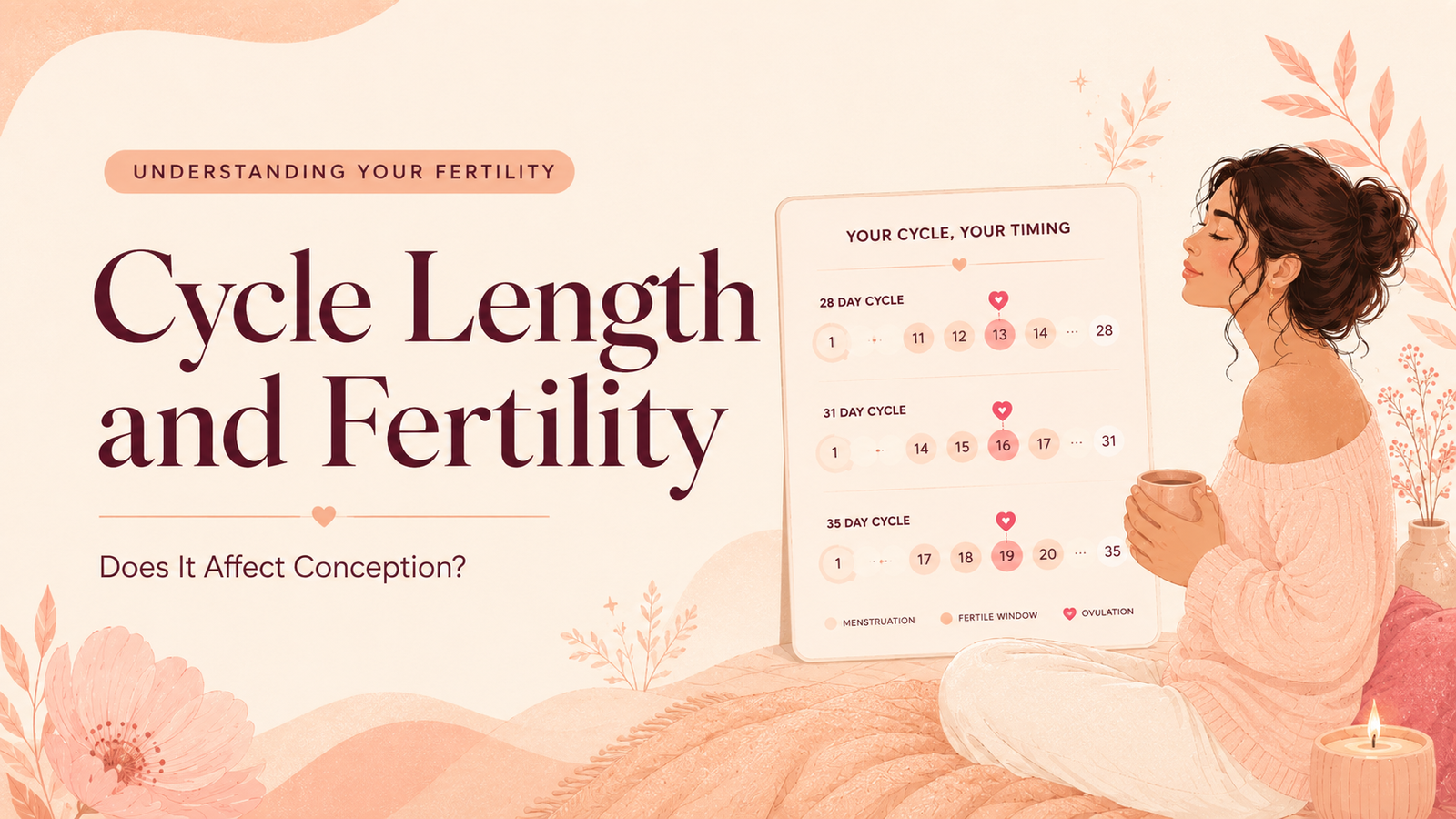
If you have ever searched your cycle length plus the word fertility, you have probably seen results that read like a diagnosis. A 24 day cycle gets framed as a warning sign. A 35 day cycle gets framed as a problem to fix. An irregular cycle gets framed as a closed door.
Cycle length is a clue, not a verdict
Here is the more honest version. Cycle length is one clue about how your body is ovulating, and it mostly matters because it changes the timing of your fertile days. Two people can have very different cycle lengths and very similar chances of conceiving in a given year. What actually drives conception odds month to month is whether you ovulate, whether sperm and egg can meet during the fertile window, and a long list of health factors that have nothing to do with the number on your calendar.
So the useful question is not whether your cycle length is good or bad. The useful question is what your cycle length tells you about when you ovulate, and how to plan around that. If you want to log your cycles privately and see your own patterns emerge over a few months, an app like Flow & Glow on the App Store can do the counting and pattern spotting for you, which makes everything in this article easier to apply.
Let's walk through how cycle length and ovulation timing connect, what short, long, and irregular cycles tend to mean in practice, and how to find your fertile window whatever your calendar looks like.
A quick anatomy of cycle length
A menstrual cycle runs from the first day of one period to the first day of the next. Clinical guidance generally treats anything from about 21 to 35 days as a typical range for adults, with plenty of healthy variation inside and even slightly outside that range. Very few people run a textbook 28 days every month.
The cycle has two halves divided by ovulation.
The follicular phase: where most variation lives
The follicular phase starts on day one of your period and ends at ovulation. This is the stretch where your body recruits and matures an egg. It is also the flexible half of the cycle. Stress, illness, travel, sleep disruption, weight changes, intense training, and ordinary hormonal noise can all stretch or shrink this phase, which is the main reason cycle length changes from month to month even in healthy bodies.
The luteal phase: the steadier half
After ovulation, the luteal phase runs until your next period starts. For most people it holds fairly steady at around 12 to 14 days, give or take a couple of days, and it does not stretch much no matter how long the overall cycle is.
This one fact unlocks the whole topic. Because the luteal phase is relatively fixed, almost all the variation in your cycle length happens before ovulation. So a longer cycle usually means ovulation happened later, and a shorter cycle usually means it happened earlier. Cycle length is essentially a readout of ovulation timing.
A rough way to estimate: subtract about 14 days from your usual cycle length to guess your ovulation day. A 24 day cycle suggests ovulation near day 10. A 35 day cycle suggests ovulation near day 21. These are estimates, not guarantees, but they are far better than assuming everyone ovulates on day 14.
Short cycles and conception
A short cycle, often defined as under 24 or 25 days, usually means your follicular phase is brief and you ovulate early, sometimes around day 8 to 10.
What this means for timing
The practical effect is that your fertile window opens earlier than most advice assumes. Because sperm can survive in fertile cervical mucus for up to about five days, your fertile days can begin while your period is ending or just after it stops. People with short cycles who wait until mid cycle to start trying often miss the window entirely, then wrongly conclude something is broken.
If your cycles run short, shift your timing earlier. Start paying attention to cervical mucus as soon as your period tapers, and treat the week after your period as potentially fertile rather than safe or neutral.
When a short cycle is worth a closer look
Most short cycles still include healthy ovulation. That said, a few patterns deserve a conversation with a clinician, especially if you are trying to conceive:
- Cycles consistently shorter than about 21 days
- A pattern suggesting a short luteal phase, such as spotting starting many days before your period or a positive ovulation test followed by a period fewer than 10 days later
- Cycles that have recently become much shorter than your normal, particularly alongside heavier or more painful periods
None of these prove a problem. They are simply patterns worth checking rather than worrying about alone.
Long cycles and conception
A long cycle, often defined as over 35 days, usually means a long follicular phase and later ovulation. With a 38 day cycle, ovulation may land around day 24, well past the point most generic advice stops counting.
What this means for timing
The biggest mistake people with long cycles make is anchoring everything to day 14. If you ovulate on day 24, intercourse clustered around day 12 to 16 lands more than a week before your egg is released, and even the hardiest sperm will not bridge that gap. The cycle then gets blamed when the timing was simply early.
If your cycles run long, stretch your expectations. Your fertile window may open in what feels like the middle or even late part of your cycle. Watching for fertile mucus and using ovulation tests starting well before your earliest expected ovulation, then continuing until you see a clear surge, works far better than calendar math.
When a long cycle is worth a closer look
Occasional long cycles are common and often trace back to stress, illness, or a cycle where ovulation happened late or not at all. Patterns worth raising with a clinician include:
- Cycles regularly longer than about 35 to 40 days
- Going more than 60 to 90 days without a period when you are not pregnant, breastfeeding, or on hormonal contraception
- Long cycles alongside symptoms like significant acne, excess facial or body hair growth, or marked weight changes
Consistently long or skipped cycles can sometimes signal that ovulation is infrequent, which makes conception slower simply because there are fewer chances per year. That is a timing and frequency issue clinicians can often address, not a closed door.
Irregular cycles and conception
Irregular cycles are usually defined as cycles that vary by more than about 7 to 9 days from month to month, for example 26 days one cycle and 38 the next. This is where search results get most discouraging and least accurate.
Here is the fair summary. Irregular cycles make conception planning harder because you cannot predict ovulation from the calendar. They do not mean you cannot conceive. Many people with variable cycles ovulate most months and conceive without intervention. The window just moves, so you have to find it in real time instead of predicting it in advance.
Finding the window when the calendar will not help
When cycle length jumps around, real time signs become your primary tools:
- Cervical mucus that turns clear, slippery, and stretchy signals that fertile days are underway right now, regardless of cycle day.
- LH test strips detect the hormone surge that precedes ovulation by roughly 24 to 36 hours. With irregular cycles you may need to test across a wider range of days, but a positive result is timing information the calendar could never give you.
- Logging both over several cycles often reveals that your irregular cycles still have a loose personal rhythm, such as ovulation usually landing somewhere between day 14 and day 22.
If your cycles vary a lot and you want to understand what the pattern itself might mean, our guide to irregular periods and PCOS walks through which patterns are worth tracking and bringing to an appointment.
When irregularity deserves evaluation
Bring very irregular cycles to a clinician if they are paired with other symptoms, if you regularly skip months entirely, or if you have been trying to conceive for a while. Common, treatable causes of irregular ovulation include polycystic ovary syndrome, thyroid conditions, and elevated prolactin. Identifying a cause is usually the fastest route to a plan.
When your cycle length recently changed
A cycle that has shifted from its usual pattern raises a different question than a cycle that has always run short or long. A single odd cycle after a stressful month, illness, travel, or a vaccination is rarely meaningful. Bodies flex.
A sustained change is more informative. Cycles that have become consistently shorter through your late 30s and 40s can reflect natural ovarian aging. Cycles that have become consistently longer or have started skipping can reflect changes in ovulation. Recently stopping hormonal contraception can also scramble cycle length for a few months while your own hormonal rhythm restarts, which is normal and usually settles.
The practical move in all of these cases is the same: log a few cycles, look at the trend rather than any single month, and bring a real record to a clinician if the new pattern persists for three or more cycles or comes with new symptoms.
How to find your fertile window at any cycle length
Whatever your cycle length, conception timing comes down to one job: getting sperm in place during the roughly six days ending on ovulation day. Here is a length-agnostic playbook.
Step 1: drop the day 14 assumption
Day 14 ovulation is an average drawn from 28 day cycles, and even within 28 day cycles it is unreliable. Research on real cycles shows ovulation day spreads across a wide range. If you want the full picture of why, read our deep dive on whether ovulation happens on day 14.
Step 2: estimate, then verify
Use your typical cycle length minus about 14 days as a starting estimate for ovulation day. Then verify with real time signs, because the estimate is only a place to begin watching, not a date to circle in ink.
Step 3: learn your body signs
Cervical mucus is the most underrated fertility sign there is. As ovulation approaches, mucus typically becomes clear, slippery, and stretchy, a bit like raw egg white. That change marks fertile days in real time. Pairing mucus observations with LH tests and body signs gives you both an early warning and a confirmation, which is especially valuable when your cycle length will not cooperate with predictions.
Step 4: cover the window generously
Because the fertile window includes about five days before ovulation plus ovulation day itself, you do not need to nail one perfect day. Clinical guidance on natural conception generally supports intercourse every one to two days across the fertile window. Starting when fertile mucus appears and continuing through a positive LH test covers the highest probability days without turning the month into a scheduling project.
Step 5: track across cycles, not within one
One cycle tells you almost nothing. Three to six logged cycles tell you your real range, your typical ovulation timing, and whether your luteal phase looks stable. That record is useful for you and genuinely useful to a clinician if you ever need one.
What the evidence actually says about cycle length and conception odds
Large studies tracking people trying to conceive have looked at whether cycle length predicts fecundability, which is the probability of conceiving in a given cycle. The broad findings are reassuring and nuanced at the same time.
Cycles in the typical range, roughly 25 to 35 days, show broadly similar conception rates. Very short cycles show somewhat lower per-cycle conception rates in some research, possibly reflecting earlier ovulation that couples miss or occasional luteal phase issues. Very long and highly irregular cycles are associated with slower time to conception on average, mostly because ovulation is less frequent or harder to time, not because conception is impossible.
Two takeaways matter here. First, these are population averages, and your individual cycle is not a statistic. Plenty of people at the edges of these ranges conceive quickly. Second, the mechanisms behind the averages are largely about ovulation frequency and timing, which are exactly the things tracking and, when needed, medical care can address.
When to talk to a clinician
Cycle length alone is rarely an emergency, but some situations deserve professional eyes rather than another month of guessing:
- You are under 35 and have been trying to conceive for 12 months, or 35 and older and have been trying for 6 months
- Your cycles are consistently shorter than 21 days or longer than 35 to 40 days
- You frequently skip periods or go months without one
- You have severe period pain, very heavy bleeding, bleeding between periods, or repeated bleeding after sex
- You have signs of infection, such as unusual discharge with fever or pelvic pain
- Your luteal phase appears consistently short across multiple tracked cycles
Bringing several months of logged cycle data to that appointment turns a vague concern into a concrete pattern, which usually means faster answers.
How tracking turns cycle length into a plan
Everything in this article gets easier with a record. Logging period start dates gives you your true cycle length range instead of a guess. Logging mucus changes and LH results shows you when your fertile window actually opens. Over a few months, the question shifts from does my cycle length hurt my fertility to here is when I ovulate and here is my plan.
Flow & Glow keeps all of that in one private place: cycle lengths, predictions that adapt to your actual data, space to log body signs and test results, and patterns you can show a clinician if you ever want backup. No tracker can promise conception, and no app replaces medical care. What tracking reliably does is replace day 14 folklore with your own evidence.
Your cycle length is information, not judgment. Learn what yours is telling you, time around it, and ask for help when the pattern says it is time. That is the whole game.
Article information
- Written by Emma Hart, MS in Science Writing
- Medically reviewed by Dr. Jennifer Martinez, MD, FACOG
- Last medically reviewed on May 19, 2026
- Published on May 19, 2026
- Updated on September 24, 2026
Key takeaways
- Cycle length shifts ovulation timing, which changes when your fertile window opens and closes.
- The second half of the cycle, the luteal phase, stays fairly stable for most people, so most length variation happens before ovulation.
- Short cycles often mean earlier ovulation, sometimes while a period is barely finished.
- Long cycles often mean later ovulation, so the fertile window can land weeks after day 14.
- Irregular cycles make calendar math unreliable, but many people with irregular cycles still ovulate and conceive.
- Body signs and LH tests can locate your fertile window when the calendar cannot.
- Very short, very long, or very erratic cycles are worth discussing with a clinician, especially when you are trying to conceive.
Frequently asked questions
Does cycle length affect my ability to get pregnant?
Mostly indirectly. Cycle length shifts when you ovulate, which changes when your fertile window falls. Typical-range cycles show broadly similar conception rates. Very long, very short, or highly irregular cycles can slow conception on average, usually because ovulation is less frequent or harder to time, and those are issues that tracking and medical care can often address.
Can I get pregnant with a short cycle?
Yes. Short cycles usually mean early ovulation, sometimes around day 8 to 10, so your fertile window can open right as your period ends. The most common issue is missed timing, not missing fertility. If your cycles run under about 21 days consistently or your luteal phase seems very short, mention it to a clinician.
Can I get pregnant with a long cycle?
Yes. Long cycles usually mean late ovulation, so your fertile days may land on day 20, 24, or later. Aiming at day 14 will miss that window entirely. Use mucus changes and LH tests to find your actual ovulation timing, and see a clinician if cycles regularly run past 35 to 40 days or you skip months.
How do I know when I ovulate if my cycles are irregular?
Rely on real time signs instead of the calendar. Clear, stretchy cervical mucus signals fertile days are underway, and LH test strips flag the surge that comes roughly a day before ovulation. Testing across a wider range of days and logging results over several cycles usually reveals your personal pattern even when cycle lengths vary.
What cycle length is considered normal?
Roughly 21 to 35 days is the typical adult range, and variation of a few days between cycles is normal. Cycles consistently outside that range, or varying by more than about 7 to 9 days month to month, are worth tracking closely and discussing with a clinician, especially when you are trying to conceive.
Does an irregular cycle mean I am not ovulating?
Not necessarily. Many people with irregular cycles ovulate most months, just on a moving schedule. Some irregular patterns do involve infrequent ovulation, which is why pairing your cycle log with ovulation signs or tests is useful. If tests rarely show a surge or you often skip periods, that is a clear thing to bring to a clinician.
When should I see a doctor about my cycle length and fertility?
See a clinician if you have been trying to conceive for 12 months under age 35 or 6 months at 35 and older, if cycles are consistently shorter than 21 days or longer than 35 to 40 days, if you skip months, or if you have severe pain, very heavy bleeding, bleeding after sex, or signs of infection. Bring your cycle log; it speeds everything up.
References
- American College of Obstetricians and Gynecologists. (2023). The menstrual cycle Source
- American Society for Reproductive Medicine. (2022). Optimizing natural fertility: A committee opinion Source
- National Health Service. (2023). Irregular periods Source
- National Institutes of Health, MedlinePlus. (2024). Infertility Source
- Office on Women's Health. (2024). Menstrual cycle Source
- NPJ Digital Medicine. (2019). Real-world menstrual cycle characteristics and cycle length variation Source
- Human Reproduction. (2021). Menstrual cycle characteristics and fecundability in a North American preconception cohort Source
Editorial and medical disclaimer
Flow & Glow health content is educational and is not a substitute for diagnosis, treatment, or personal medical advice from a qualified clinician.
Our editorial standards, reviewer process, sourcing approach, and correction process are explained in the Editorial Policy. You can also review our authors and medical reviewers, healthcare professional information, contact page, and privacy policy.