Is Period Blood Actually Blood? What Color and Texture Mean
Yes, period fluid contains blood, plus uterine tissue and other fluids. Learn why color and texture change, what matters more, and when to seek care.
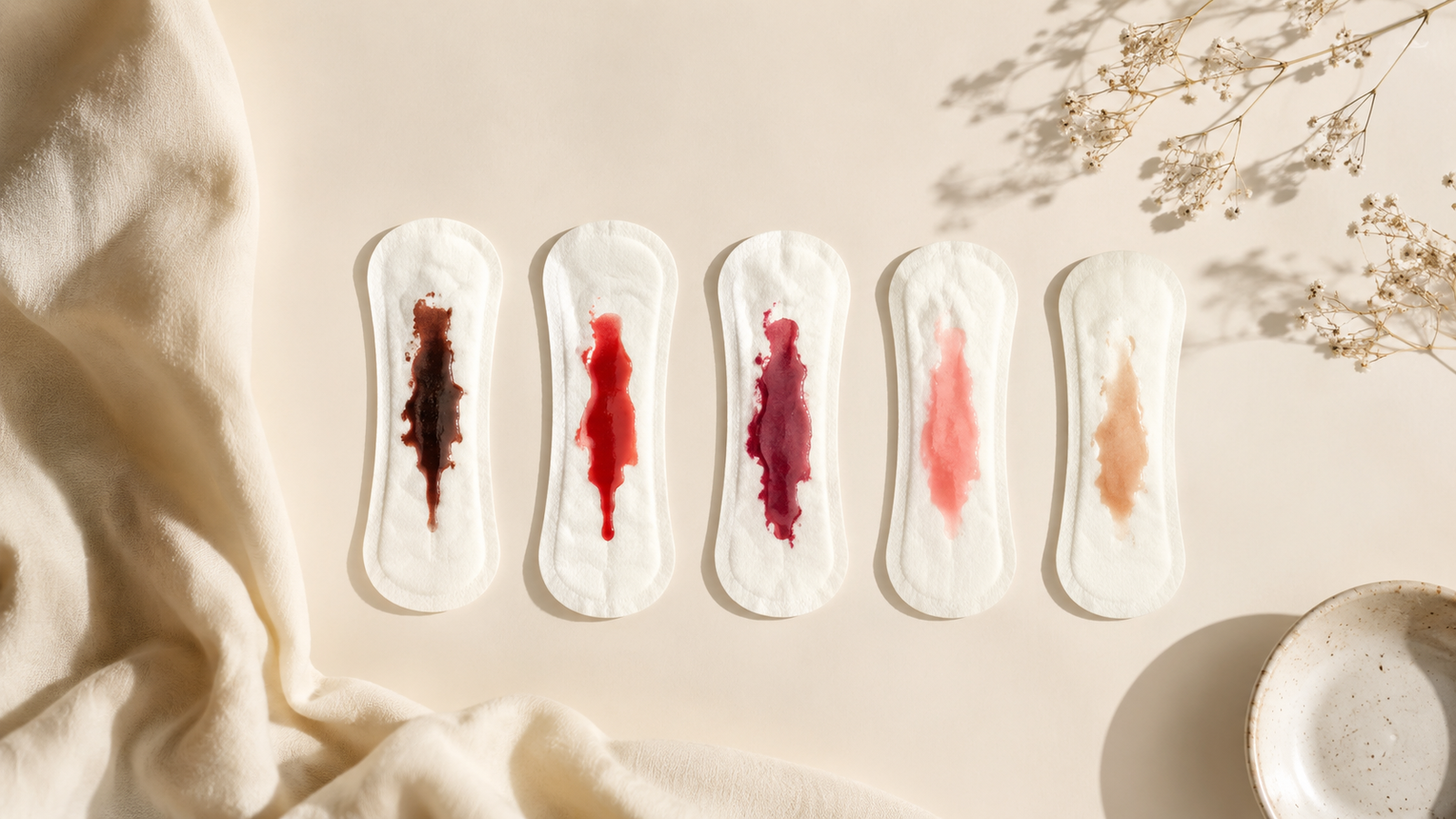
Yes, period blood is real blood, but it is not only blood. The fluid that leaves your body during a period is a mixture: blood from small vessels in the uterus, fragments of the uterine lining that built up during your cycle, and fluid from the cervix and vagina that everything passes through on the way out. That mixture is why menstrual fluid looks, moves, smells, and clots differently than the blood you would see from a cut finger.
Because the mixture shifts from the first day of your period to the last, its color and texture shift too. Bright red one day, deep brownish red the next, thin and watery in the morning, thicker with a small clot by evening. None of that variety is automatically a problem, and none of it works as a home diagnostic test. If you log your cycle with Flow & Glow, you have probably noticed this variety yourself, and you have probably also seen color charts online that promise each shade reveals something about your hormones or your health. Most of those charts overpromise.
This guide answers the composition question first, because it explains everything else: what menstrual fluid actually contains, how it differs from regular blood, why appearance changes, what a shade genuinely cannot tell you, and which parts of your period deserve real attention. By the end you will have a simple log, a calm care ladder, and a way to describe your whole pattern to a clinician instead of a single color.
What Menstrual Fluid Contains
A period is the shedding of the endometrium, the lining that thickens inside the uterus each cycle in case a pregnancy begins. When no pregnancy starts, hormone levels fall, the lining breaks down, and the uterus releases it over several days. What arrives on your pad, tampon, or cup is everything involved in that process, not blood alone.
Three ingredients make up the bulk of it.
Blood From Uterine Vessels
As the lining separates, the small blood vessels that fed it open and bleed. This is genuine blood, with red blood cells, white blood cells, plasma, and the other components you would expect. It is the ingredient that gives menstrual fluid its red color family, and the amount of it varies day to day, which is one reason flow feels heavier at some points than others. For most people the total blood loss across a whole period is far smaller than it looks, because the visible volume includes everything else in the mixture, not just blood.
Endometrial Tissue and Cells
The lining itself leaves too. Endometrial tissue arrives as soft fragments, sometimes too small to notice and sometimes visible as darker specks, strings, or small pieces in the flow. This tissue is expected. It is the entire point of a period. Fragments of lining are also part of why menstrual fluid can look uneven or textured in a way that blood from a cut never does. Seeing tissue in period fluid is not, by itself, a sign that something has gone wrong, and it is not something you can identify or diagnose by eye.
Cervical and Vaginal Fluid
On its way out, everything passes through the cervix and vagina, both of which produce their own fluid throughout the cycle. That fluid mixes in and dilutes the blood, especially at the very start and very end of a period when bleeding is light. This is the main reason spotting often looks pink or brown rather than red: a small amount of blood is being carried in a larger amount of other fluid. Cervical and vaginal fluid also affect texture, making some days of flow feel thinner, slipperier, or more mucus-like.
Put together, these three ingredients explain nearly every appearance question people search for. More blood moving quickly looks bright and liquid. Older blood that sat in the uterus or vagina looks darker. More secretions make things lighter and thinner. More tissue makes things textured. The proportions change across a single period and differ between people, and there is no fixed percentage recipe that applies to everyone, so be skeptical of any page that quotes one.
Period Blood vs Regular Blood
People often ask whether period blood is the same as the blood in their veins, and the honest answer is that the blood component is the same substance, but the fluid as a whole is meaningfully different. A sample drawn from your arm is blood and nothing else. Menstrual fluid is blood plus tissue plus secretions, collected over hours rather than seconds, exposed to air and to the environment of the vagina before you ever see it.
Why It Behaves Differently
Menstrual fluid usually flows rather than clotting solid, even though blood from a cut clots quickly. The body releases natural anticoagulant activity as the lining sheds, which keeps the flow moving so it can leave the uterus. When flow is heavy or fast, that system can be outpaced, and some blood clots before it exits, which is why clots tend to show up on heavier days. This is also why menstrual fluid can look glossier, stringier, or more variable than the uniform red of fresh venous blood: it is a mixture with moving proportions, not a single substance.
Researchers have studied menstrual fluid in detail and found that it carries proteins, cells, and other components that a standard blood sample does not, precisely because it includes endometrial tissue and secretions. There is genuine scientific interest in whether menstrual fluid could one day be used as a convenient testing sample. That work is promising, and it is also the clearest evidence against home color-reading: even in a laboratory, information comes from analyzing the fluid, not from looking at its shade. Your bathroom lighting cannot do what an assay does.
Why It Is Not Dirty Blood
A persistent myth says period blood is dirty blood, waste blood, or blood the body is rejecting because something is wrong with it. It is none of those things. It is ordinary blood mixed with the ordinary tissue of a healthy process. The uterus is not filtering out bad blood, and a period is not a detox. This myth matters because it makes people feel shame about a routine bodily function and, worse, tempts them to douche or otherwise try to clean or alter the flow. There is no health reason to do that, and attempts to wash out the vagina can disturb its natural balance. Menstrual fluid needs no correction, only ordinary hygiene.
Why Appearance Changes
Almost every color and texture variation traces back to a handful of mechanisms. Rather than memorizing a rainbow chart, it is more useful to understand the five processes below, because they explain what you see without pretending to diagnose anything.
| What is happening | What you tend to see | Typical context |
|---|---|---|
| Fresh, faster flow | Bright to medium red, fluid and liquid | Heavier days, often early or mid period |
| Slower exit and oxidation | Dark red, brown, or near black | Start or end of a period, lighter days, first flow after waking |
| Dilution by secretions | Pink or light, thin, sometimes watery | Very light flow, spotting, tapering days |
| Tissue fragments in the flow | Specks, strings, or uneven texture | Any day, often with moderate or heavy flow |
| Clotting during heavy flow | Jelly-like clumps, usually darker | Heaviest hours of the heaviest days |
How to Read the Table
Read it as physics and chemistry, not as a diagnosis. Blood that leaves quickly has little time to change, so it keeps its bright color. Blood that leaves slowly is exposed to oxygen longer, and oxidized blood darkens, the same way a cut apple browns. Blood mixed with a lot of cervical or vaginal fluid is carried in a paler, thinner medium. Tissue makes texture. Fast loss makes clots. That is the entire mechanical story behind most of the types of menstrual blood people try to decode.
Notice what the table does not say. It does not connect any shade to hormone levels, iron status, fertility, infection, or pregnancy outcome, because appearance cannot carry that information reliably. Two people with identical health can see different colors on the same cycle day, and one person can see several colors in a single day. The mechanisms are common to everyone; the mixture is personal.
A single shade is a snapshot. Your pattern across the whole period is the story.
Color Families at a Glance
With the mechanisms in mind, here is the honest version of the color overview, kept deliberately brief because shade is the least informative part of your period.
Bright Red and Deep Red
Bright red generally means fresh blood moving at a steady pace, and it is common on the fuller-flow days. Deep or dark red usually means the blood spent a little longer on the way out. Both sit comfortably inside the range of healthy menstrual blood for most people. Neither shade certifies that everything is fine, and neither warns that something is wrong. If the amount, duration, and symptoms around a red flow match your usual pattern, the exact depth of red is rarely worth a second thought.
Brown and Near Black
Brown flow is typically older blood that oxidized before leaving, which is why it so often appears at the very beginning or very end of a period, and in the first flow after a night of lying down. Very dark, near-black flow is usually the same process taken further. Dark shades look alarming and are usually the least alarming thing on this page. If very dark flow is frequent for you, arrives with other changes, or you simply want the full picture, the deep dive on black period blood walks through the common mechanisms and the situations that deserve a closer look.
Pink and Light Flow
Pink usually means a small amount of blood diluted by cervical or vaginal fluid, which is why spotting and the lightest days often look pink. Light, thin flow at the edges of a period is common. Pink flow does not measure your hormone levels, and a light period does not by itself confirm or rule out anything about your health or fertility. What matters is whether light flow is your usual pattern or a new departure from it, and whether pregnancy is possible, because new spotting when pregnancy is possible always deserves a test rather than a guess.
Orange, Gray, and Odor
Orange-tinted fluid is often just blood mixed with secretions, but a shift in color that arrives together with a strong or foul odor, unusual discharge, itching, burning, pain, or fever is a different situation from an ordinary color change. Gray material in particular is not simply another period color, and it is not something to self-diagnose in either direction. If you see gray discharge, or any color paired with the symptoms above, book a clinical assessment. That is not an emergency instruction; it is a this-deserves-a-professional instruction. And if you are pregnant or could be, tissue or unusual material in bleeding is a reason for prompt clinical evaluation and appropriate testing, not for conclusions drawn at home.
Texture, Strings, and Clots
Texture questions deserve the same mechanism-first treatment as color. Menstrual fluid can be thin, thick, slippery, stringy, or clumpy at different points in the same period, because the ratio of blood, tissue, and secretions keeps changing. Stringy moments usually reflect mucus mixing with blood or small strands of tissue. Watery moments usually reflect dilution. Thicker, jelly-like moments usually reflect clotting during heavier flow.
Clots deserve one clear paragraph of their own. Small, occasional clots on the heaviest day or two are common, because fast flow can outpace the natural anticoagulant activity that normally keeps menstrual fluid liquid. Clots become more meaningful as they become larger, more frequent, or a new feature of your periods, especially alongside flow heavy enough to soak through protection quickly. The full breakdown of when period clots are normal versus concerning covers sizes, frequency, and the questions a clinician will actually ask. The short version: judge clots by size, frequency, and change from your baseline, together with how heavy the flow around them is, never by their color.
What Color Cannot Diagnose
This section exists because the internet keeps implying otherwise. Here is what a shade of period blood cannot do:
- It cannot measure your hormone levels. No color, including pink or orange, confirms low or high estrogen, progesterone, or anything else.
- It cannot diagnose or rule out anemia. Iron status comes from a blood test, not from how red your flow looks.
- It cannot confirm an infection. Infections are assessed by symptoms, examination, and testing, not by tint.
- It cannot tell you whether you are pregnant, whether a pregnancy is healthy, or whether a pregnancy has ended. Those questions require a pregnancy test and clinical evaluation, full stop.
- It cannot assess your fertility. Fertility involves far more than the appearance of menstrual flow.
- It cannot substitute for the pattern. A perfect-looking red period that suddenly lasts twice as long as usual matters more than an odd-looking brown day inside a completely typical cycle.
None of this means appearance is worthless. Color and texture are honest clues about flow speed, oxidation, and mixing, and a genuinely new appearance can be a nudge to pay attention. The problem is treating clues as verdicts. A color chart that assigns a diagnosis to each shade is astrology wearing a lab coat.
Pattern Before Palette
If shade is the least useful signal, what should you actually watch? Rank these seven things above color, in roughly this order:
- Amount. How heavy the flow is and whether you are soaking through protection unusually fast. Very heavy loss is the single most consequential feature of a period, both for daily life and for health, because sustained heavy bleeding can wear down iron stores over time. If your periods regularly involve overwhelming, gushing-level loss, the guide to flooding during your period covers what counts as flooding and what to do about it.
- Timing. Whether bleeding arrives roughly when expected, or between periods, after sex, or after menopause. Bleeding outside your expected window is worth more attention than any shade within it, and any bleeding after menopause deserves a clinical review.
- Duration. Whether the period lasts about as long as yours usually do. A cycle that stretches well beyond your usual length, or bleeding that barely stops, matters regardless of color.
- Pain. Whether cramping is in your usual range or newly severe, one-sided, or disruptive enough to shut down your day.
- Odor and discharge. Whether there is a foul smell, unusual discharge, itching, burning, or fever alongside the bleeding.
- Pregnancy possibility. Whether you could be pregnant. Bleeding plus possible pregnancy changes the priority of everything above and calls for a test and clinical input rather than watchful waiting.
- Change from baseline. Whether any of this is new for you. Your own history is the reference range that matters most; a pattern that would be ordinary for one person can be a significant change for another.
Only after those seven does shade earn a place in your notes, and even then mostly as supporting detail. This ranking is the single most useful habit to take from this page: pattern before palette, always.
The 30-Second Log
You do not need to journal at length to capture your pattern. Once a day during your period, record six quick fields:
- Day: which day of the period it is, counting from the first day of real flow.
- Flow: light, medium, heavy, or flooding, judged by how often you change protection.
- Color family: red, dark, brown, or pink is plenty. No need for paint-swatch precision.
- Texture or clots: thin, thick, stringy, or clots, with a rough clot size if present.
- Symptoms: cramps, fatigue, headache, fever, unusual odor or discharge, or nothing.
- New or usual: one word on whether today matches your normal pattern.
That is the whole log, and it genuinely takes about half a minute. Kept across one full cycle, it turns vague impressions into a record you can compare month to month, and it is exactly the kind of information that makes a medical appointment productive. Keeping it inside your cycle tracker beats scattered paper notes, and the guide to period tracker notes shows how to structure entries so trends stand out at a glance. Two or three cycles of this log will teach you your own baseline better than any generic chart, and your baseline is the standard everything else gets measured against.
Track the period you actually have, not the period a color chart says you should have.
A Calm Care Ladder
Most period questions do not need a clinic, some need a routine appointment, a few need prompt advice, and a small number need urgent care. Here is the ladder, from bottom to top.
Watch and Record
For appearance changes inside an otherwise typical period, the right response is usually observation, not action. An unfamiliar shade, a stringy day, a small clot on your heaviest day: log it, note whether it repeats, and carry on. Most one-off oddities never come back, and a log entry costs you thirty seconds. If something recurs across two or three cycles, you now have a record instead of a worry, and you can move up the ladder with evidence in hand.
Book a Routine Review
Arrange an ordinary, non-urgent appointment when a pattern changes and stays changed: periods that have become consistently heavier or longer than your baseline, clots that are newly large or frequent, bleeding between periods more than once, periods that have become significantly more painful, or a persistent odor or discharge change without fever. None of these mean something is seriously wrong. They mean the pattern has shifted enough that a professional should look, ask questions, and possibly run simple tests. Bring your log.
Seek Prompt Advice
Get advice within a day or two, rather than waiting for a routine slot, when bleeding is unusually heavy and not settling, when you have bleeding with fever or feel unwell in yourself, when pain is escalating beyond anything usual for you, or when you have a positive pregnancy test or a real possibility of pregnancy alongside bleeding. Prompt does not mean panic. It means this combination deserves a professional opinion soon, by phone or appointment, so that nothing important waits.
Get Urgent Care
Seek urgent care now if you are soaking through pads or tampons hour after hour without letup, if you feel faint, dizzy, or confused, if you have shortness of breath or chest symptoms, if you have severe or one-sided abdominal pain, if you have heavy bleeding with a known or possible pregnancy, or if you feel acutely unwell in a way that frightens you. These situations are uncommon, and naming them is not meant to alarm you. It is meant to remove hesitation on the rare day hesitation would cost you something.
A Clinician-Ready Summary
When you do book an appointment, the most useful thing you can bring is a description of the whole pattern. Clinicians can do very little with a color observation on its own, and a great deal with a summary like this:
My periods usually run five days, medium flow, with mild day-one cramps. For the last three cycles they have run eight or nine days, I am changing protection every two hours on days two and three, and I passed clots bigger than usual several times. Nothing has changed in my medications. My last period ended ten days ago and I have had spotting twice since. I am not currently able to rule out pregnancy.
Notice what that paragraph does. It states your baseline, describes the change, quantifies flow in practical terms, mentions clots by size and frequency rather than by color, covers timing and spotting, and flags pregnancy possibility. It does not attempt a diagnosis, and it does not lean on shade at all. A summary in this shape, backed by your 30-second log, lets an appointment start at the real question instead of spending its first half reconstructing history. If you take one structural habit from this page, make it this: your job is to describe the pattern accurately; the diagnosing is theirs.
Article information
- Written by Jessica Morrison, MS in Health Communication, CHES
- Medically reviewed by Dr. Sofia Reyes, MD, FACOG
- Last medically reviewed on August 7, 2026
- Published on May 15, 2026
- Updated on August 13, 2026
Key takeaways
- Menstrual fluid is blood plus endometrial tissue, cells, and cervical and vaginal fluid, which is why it behaves differently than blood from a vein.
- Bright red usually reflects fresher, faster flow, while brown or near-black shades usually reflect slower exit and oxidation.
- Color alone cannot confirm or rule out hormone problems, anemia, infection, pregnancy, or any other condition.
- Amount, duration, timing, pain, odor or unusual discharge, pregnancy possibility, and change from your own baseline all matter more than shade.
- A 30-second daily log across one full cycle gives you and your clinician far more useful information than any color chart.
- Rapid soaking, faintness, chest symptoms, severe or one-sided pain, or possible pregnancy with bleeding deserve prompt or urgent care regardless of color.
Frequently asked questions
Is period blood actually blood?
Yes. Menstrual fluid contains real blood from vessels in the uterine lining, and that blood is the same substance found elsewhere in your body. But the fluid as a whole is a mixture: blood, endometrial tissue and cells, and cervical and vaginal fluid. The proportions shift across your period and differ between people, which is why menstrual fluid looks and behaves differently than blood from a cut and why no fixed percentage breakdown applies to everyone.
Is period blood dirty or waste blood?
No. This is a myth. Period blood is ordinary blood mixed with the tissue of a healthy monthly process. The uterus is not expelling bad or rejected blood, and a period is not a cleanse or detox. There is no reason to douche or try to clean the flow, and doing so can disturb the vagina's natural balance. Regular hygiene is all a period requires.
Why is my period blood dark or brown?
Dark red, brown, or near-black flow usually reflects blood that left the uterus slowly and oxidized along the way, which darkens it the same way air browns a cut apple. That is why dark shades cluster at the start and end of periods and in the first flow after waking. Slow, oxidized flow is common. If dark flow arrives with a big change in amount, duration, pain, or odor, judge it by those features, not the shade.
Does bright red blood mean my period is healthy?
Bright red usually means fresh blood moving at a steady pace, which is common on fuller-flow days, but no color certifies health. A healthy period is defined by the whole pattern: an amount, duration, timing, and symptom level that fit your own baseline. A bright red period that suddenly doubles in length still deserves attention, and a brown-tinged period inside a completely typical cycle usually does not.
Are clots in period blood normal?
Small, occasional clots on your heaviest day or two are common, because fast flow can outpace the natural anticoagulant activity that keeps menstrual fluid liquid. Clots earn more attention as they become larger, more frequent, or new for you, especially alongside flow heavy enough to soak protection quickly. Judge clots by size, frequency, and change from your baseline together with flow, and raise persistent changes at a routine appointment.
Can period blood color show pregnancy or miscarriage?
No. No shade of menstrual or vaginal bleeding can confirm a pregnancy, rule one out, or tell you whether a pregnancy is continuing. Those questions require a pregnancy test and clinical evaluation. If you are bleeding and pregnancy is possible, take a test and seek clinical input promptly rather than interpreting color or tissue at home; heavy bleeding with a known or possible pregnancy is a reason for urgent care.
When should I see a doctor about period blood?
Book a routine review for sustained changes: consistently heavier or longer periods, newly large or frequent clots, repeated bleeding between periods, significantly worse pain, or persistent odor or discharge changes. Seek prompt advice for heavy bleeding that is not settling, bleeding with fever, or possible pregnancy with bleeding. Seek urgent care for soaking through protection hour after hour, faintness or confusion, shortness of breath or chest symptoms, or severe one-sided pain. Any bleeding after menopause deserves a clinical review.
References
- Centers for Disease Control and Prevention. (n.d.). About heavy menstrual bleeding Source
- Cleveland Clinic. (n.d.). Period blood comes in different colors: Here's what they mean Source
- Critchley, H. O. D., et al. (2024). Potential for and challenges of menstrual blood as a non-invasive diagnostic specimen Source
- MedlinePlus. (n.d.). Menstruation Source
- MedlinePlus Medical Encyclopedia. (n.d.). Abnormal uterine bleeding Source
- National Health Service. (n.d.). Periods Source
- Office on Women's Health. (n.d.). Your menstrual cycle Source
- Yang, H., et al. (2012). Proteomic analysis of menstrual blood Source
Editorial and medical disclaimer
Flow & Glow health content is educational and is not a substitute for diagnosis, treatment, or personal medical advice from a qualified clinician.
Our editorial standards, reviewer process, sourcing approach, and correction process are explained in the Editorial Policy. You can also review our authors and medical reviewers, healthcare professional information, contact page, and privacy policy.